
 Balinder Walia
The AI infrastructure landscape is evolving rapidly. Teams building RAG pipelines, semantic search, and intelligent applications face a fundamental choice: do you adopt a general-purpose AI-native database you control, or do you pay for a agent memory platform that handles infrastructure for you?
This post compares NebulaDB — our open-source, Rust-powered AI-native hybrid database — against the emerging category of agent memory platforms (SaaS services that provide persistent memory, context retrieval, and temporal state for AI agents). The full deep-dive is available as a comprehensive article; here we cover the highlights.
What is NebulaDB?
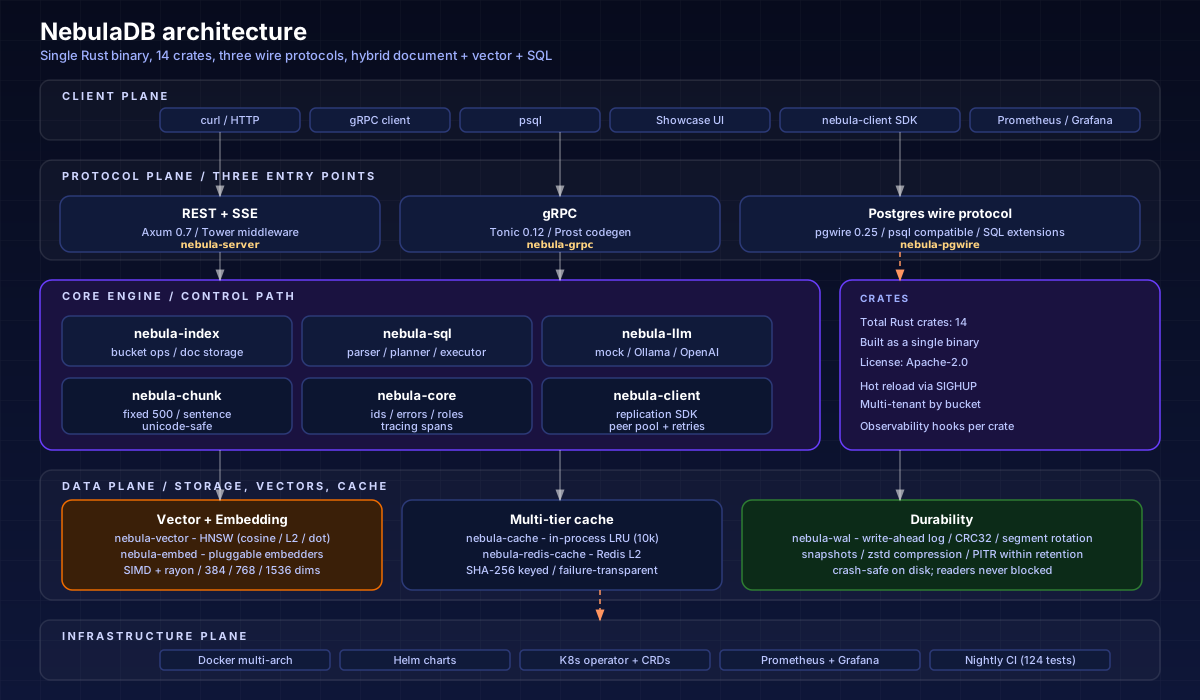
NebulaDB is an AI-native hybrid database that combines document storage, vector search (HNSW), SQL querying with AI extensions, and streaming RAG — all in a single Rust binary. Licensed under Apache-2.0, it ships as a self-hosted solution with Docker, Helm charts, and a full Kubernetes Operator.
Key capabilities at a glance
- Three protocols from one binary: REST+SSE (Axum), gRPC (Tonic), Postgres wire protocol
- HNSW vector index: Cosine, L2, and dot-product distances with SIMD optimization
- SQL with AI extensions:
semantic_match()andvector_distance()as first-class SQL functions, plus GROUP BY, JOIN, and aggregates - Streaming RAG: Server-Sent Events with context chunks before answer tokens — real-time generation
- Complete pipeline: Ingest → Chunk → Embed → Index → Search → Generate in one system
- Multi-tier caching: In-process LRU (10,000 entries) + optional Redis with failure-transparent fallback
- WAL durability: CRC32-checked write-ahead log with snapshot recovery and zstd compression
- Kubernetes-native: CRDs for NebulaCluster, NebulaBucket, and NebulaRebalance via a dedicated operator
- Production-ready: 124 tests, nightly CI, multi-arch Docker images, Prometheus + Grafana observability
What are Agent Memory Platforms?
Agent memory platforms are a newer category of proprietary SaaS services designed to provide persistent memory and context infrastructure for AI agents. They typically offer temporal knowledge graphs, immutable state ledgers, and shared context layers for multi-agent systems. Access is usually via REST APIs and language SDKs, with pricing starting at $249/month and scaling to $5,000+ for enterprise tiers.
The Comparison: Why NebulaDB Wins
Here is how NebulaDB stacks up against agent memory platforms across the dimensions that matter most:
| Dimension | NebulaDB | Managed Platforms |
|---|---|---|
| License | Apache-2.0 (free) | Proprietary ($249-$5k+/mo) |
| Written In | Rust (open-source) | Unknown (closed-source) |
| Query Interfaces | REST, gRPC, Postgres, SQL | REST API, SDKs |
| Vector Index | HNSW (SIMD-optimized) | Proprietary |
| LLM Integration | Built-in streaming RAG | Context retrieval only |
| Observability | Prometheus + Grafana | Not documented |
| Deployment | Docker, Helm, K8s Operator | SaaS or enterprise self-host |
Decision Framework
Choose NebulaDB if you:
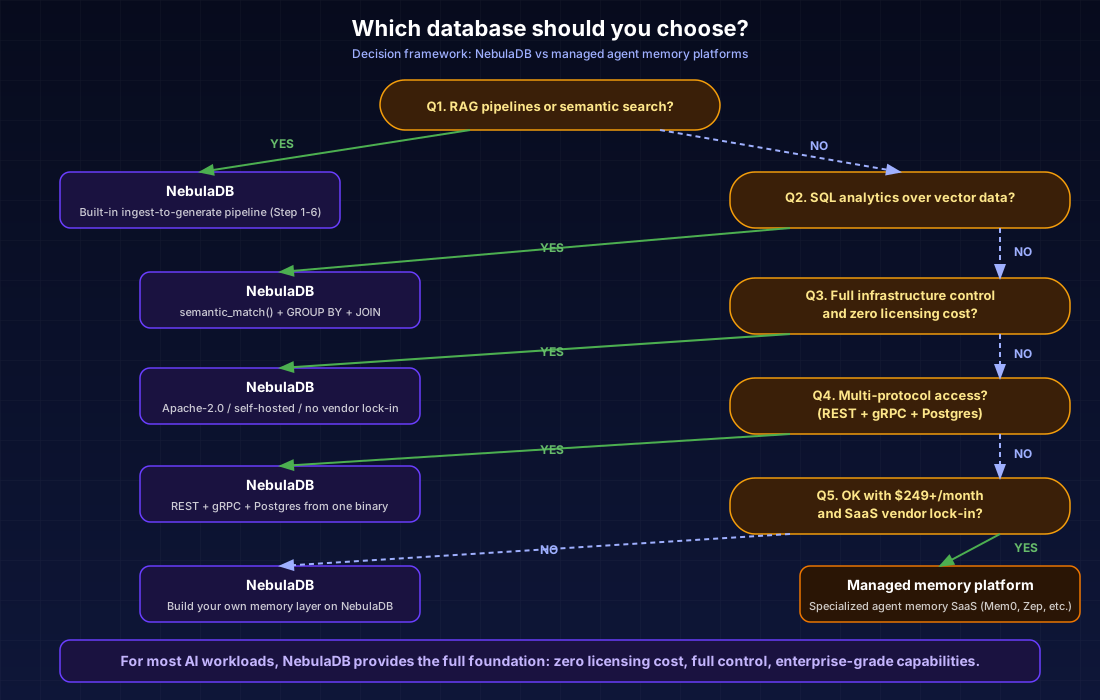
- Want full control over your infrastructure with no vendor lock-in
- Are building RAG pipelines with streaming LLM responses
- Need multi-protocol access (REST + gRPC + Postgres from one binary)
- Want SQL analytics over your vector corpus (GROUP BY, JOIN with semantic filters)
- Care about cost — NebulaDB is free and open-source
- Need production-grade observability (Prometheus, Grafana, tracing)
- Want a complete pipeline: ingest → chunk → embed → index → search → generate
Managed platforms may fit if you:
- Are building stateful AI agents that need persistent cross-session memory
- Need temporal reasoning ("what did the user prefer last month vs now?")
- Have multi-agent systems requiring shared context layers
- Prefer zero ops burden and are willing to pay $249+/month
Conclusion
For most AI workloads — RAG pipelines, semantic search, document retrieval, SQL analytics over embeddings — NebulaDB delivers enterprise-grade capabilities at zero cost with full infrastructure control. Its Rust foundation ensures performance and safety, while the three-protocol architecture (REST, gRPC, Postgres wire) means your existing tools and workflows integrate seamlessly.
Agent memory platforms serve a narrower niche: teams building stateful conversational agents who need temporal reasoning and are willing to accept vendor lock-in and recurring costs. Even for those use cases, NebulaDB's WAL-based event replay and extensible architecture offer a viable self-hosted alternative.
Read the full comprehensive comparison article for architecture deep-dives, API examples, and detailed analysis across 15+ dimensions.