
Claude Fable 5: The Complete Guide to Anthropic's Mythos-Class Model
What Fable 5 is, how the community reacted, the best YouTube deep-dives, when to use it vs Opus or Sonnet, and practical token-saving tactics
 Balinder WaliaJuly 7, 20266 min read
Anthropic's Claude Fable 5 is the first generally available Mythos-class model — built for long-horizon agentic work, not quick chat. This post covers what changed, how people are reacting, which YouTube deep-dives are worth your time, and how to use Fable 5 without burning through your token budget. For the full playbook, read the long article.
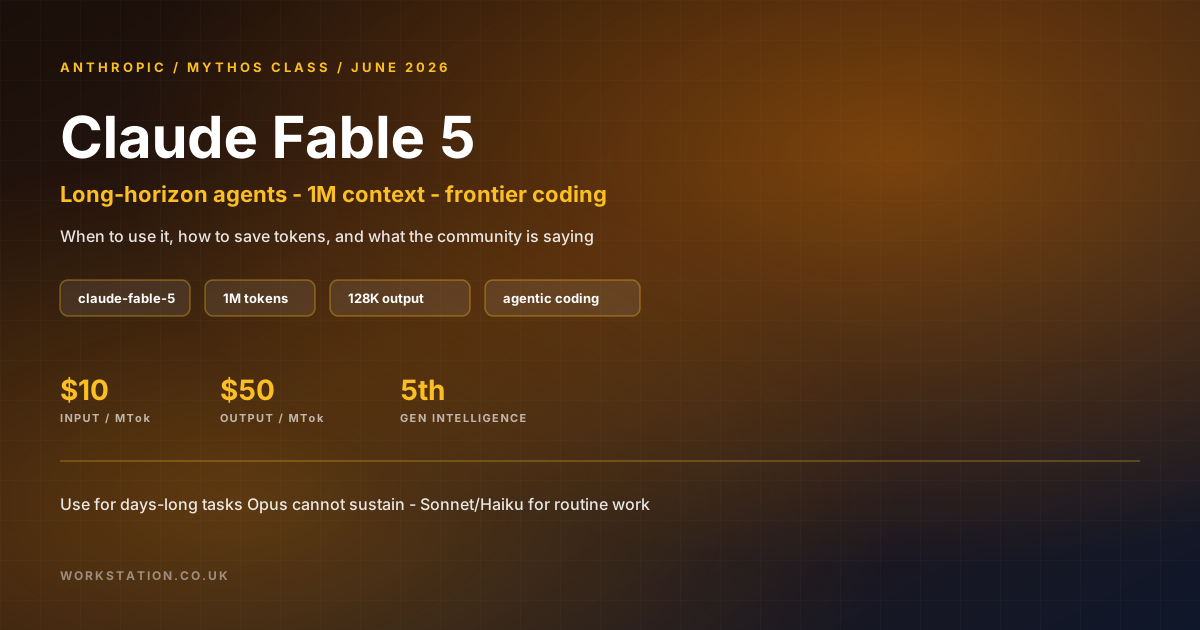
claude-fable-5) is Anthropic's most capable widely released model — a Mythos-class tier above Opus 4.8, with a 1M-token context window and up to 128K output tokens per request. It is designed for work that takes a person hours, days, or weeks: large codebase refactors, autonomous coding agents, multi-document analysis, and long-running workflows. It costs $10 per million input tokens and $50 per million output tokens — roughly double Opus — so the winning strategy is to reserve it for hard problems and route everything else to Sonnet or Haiku.
What is Claude Fable 5?
On 9 June 2026, Anthropic launched Claude Fable 5 — the public-facing version of capabilities first previewed as Claude Mythos Preview under Project Glasswing. Fable 5 shares the same underlying weights as the invitation-only Claude Mythos 5, but adds safety classifiers that route sensitive cybersecurity and biology queries to Claude Opus 4.8. Anthropic reports these fallbacks fire in fewer than 5% of sessions, meaning most of the time you are running on full Mythos-class intelligence.
Where Opus 4.8 is Anthropic's workhorse for complex agentic coding, Fable 5 is the model you reach for when the task is too long, too ambiguous, or too multi-step for anything else. Anthropic's own framing: the longer and more complex the task, the larger Fable's lead over prior models.
Five takeaways from launch week
- Benchmarks jumped, especially on agentic coding. Community testers and Anthropic's own numbers show large gains on SWE-bench Pro, OSWorld, and long-horizon coding tasks — often 15–20% ahead of GPT-5.5 and prior Claude models on software engineering workloads.
- It is a different kind of model, not a faster Opus. Fable 5 runs longer per turn, dispatches parallel subagents more readily, and benefits from leaner prompts than the prescriptive skills many teams built for Opus. Drop-in replacement without prompt changes often disappoints.
- Effort level is your cost dial. API users can set effort to low, medium, high, or extra-high. Medium Fable 5 frequently matches or beats Opus at extra-high — at a fraction of the cost. Defaulting everything to maximum is the most common budget mistake.
- Guardrails became a community flashpoint. Early invisible fallbacks to Opus 4.8 frustrated researchers who did not know which model they were talking to. Anthropic walked back parts of the approach after backlash from Wired, The Verge, and Hacker News — transparency matters when you are paying frontier prices.
- Think in loops, not prompts. The builders getting the most from Fable 5 treat it as an autonomous worker: goal statements, hourly check-in loops, integration with project tools like Linear, and async harnesses that do not block on each subagent.
How the community is reacting
Reactions split along predictable lines — capability versus cost versus control.
- Builders are impressed on hard tasks. Simon Willison called Fable 5 slow and expensive but noted it keeps working through difficult problems that stall other models. Hacker News launch threads focused on autonomous coding and whether this is the inflection point for "agent that actually finishes."
- Skeptics question daily-driver value. Several independent testers (including $200+ API spend comparisons) found Fable 5 is often the best model but not always the best value — especially at medium effort on routine coding, where Opus 4.8 at high effort is close enough and cheaper.
- YouTube hype is loud; task traces are signal. Titles like "Greatest AI Model Ever" are marketing. What matters is whether a reviewer shows multi-hour agent runs, failure modes, side-by-side UI rebuilds, and honest cost accounting — not thumbnail superlatives.
- Subscription access shifted. Fable 5 rolled out to Pro, Max, Team, and Enterprise plans with usage credits. Anthropic signalled API-first pricing for sustained frontier access — a hint that heavily subsidised flat-rate subscriptions may not carry Mythos-class models indefinitely.
YouTube videos worth watching
These are among the most-viewed and most substantive Fable 5 videos as of July 2026. Watch for the actual tests, not the titles.
| Video | Why watch it |
|---|---|
| Claude Fable 5 in 7 Minutes | Fast launch overview: benchmarks, pricing, positioning vs Mythos preview. |
| Claude Fable 5 IS INCREDIBLE! (Fully Tested) | Broad stress test: coding, 3D/WebGL, vision, agentic workflows, real benchmarks. |
| Claude Fable 5 just dropped and I'm speechless | Claude Code loops, goal statements, Linear integration — practical agent patterns. |
| Fable 5 vs Opus — Don't Waste Your Credits | Side-by-side UI rebuilds, 3D games, document analysis — honest first impressions. |
| I Spent $200 Testing Fable 5 (Worth It?) | Same app built three ways; effort levels, cost-quality trade-off — essential for FinOps. |
| Vibe Coding With Claude Fable 5 | Live coding session: FPS in one HTML file, codebase performance review — real-world vibe checks. |
| How to Use Fable 5 the Right Way | Walkthrough of Anthropic's official prompting guide: effort, subagents, lean prompts. |
When to use Fable 5 (and when not to)
| Reach for Fable 5 | Use Sonnet or Opus instead |
|---|---|
| Multi-day codebase migrations or large refactors | Single-file bug fixes and small PRs |
| Autonomous agents that run for hours with tool use | Quick Q&A and drafting emails |
| Ambiguous specs where the model must scope and clarify | Well-defined extraction with a schema |
| Cross-repo code review and deep debugging | Linting, formatting, boilerplate generation |
| Enterprise docs: financial models, slides, long reports | High-volume classification at scale (use Haiku) |
| Problems you already failed twice on Opus | Latency-sensitive chat with sub-second replies |
How to save tokens on Fable 5
Fable 5's output tokens cost five times its input tokens ($50 vs $10 per million). On long agent runs, output dominates your bill. These practices matter more here than on any prior Claude model.
- Match effort to the task. Use
mediumfor routine work; reservehighandxhighfor genuinely hard problems. Many teams overpay by maxing effort on every call. - Trim prescriptive prompts. Skills written for Opus are often too verbose for Fable 5 and can degrade quality. Start lean; add constraints only when default behaviour misses.
- Never ask it to echo reasoning in the response. Instructions to "show your thinking" in user-visible text can trigger safety refusals and Opus fallbacks — use structured
thinkingblocks and asend_to_usertool for progress instead. - Use prompt caching. Fable 5 supports Anthropic's 90% input discount on cached prefixes — critical for agents that resend the same system prompt and tool definitions every turn.
- Delegate with parallel subagents. Independent subtasks in parallel beats one monolithic thread that accumulates context.
- Give a memory file, not a transcript. One lesson per Markdown note beats re-pasting entire chat history each session.
- Route the router. Classify incoming requests with Haiku; escalate to Sonnet, then Fable 5 only when complexity warrants it.
- Cap output length. Set
max_tokensintentionally. Ask for TLDR-first summaries: "Lead with the outcome; supporting detail after."
Getting started
- Claude.ai / Claude Code: select Fable 5 in the model picker or run
/model fablein Claude Code (v2.1.170+). - API:
model: "claude-fable-5"on the Messages API, AWS Bedrock, Google Vertex, or Microsoft Foundry. - Docs: Introducing Claude Fable 5 and Prompting Claude Fable 5.
Read the long version
The long article covers Mythos-class history, a full task matrix, effort-level economics, guardrail and fallback handling, harness scaffolding for async agents, community reaction timeline, and an API integration checklist. Published by Workstation.