Workstation technical brief on enterprise agentic frameworks: LangChain / LangGraph / LangSmith, Apache Airflow 3, and the operational patterns that keep agent workflows in production. Companion: business summary · Products: /products#agentic-frameworks · Related: production agent workflows.
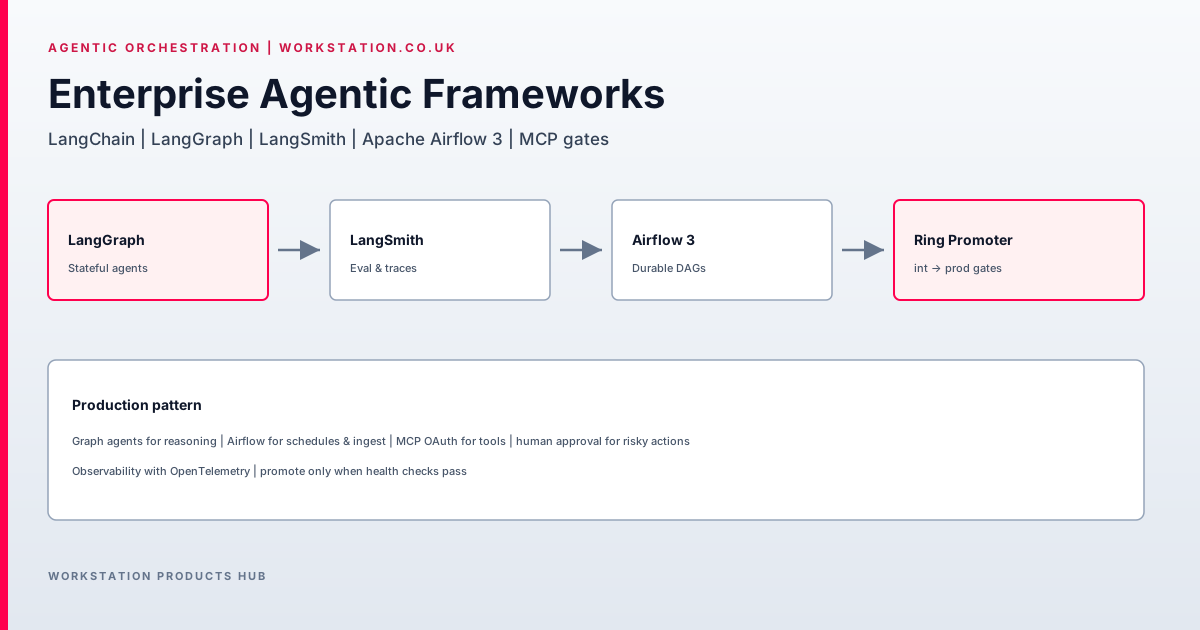
- LangGraph: stateful agent graphs, tool calling, human-in-the-loop interrupts, checkpoints.
- LangSmith: traces, datasets, evals — catch regressions before ring promotion.
- Airflow 3.x: durable DAGs for ingest, model refresh, scheduled agent jobs (3.3.x on the public project site).
- Ops layer: MCP OAuth, approval gates, Ring Promoter, OpenTelemetry cost control.
1. Frameworks are not a production system
Enterprise teams often buy an agent demo and discover that demos lack durable schedules, audit trails, secret rotation, and promotion gates. Workstation’s products page therefore groups frameworks and orchestration together: reasoning graphs plus workflow engines plus control planes.
2. LangChain and LangGraph
LangChain remains the broad toolkit for LLM applications (retrievers, tools, memory helpers). LangGraph is the graph runtime for stateful, multi-step agents — the piece most enterprises need once copilots become long-horizon workflows.
Patterns we implement in AI Labs:
- Supervisor / worker multi-agent cells for ops and support
- Human-in-the-loop interrupts before irreversible actions (refunds, infra changes, outbound email)
- Checkpointing so a failed step can resume without replaying the whole plan
- MCP (Model Context Protocol) tools behind OAuth rather than long-lived API keys in prompts
3. LangSmith — evaluation as a release gate
LangSmith (and similar observability stacks) turns agent behaviour into traces and datasets. Treat eval failure like a failing CI job: do not promote an agent prompt or graph revision from int → test → acc → prod when golden datasets regress. Pair with Ring Promoter health gates for the deployable artefact.
4. Apache Airflow 3 for durable enterprise workflows
Agent graphs handle conversational and reactive work. Apache Airflow 3 (public project site lists 3.3.x releases) still owns:
- Nightly / weekly knowledge-base ingest for RAG
- Model weight refresh and embedding rebuilds
- Compliance exports and batch reporting that must survive restarts
- Scheduled “agent jobs” that should run as DAGs with SLA sensors, not as forever-running chat sessions
Trending enterprise pattern: Airflow schedules and prepares; LangGraph reasons and acts; humans approve high-risk tools; rings promote changes.
| Layer | Tooling | Job |
|---|---|---|
| Reasoning | LangGraph / LangChain | Plans, tools, multi-agent dialogue |
| Eval | LangSmith / OTel + Langfuse-style stacks | Trace, score, budget tokens |
| Schedule | Airflow 3 | Ingest, refresh, batch agents |
| Promote | Ring Promoter | Health-gated int→prod |
| Edge | WSL Proxy | Gateway, WAF, agent traffic |
5. Other trending enterprise workflow tools
Teams also ask about Temporal-style durable execution, Prefect/Dagster for data-centric DAGs, and vendor agent studios. Choose based on who owns ops: if your platform team already runs Airflow, extend it; if you need long-running sagas with human wait states, evaluate durable-execution engines alongside LangGraph. Avoid stacking three orchestrators “just in case.”
6. Security and governance (non-optional)
See our brief on Agentic AI Security: MCP OAuth, VPN & Vault. Short version: short-lived secrets, private MCP where risk is high, and explainable deny paths at the edge.
7. Closing
LangChain/LangGraph give you agent brains; Airflow 3 gives you enterprise time; Workstation control planes give you promotion and edge safety. Start from Products → Agentic frameworks.
Published by Workstation.