Agentic AI Shifts Resource Allocation

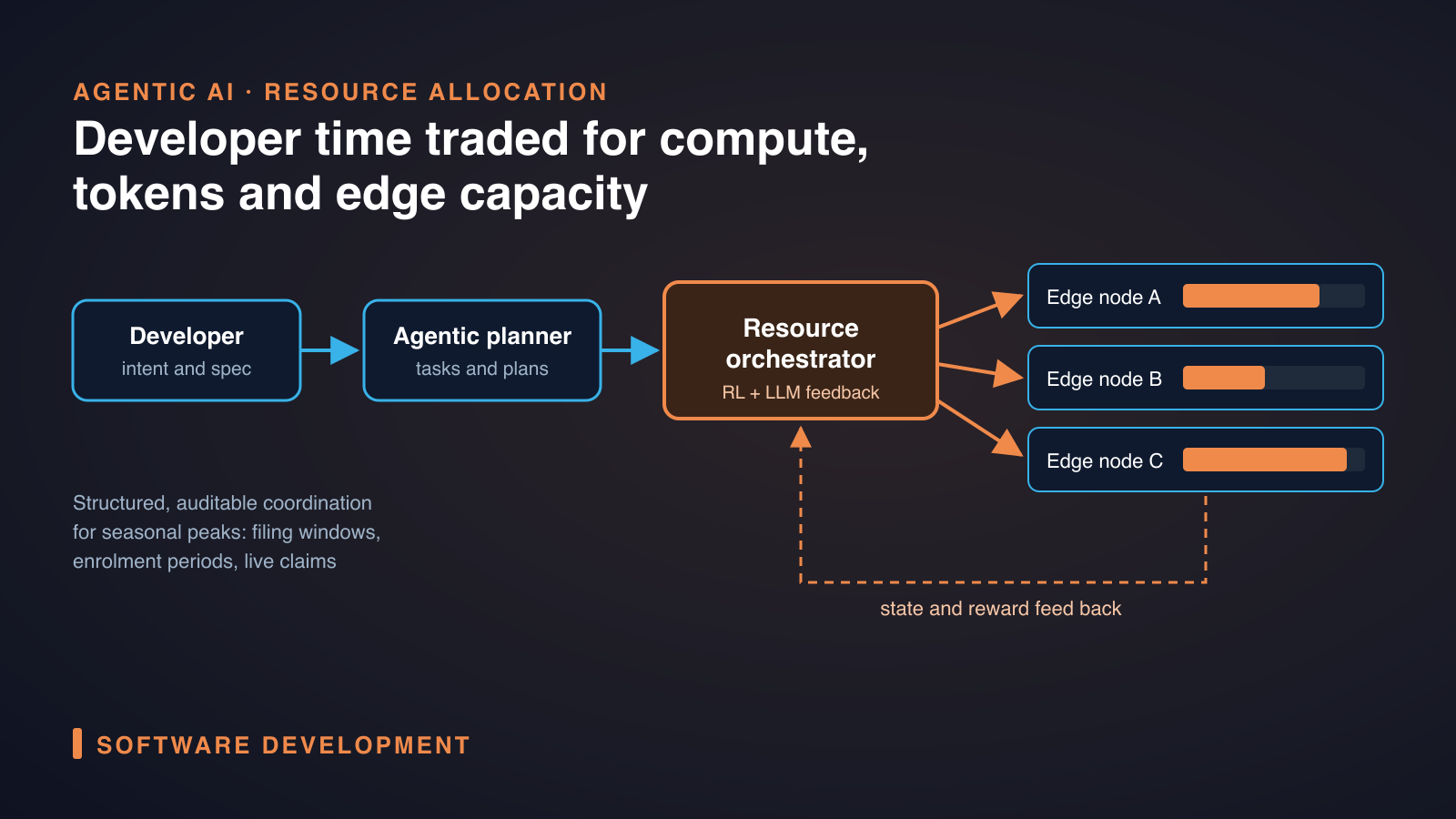
Agentic AI moves software engineering from prompt-response tools to autonomous agents that plan, execute, and coordinate work across the development lifecycle. For organizations in Banking, Education, HealthTech, FinTech and Tax Returns, that shift changes where compute, data and human attention are spent — and how teams measure value. Resource allocation becomes explicit: developer time is traded for compute, tokens and edge capacity, and ad-hoc collaboration is replaced by structured, auditable coordination.
Agentic AI in Software Engineering
What changes in collaboration
Agentic software engineering is a shift from informal collaboration to structured collaboration [1]. In this model:
- Humans author the coordination system, and agents generate the task artifacts [1]
- Coordination artifacts are primarily natural-language-shaped [1], which means specs, plans and acceptance criteria become the interface between people and agents
Why edge orchestration matters in regulated sectors
In regulated sectors, resource allocation is not just about speed. It is about meeting compliance, auditability and latency targets while handling seasonal spikes, e.g., tax filing windows, enrollment periods, or real-time claims processing. That is where edge-aware agentic orchestration becomes relevant.
RAGAM-AI for MEC resource allocation
RAGAM-AI combines the capabilities of RL algorithms and Generative-AI for powering an Agentic AI workflow that optimizes resource allocation at the Multi-access Edge Computing units [2].
- Reward generalization is resolved by utilizing Large Language Model for feedback [2]
- RAGAM-AI interprets system state information and evaluates multi-objective trade-offs guiding the resource orchestration loop over distributed edge server agents [2]
- On using RAGAM-AI, lower allocation deviations for CPU, memory and bandwidth resources are reported while minimizing the latency and data rate costs [2]
For HealthTech clinics using edge nodes for imaging inference, or FinTech branches running local fraud checks, that pattern matters: the agent is not just picking a server, it is balancing cost, latency and data residency constraints under changing load.
Benefits and Challenges
Benefits
- Speed of iteration improves through structured planning and automated generation
- Operational cost visibility improves via explicit resource budgets per agent task
- Quick iterations with online A/B experiments are key for measuring user value [3]
- High-quality data from activities of Google engineers across software tools, including interactions with features, is essential for model quality [3]
Cost pattern
- The iterative Code Review stage accounts for the majority of token consumption for an average of 59.4% of tokens [4]
- The primary cost of agentic software engineering lies not in initial code generation but in automated refinement and verification [4]
- A novel methodology can help practitioners predict expenses and optimize workflows [4]
For Banking and Tax Returns, where code review must be auditable and explanations must be human-readable, token concentration translates directly to budget and governance risk. For Education platforms, agent-assisted grading and content generation can become expensive at scale unless review loops are bounded.
Sector trade-offs
- Deployment speed: Agents can generate and refactor boilerplate and plan tests, but HealthTech requires validation and clinical safety sign-off
- Resource efficiency: Edge orchestration reduces latency and data transfer, but Banking has data residency and private network requirements
- Cost predictability: Token usage can be modeled per workflow, but Tax Returns has seasonal spikes that break steady-state models
- Compliance: Natural-language artifacts aid documentation, but Education needs FERPA/COPPA audit trails for student data
Platform coherence challenge
Challenges include reward generalization, coordination drift, and the need for end-to-end platform coherence. Language design in the service of software engineering requires not just a language, but an end-to-end platform with tooling all around the software development life cycle [5]. Go is a platform with developer touchpoints all across the software development life cycle [5]. This integrated tooling has a second, less obvious benefit: ecosystem-wide coherence [5].
Implications for Software Engineers
The role moves from writing every line to authoring coordination systems and verifying agent output. Engineers become reviewers of plans, not just code.
- In FinTech, an engineer might define a natural-language policy for transaction monitoring changes, then audit the agent-generated implementation against regulatory checklists
- In HealthTech, an engineer authors the safety constraints for an agent that updates patient portal code, and the agent proposes changes within those bounds
Workflows become structured:
# Example coordination artifact: agent task spec
task = {
  "goal": "Add rate limiting to payment webhook",
  "constraints": ["no PII leaves VPC", "latency < 200ms p95", "audit log required"],
  "acceptance": "unit tests pass, load test shows <200ms, security review checklist completed",
  "resources": "edge node pool A, max CPU 30%"
}
The engineer owns the constraints; the agent owns the artifact generation.
New Skills and Processes
Teams need skills in prompt engineering for coordination, not just coding, plus systems thinking about resource trade-offs. Processes must capture agent decisions for audit.
Agentic SE is, at its core, a shift from informal collaboration to structured collaboration [1]. That means:
- Spec-first development with natural-language-shaped artifacts [1]
- Explicit resource budgets per agent task, e.g., CPU/memory/bandwidth caps
- Verification pipelines that separate generation from refinement, because refinement dominates token cost [4]
For Banking and Tax Returns, where year-end filing drives load, processes should include pre-season simulation of edge resource orchestration and token budgets. For Education, processes should include data minimization reviews before agents touch student data.
Real-World Applications
- Banking: Agents orchestrate canary releases across regional edge nodes while respecting data residency, using state feedback to balance latency and cost. RAGAM-AI interprets system state information and evaluates multi-objective trade-offs guiding the resource orchestration loop over distributed edge server agents [2]
- HealthTech: Agents generate FHIR-compliant data access layers and run local tests on edge nodes near clinics to reduce data movement. Lower allocation deviations for CPU, memory and bandwidth resources are reported while minimizing latency and data rate costs [2]
- Education: Agents draft course content updates and run automated accessibility checks, but token spend concentrates in iterative review [4]. Teams can use predictive cost models to cap review iterations per content module [4]
- FinTech and Tax Returns: Agents maintain reconciliation scripts across multiple tax years, with coordination artifacts that explicitly reference regulatory clauses. Humans author the coordination system, and agents generate the task artifacts [1]
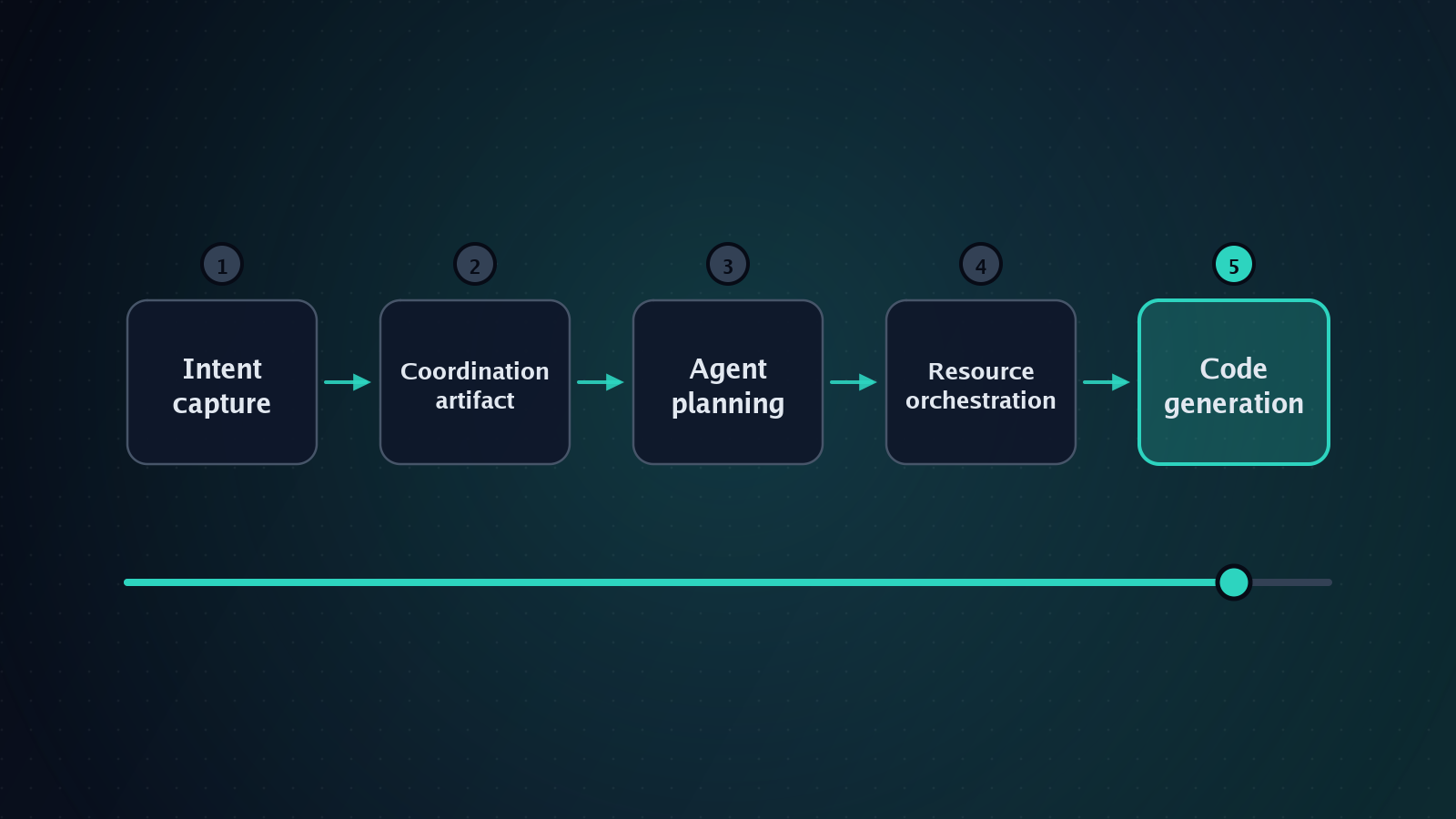
Across these sectors, the mechanics are the same — agents plan, orchestrate resources, and generate artifacts — but constraints differ in timing, compliance and data sensitivity. The value comes from making those constraints explicit in the coordination system rather than hoping agents infer them.
Summary and Conclusion
Agentic AI shifts resource allocation from developer time to compute, tokens and edge capacity, and from ad-hoc collaboration to structured, auditable coordination. Key points are:
- Structured collaboration replaces informal collaboration, with natural-language coordination artifacts as the interface
- Edge-aware orchestration with frameworks like RAGAM-AI reduces allocation deviations while minimizing latency and data rate costs
- Token costs concentrate in iterative code review and refinement, requiring budget modeling and bounded review loops
- Platform coherence and end-to-end tooling are required for software engineering at scale
- Engineers author constraints and verify outputs; agents generate artifacts within those bounds
For software engineers in regulated industries, success will depend less on coding speed and more on designing clear constraints, measuring real user value with quick iterations [3], and keeping cost and compliance visible in every agent loop.
References
- AgenticSE_Book.pdf — agenticse-book.github.io (23 February 2026)
- RAGAM-AI: A Hybrid Reinforcement Learning based Agentic approach powered by Generative AI for Edge Resource Management — arxiv.org
- AI in software engineering at Google: Progress and the path ahead — research.google (6 June 2024)
- [2601.14470] Tokenomics: Quantifying Where Tokens Are Used in Agentic Software Engineering — arxiv.org (7 June 2026)
- Why Go is an Ideal Language for AI-Assisted Software Engineering — developers.googleblog.com (11 August 2026)