AI Data Centre Services: How Workstation Designs, Builds and Hands Over
Site, power, cooling, fabric, GPUs, storage and software, from a pilot rack to a hall, with a 72-hour burn-in before you operate it.
 Balinder Walia17 de novembro de 20267 min read
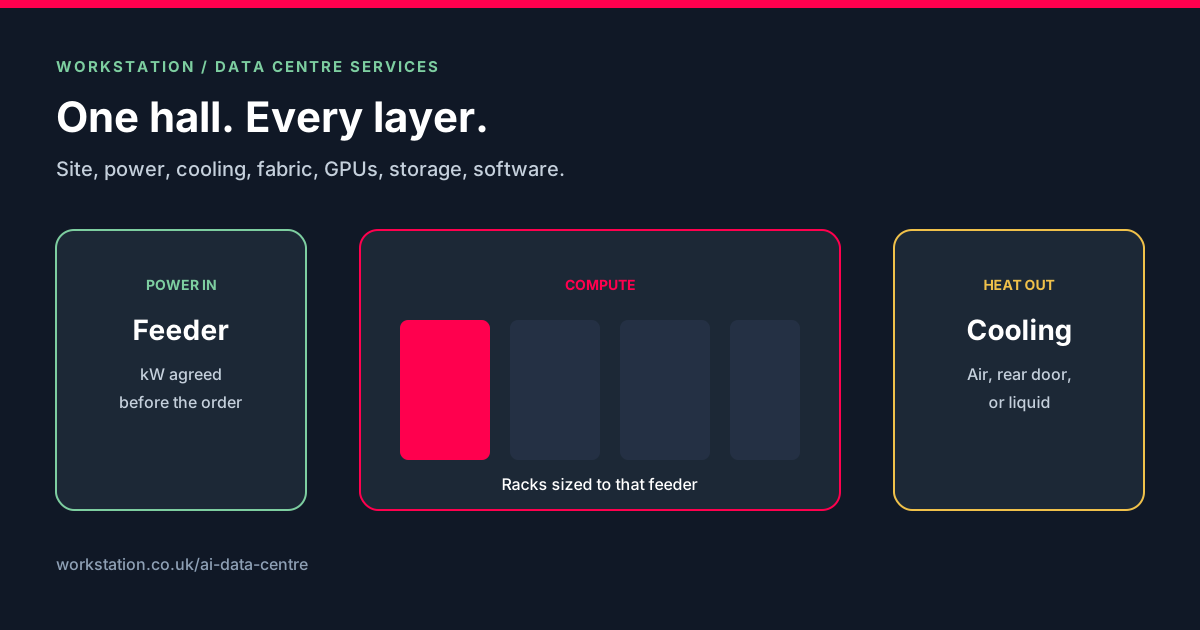
An AI data centre is not a server room with faster cards in it. The power, the heat and the network have to be designed for the GPUs, or the GPUs sit idle. Workstation takes that whole path: the site, the kilowatts, the cooling, the fabric, the machines, the software, and a handover you can operate.
The companion piece, Energy first, is the power budget. This one is the service around it.
Designed for the GPU, not retrofitted around it
A traditional enterprise row was built for servers that draw a kilowatt or two. An 8-GPU air-cooled system such as NVIDIA's DGX B300 is rated at about 14 kW. Four of them in a rack is about 56 kW in NVIDIA's B300 reference. Rack-scale NVL72 systems are liquid-cooled by design. If the room cannot reject that heat, or the feeder cannot supply it, the specification on the quote is fiction.
So the design starts from the workload and the building together.
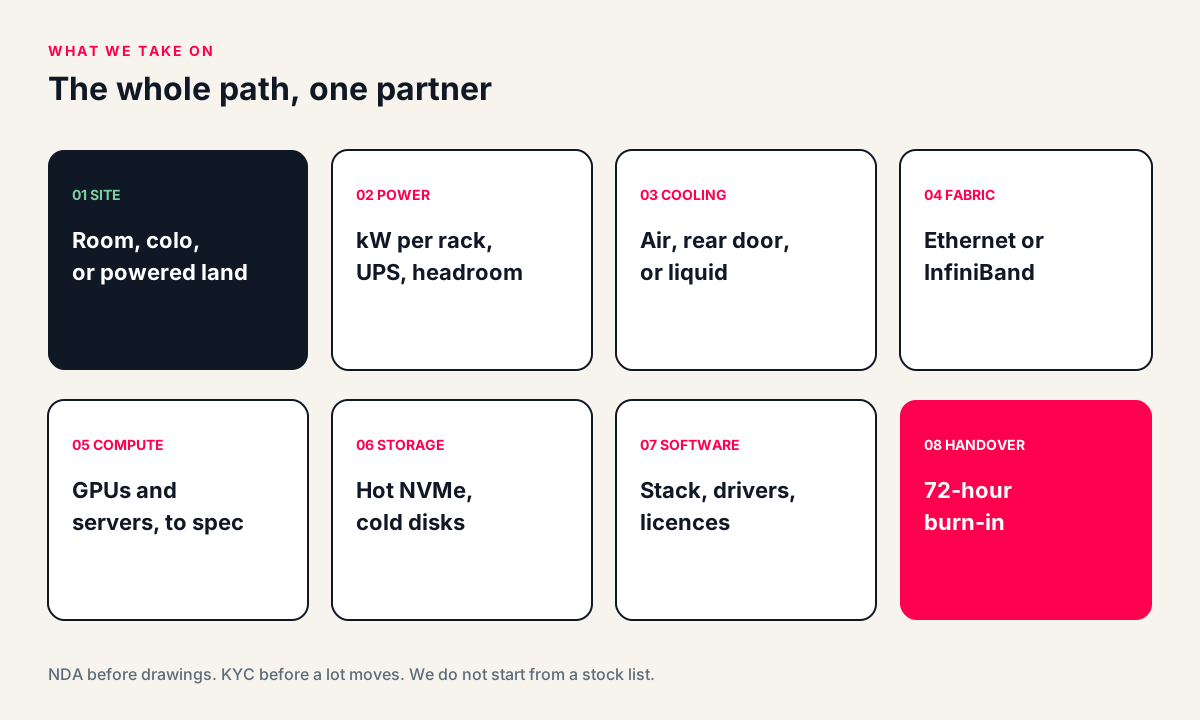
- Cooling that matches the platform. Air when the room can take it. A rear-door heat exchanger when the row is dense but the machines are still air-cooled. Direct liquid, with a water loop and leak detection, when the platform requires cold plates.
- A fabric that does not starve the GPUs. ConnectX-7 and ConnectX-8 adapters, up to 800 Gb/s, BlueField-3 for storage and management, Spectrum Ethernet or Quantum InfiniBand between the nodes. The network is part of the machine, not a later upgrade.
- Power you can name. Kilowatts per rack, UPS and generator cover, and headroom left on the feeder. We do not sell a generation project. We plan the load the site already has, or the colo suite or powered land you still need to secure.
What we actually do
Site
Three places a cluster can live. A room you already have, if the power and the floor loading are real. A colocation hall, when the building is the constraint and the data still has to stay in a known place. Powered land or an available megawatt, when you are the operator and the hall does not exist yet. We help acquire that capacity. We also say when the room you hoped to use cannot take the machines.
Power and capacity
The AI data centre planner uses indicative bands so a pilot does not become a megawatt design by accident: under 1 kW on a desk, 1.5 to 3 kW for a team, 6 to 20 kW for a rack, 40 to 130 kW for a pod, and 0.5 to 5 MW for a factory. Those are planning ranges. The survey replaces them with your feeder. A worked example sits in the AI data centre guide: a DGX B300 at its 14 kW rating is 122,640 kWh a year at full draw, before power usage effectiveness.
Cooling
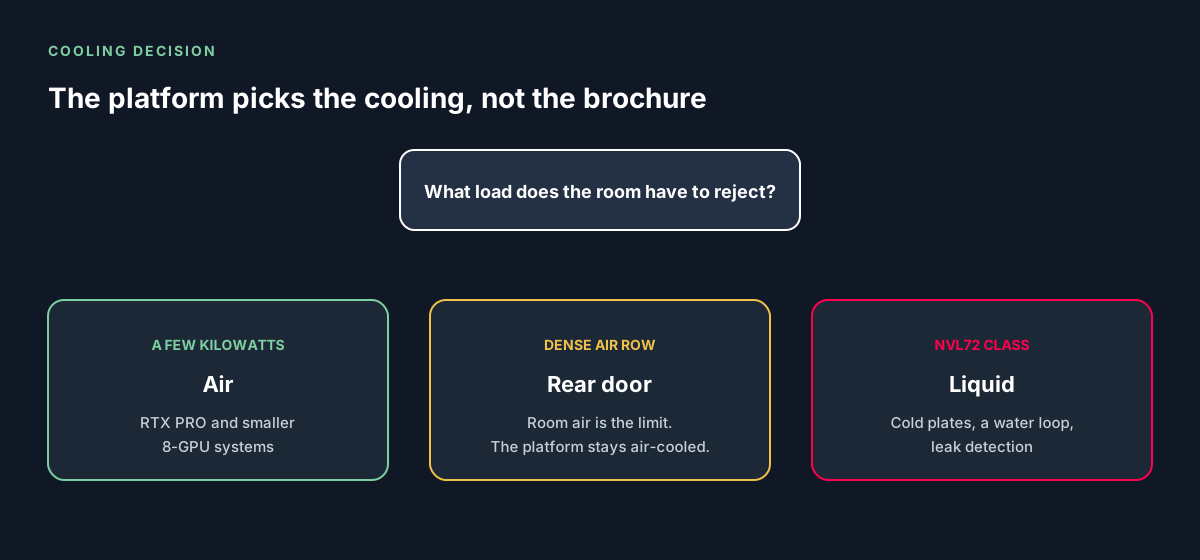
Liquid cooling is specified when the platform needs it, or when air cannot leave the room. It is not specified to make a proposal look newer. Closed-loop liquid, where the coolant stays in the rack circuit and rejects heat at a cooler, is one way to add density without rebuilding the whole hall. It still needs a design, a leak plan and a landlord who will sign it.
Compute
Sourced to your specification, new or vetted refurbished. Passively cooled data-centre GPUs, including H100, L40S and RTX PRO Blackwell Server Edition. Complete systems: 4U 8-GPU servers, HGX B200 on quote, DGX Station and DGX Spark. If you are refreshing an older 8-GPU generation, we place the outgoing hardware as well as supplying the next one. Provenance, condition and warranty are checked before a lot is offered. When we share a live lot, we are representing our client.
Storage
Hot data on all-NVMe nodes, including 2U 24-bay servers and PCIe 5.0 drives, and colder data on large enterprise disks. Training sets, checkpoints and retrieval corpora do not belong on the GPU server's boot drives.
Networking
The adapters, the DPUs and the switches above, sized to the number of GPUs rather than copied from last year's office network. A fabric that is one generation behind the GPUs shows up as idle accelerators, not as a slow switch LED.
Memory, CPUs and the rest of the box
DDR5 ECC registered memory, and the CPUs the platform expects, including Threadripper PRO and EPYC where that is the right host. Upgrades to machines you already own, when the chassis and the power budget allow it.
Software
Operating system, data-centre drivers, the container toolkit, and NVIDIA AI Enterprise where the deployment needs the supported stack. The handover includes a machine that runs your models, not a pallet and a packing list.
Install and burn-in
On-site installation, then a 72-hour burn-in on every rack we install. The point of the burn-in is to fail a supply, a DIMM or a GPU on our clock, not on yours.
Speed, without pretending the grid moves overnight
One partner is faster than a chain of a site agent, a mechanical consultant, a reseller and a separate installer who have never read each other's drawings. Requirements, a mutual NDA, standard KYC, then options that fit the specification, the budget and the date. That is the sequence. It removes handoffs. It does not remove a substation.
The planner's indication of lead time runs from about a week for a desk system to 16 to 40 weeks for a factory-scale design. A survey can move those numbers. Quote-only platforms, including HGX B200 and NVL72, stay on quote because allocation and site work dominate the date. Systems in the AI Shop carry live prices.
Modular growth is how most of our customers actually expand. Prove the workload on one server. Add the same configuration when the feeder has room. A consistent build is easier to cool, to spare and to operate than a row of one-off machines.
When you should not build the hall
If the data can live in a known place and the constraint is the building, a private GPU cloud is the same sizing exercise without the substation. You still need a power and cooling story. It belongs to the hall you rent, and we still size the GPUs to it.
If you have surplus GPU servers, we help place them with vetted buyers. That is a separate conversation from a new build, and it starts with the same NDA.
What this service is not
- Not a power station. We do not develop generation, and we do not quote geothermal, nuclear or a gas plant as if Workstation were the utility. Your energy contract stays with your supplier. We tell you the kilowatts the design needs.
- Not a stock list. The machines follow the survey. If the only system that fits is smaller than the one in the brief, that is the recommendation.
- Not a fixed campus timeline. Months is realistic for a rack in a room that can take it. A new hall follows the power, the permits and the cooling plant.
- Not a peak-FLOPS brochure. NVIDIA's throughput figures are NVIDIA's. We size from your models, your users and your feeder.
How to start
- Answer the seven questions on the planner. You get a profile, a tier and an indication of budget, power and time. No sign-up.
- Or send the site and the workload: incoming power, the models, the number of users, and whether the machines must stay in a room you name.
- We sign an NDA before drawings or a lot list change hands, then KYC, then a written set of options.
Sources
- Workstation: AI data centre solutions
- Workstation: energy first
- Workstation: NVIDIA AI data centre guide
- NVIDIA: DGX B300
Trademarks. NVIDIA, DGX, NVL72, ConnectX, BlueField, Spectrum and Quantum are trademarks of NVIDIA Corporation. AMD, Threadripper and EPYC are trademarks of Advanced Micro Devices, Inc. The 14 kW figure is NVIDIA's DGX B300 rating, used as an example. Power bands and lead times are Workstation planning ranges, replaced by a survey before a quote.