A loja já está aberta

Construímos máquinas Workstation AI para sites, agentes de IA e treino de LLM — configure e compre online.

Obter preços profissionais
Produtos de IA
Labs de IAAgentes OpenAIAgentes ClaudeGrok BotCRM nativo da Workstation AIMarketingTodos os produtos
Soluções de IA
IA aplicadaAgentes de IAIA generativaAutomatização com IAQualificação em IAPacotes de IA para PMELaboratório de IA empresarialEstações de trabalho de IAHardware e software NVIDIANVIDIA Accelerated ComputingIA privadaNuvem privada de GPUClusters de GPUIA de bordaIA por setor
Serviços de IA
Modernização de plataformasEngenharia digitalFundações de dados e IAOperações autónomasConsultoria de IAAutomação DevOpsCibersegurançaDesenvolvimento de softwareConstrução de agentesConfiguração MLOpsLocação de GPUsNuvem privada de GPU
Sobre nós
EmpresaA nossa históriaParceirosCasos de sucesso
Centros de dados de IA
Centros de dados de IANuvem privada de GPUClusters de GPULocação de GPUs
Análises de IASérie JevLaboratório de benchmarksSeleção de modelos
Notas técnicas
Documentação
SO LinuxUbuntuRed Hat Enterprise LinuxSUSE LinuxAlpine LinuxDebian, Rocky & AlmaLinux
Plataformas de IA na nuvemAWS & Amazon BedrockGoogle Cloud & Vertex AIMicrosoft Azure & AI FoundryNuvens e marketplaces de GPU
Centros de dados de IA privadosPara escritórios de advocaciaPara escritórios de contabilidadePlataformas locaisNuvem totalmente protegida
FerramentasRing PromoterJobshout
Notícias
Blog
Fale conoscoEntrar

Estações de trabalho de IA, software multiagente de IA, infraestrutura de GPU e soluções de agentes inteligentes para empresas modernas.

Fale conosco

Soluções de IA

IA aplicadaAgentes de IAIA generativaAutomatização com IAQualificação em IAPacotes de IA para PMELaboratório de IA empresarialIA por setor

Produtos

Todos os produtosWorkstation AI native CRM e ERPMarketingAgentes OpenAIRing PromoterJobshout

Empresa

Sobre nósEmpresaCentros de dados de IAPor que WorkstationParceirosCasos de sucessoPreçosContatoTenthMatrix

Recursos

Análises de IANotas técnicasDocumentaçãoSO LinuxPlataformas de IA na nuvemCentros de dados de IA privadosBlogBuscarMapa do site
Sede no Reino Unido
77-79 Marlowes, Hemel Hempstead HP1 1LFComo chegar: pegue a saída 20 da M25, Outer LondonN.º da empresa: 11641870Seg - Sex: 9:00 - 18:00 GMT
+44 7515 356 146
Escritório da Bélgica
Workstation SRL, Rue Vanderkindere 34, 1180 Uccle, BrusselsBE 0751.518.683Seg - Sex: 9:00 - 18:00 CET
+32 492 45 67 46
Escritório da Índia
#159 Sector 9, Pocket 1, DDA Flats, 110077 Dwarka, New Delhi
+91 98881 98841
Escritório de Taiwan
3F, No. 2-4, Aisi Rd., Ren'ai Dist., Keelung City 200, Taiwan基隆市仁愛區愛四路2之4號3樓Seg - Sex: 9:00 - 18:00, hora de Taiwan (GMT+8)
+886 926 892 701+32 492 45 67 46
Escritório na Estônia
Aleksander Puškini tn 30-25, 20306 Narva, EstoniaSeg - Sex: 9h00 - 18h00, horário da Estônia (EET)
+32 492 45 67 46
Escritório e fábrica de montagem na Tailândia
220 m.8 Detudom, Nong Yao, Det Udom, Ubonratchathani, Phon Ngam 34160, Thailand

© 2000-2026 Balinder Singh Walia. Todos os direitos reservados.

O site Workstation e todo o seu conteúdo, bem como as APIs e plugins associados, são protegidos por direitos de autor de Balinder Singh Walia. balinder.walia@gmail.com

PrivacidadeEliminação de dadosCookiesTermos de serviçoMapa do site

NVIDIA, the NVIDIA logo, RTX, RTX PRO, Blackwell, CUDA, NVLink, MGX, Omniverse, Spectrum-X, Quantum, BlueField, DGX and HGX are trademarks and/or registered trademarks of NVIDIA Corporation in the US and other countries. AMD, the AMD Arrow logo, EPYC, Instinct, Ryzen and Threadripper are trademarks of Advanced Micro Devices, Inc. Dell and PowerEdge are trademarks of Dell Inc. or its subsidiaries. Intel and Xeon are trademarks of Intel Corporation or its subsidiaries. AMAX, AceleMax and LiquidMax are trademarks of AMAX Engineering Corporation. All other product names, logos and brands are the property of their respective owners. We use them only to identify the products we describe, supply or support; their use does not mean their owners endorse us.

Jev & The Next Generation of AI Automation

How to choose the right AI model

Pick models by workload, budget and risk, not by leaderboard. Try the interactive chooser, follow a typical AI developer’s journey, then use the matrix as your starting hypothesis.

Published 26 September 2026Updated 8 November 2026Reading time 8 min (or 1 min with the chooser)AI landscape reviewed 26 September 2026
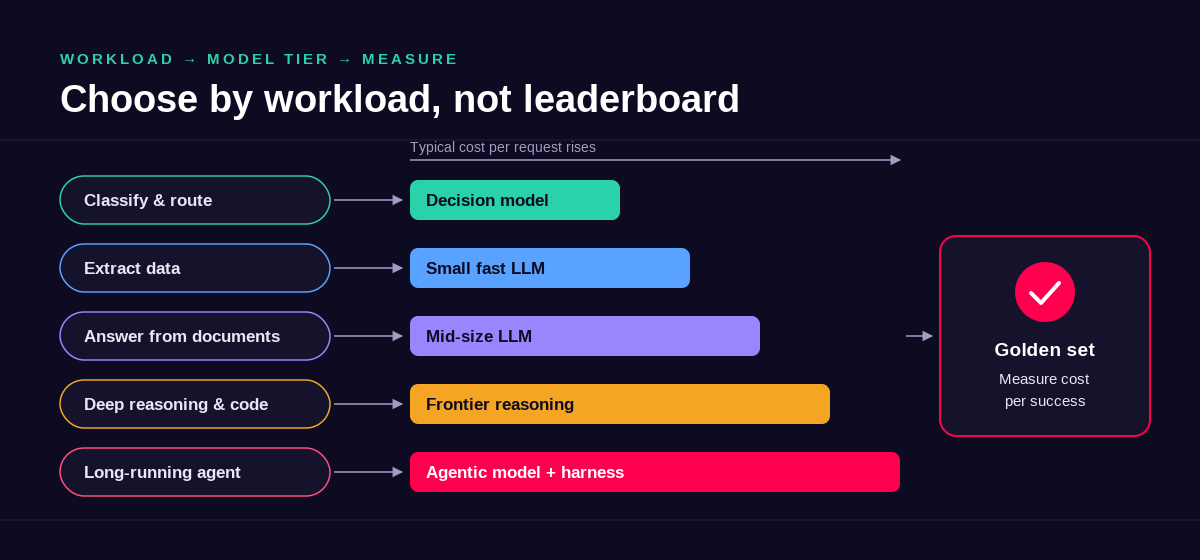
Workloads on the left flow into five model tiers, from decision models to agentic frontier models, ordered by cost per request.

Key takeaways

  • Start from the workload, not the launch blog.
  • Use the cheapest model that passes a measured quality bar.
  • Split steps that both decide and generate; route the easy ones to small models.
  • Measure cost per success on your own data, and re-test monthly.

Why this matters

Model selection fails when teams chase leaderboards. Workloads differ, so the best model differs too. This guide gives you a framework, not a permanent ranking of brands.

01

Workload first

Name the step. Does it decide, extract, answer or act?

02

Cheapest that passes

Set a quality bar, then pick the cheapest model that clears it.

03

Measure, don’t guess

Test on your own labelled data. Keep every eval version.

Choose a model type in 60 seconds

Interactive

Model chooser

Pick a workload, set your budget and volume, and see which model tier to evaluate first. The chart shows where your budget per request lands.

1

What is the step doing?

2

Budget, volume and constraints

3

Your starting point

0.001p0.01p0.1p1p10p£1.00£10Typical cost per request (log scale)Agentic + harnessFrontier reasoningMid-size LLMSmall fast LLMDecision modelYour budget: 0.83p / request

Bands are illustrative orders of magnitude at about 1,500 tokens per request (per task for agents). They are not quotes. Check current provider price lists.

Evaluate first

Mid-size generalist LLM

The step writes answers people read. Quality matters, but most requests do not need multi-step reasoning.

Measure
Answer quality
Budget per request
0.83p
Typical API spend / month
£120–£1,200

Fits your budget. Your budget per request sits inside this tier’s typical band.

Ask the AI Sales Engineer

Decision framework

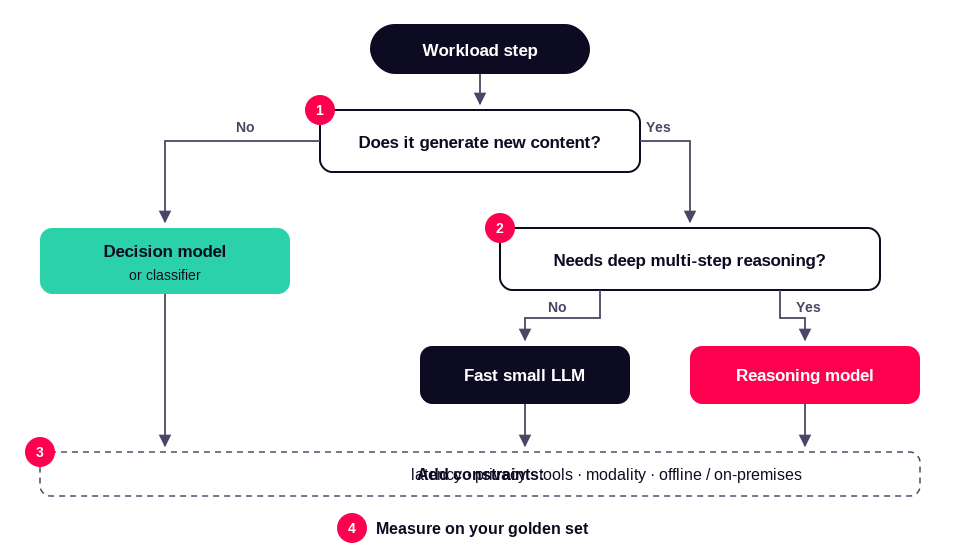
Decision tree: does the step generate new content? No leads to a decision model. Yes leads to: does it need deep multi-step reasoning? Yes leads to a reasoning model, no to a fast small LLM. Then add constraints and measure on a golden set.
Two questions pick the model type. Constraints and a golden set confirm it.
  1. Does it generate?If the step only decides (yes/no, a label, a route), start with a decision model or classifier.
  2. Does it reason deeply?If it generates and needs multi-step reasoning, use a reasoning model. If not, a fast small LLM may be enough.
  3. Add constraintsLatency target, privacy, tool use, modality, and whether it must run offline or on-premises.
  4. MeasureRun the candidate on your golden set before you commit.

Selection matrix

Treat each row as a starting hypothesis. The colour shows the model tier.

  • Decision model
  • Small fast LLM
  • Mid-size LLM
  • Frontier reasoning
  • Agentic + harness

Classification

Decision model / classifier

Measure Accuracy + latency

Routing

Decision model

Measure Correct routing + escalation quality

Tool safety

Decision model

Measure False negatives

High-volume automation

Fast decision model

Measure Cost × accuracy

RAG evaluation

Judge / decision model

Measure Calibration

Simple extraction

Small/fast LLM or decision model

Measure Accuracy / cost

Real-time voice

Fast multimodal

Measure End-to-end latency

RAG generation

LLM

Measure Answer quality

Creative writing

Generative LLM

Measure Quality rubrics

Coding

Coding / agentic model

Measure Task success

Deep reasoning

Reasoning model

Measure Correctness

Long-running agent

Agentic frontier model + harness

Measure Task completion

The journey of a typical AI developer

Interactive

From prototype to production

Most AI developers walk the same path. Click a stop to see what happens, which model fits at that stage, and the trap to avoid.

  • Explore
  • Build
  • Run
1Prototype2Golden set3Split steps4Right-size5Guardrails6Cost/success7Scale & place8Re-evaluate
Explore1 / 8

Prove the idea works

What you do
Wire the happy path end to end with one capable hosted model.
Model choice
One frontier model for everything. Speed of learning beats cost here.
Trap to avoid
Shipping the prototype model to production unchanged.

What to measure

Sixteen dimensions, in four groups. Most steps only care about a few of them, so pick those and ignore the rest.

Quality

  • Intelligence & reasoning depth
  • Task-specific accuracy
  • Coding ability
  • Calibration

Speed & cost

  • Latency & tail latency
  • Cost & cost per success
  • Rate limits
  • Context window needs

Integration

  • Structured output reliability
  • Tool use / MCP fitness
  • Multimodal needs
  • Observability hooks

Risk & operations

  • Privacy / data residency
  • Deployment model
  • Reliability & uptime
  • Safety tooling

Worked example: from journey to model policy

  1. Map the journeyWrite down the user journey and list each step that decides or generates.
  2. Assign a typeGive each step a candidate model type from the matrix. Skipping this is how teams spend premium reasoning tokens on yes/no gates.
  3. Write the metricOne metric per step. Only then pick a vendor.
  4. Name an ownerEach step gets a named owner, so model policy changes land in a human inbox.
  5. Split and hardenIf a step both decides and generates, split it. High volume: invest in calibration. Irreversible: invest in false-negative analysis and human escalation, not only model IQ.
  6. Re-run monthlyRe-run a fixed eval harness every month and store the results beside the policy document.

Production checklist

  • Keep a written model policy, and version it.
  • Pin explicit model ids in production paths that encode thresholds, not moving aliases.
  • Revisit the policy when providers change defaults.
  • Track cost per successful task, not cost per token.
  • Keep historical eval versions so you can compare like with like.

Conclusion

The rule

The right model is the cheapest model that meets a measured quality bar under your latency and risk constraints. Sometimes that is a Jev-like decision model, sometimes a frontier reasoner, and often both in one system.

Related on Workstation

  • Benchmark Lab — Interactive charts
  • Model routing — Send each request to the right model
  • Guardrails and tool safety
  • AI data centre planner — Run models privately
  • AI Agents

Sources

  1. TypeSafe AI — Introducing System One Models & Jev — Primary vendor source (15 Sep 2026).
  2. LangChain — Building a Harness with Jev — Harness integration (17 Sep 2026).
  3. TypeSafe documentation index — Concepts, primitives, API, cookbooks.
  4. LangChain — Can Jev Be a Better Agent Evaluator? — 20 Sep 2026 LangSmith experiment.
  5. OpenRouter — Jev vs LLM when to use each — Published triage cost/latency/accuracy.
  6. AyAutomate — Independent Jev benchmark — 791 decisions; challenges headline multipliers vs small models.
  7. JevBench RESULTS v1.2 — Public community harness.
  8. OpenAI — Introducing the Agents API — Landscape: agent platform primitives.

Ask about this article

Curated answers from this page's sources and methodology. Not a live model call.

Which model should I evaluate for my workload?Map each step through the matrix, then shortlist one decision-model candidate and one generative candidate where relevant. Run both on a labelled sample before standardising.

On this page

  1. Why this matters
  2. Interactive model chooser
  3. Decision framework
  4. Selection matrix
  5. A developer’s journey
  6. What to measure
  7. Worked example
  8. Production checklist
  9. Conclusion
  10. Sources

Explore

  1. AI Insights home
  2. Jev series
  3. Benchmark lab
  4. AI Agents
  5. Jobs