Energy First: How Workstation Plans AI Infrastructure
Power, heat and the room come before the GPU order. Here is how we size a desk, a rack or a hall.
 Balinder WaliaNovember 17, 20266 min read
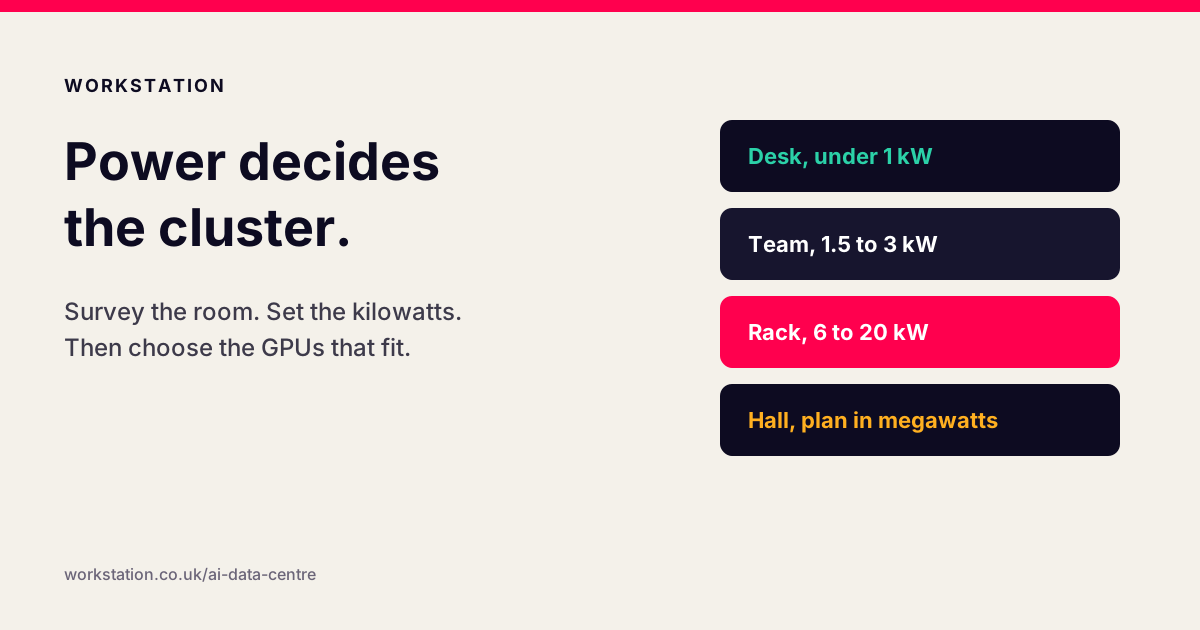
The GPUs are the last decision. The feeder, the heat and the floor decide what you can switch on. Workstation plans AI infrastructure in that order: find the power, design the cooling, then buy the machines that fit.
Six benefits of starting with energy
- Faster to first token. Power design and the machine list move together. You do not wait twelve weeks for a server, then discover the room has a 3 kW spare circuit. The AI data centre planner asks for the site before it suggests a tier.
- Scale that matches the building. The same method covers a desk, a team server, a rack row or a hall. The kilowatts change. The order of the questions does not.
- A lower bill for the work you actually run. An idle GPU still has a capital cost, and a GPU you cannot power is only a capital cost. Right-sizing is how the energy line and the hardware line both stay honest.
- More work per watt, where the hardware allows it. Newer systems do more tokens for the same draw. NVIDIA publishes those comparisons. We use them to choose a generation. We do not treat a peak FLOPS number as your electricity bill.
- The site is chosen for power, not the other way round. An office, a colocation hall, or powered land. If the building cannot take the load, we say so before the order.
- A mix, tuned to the job. Air where the room can take it. Rear-door heat exchangers where the row is dense. Direct liquid only when the platform requires it. On your floor, in a hall, or as a private GPU cloud when you need the capacity without building the substation.
Indicative power bands
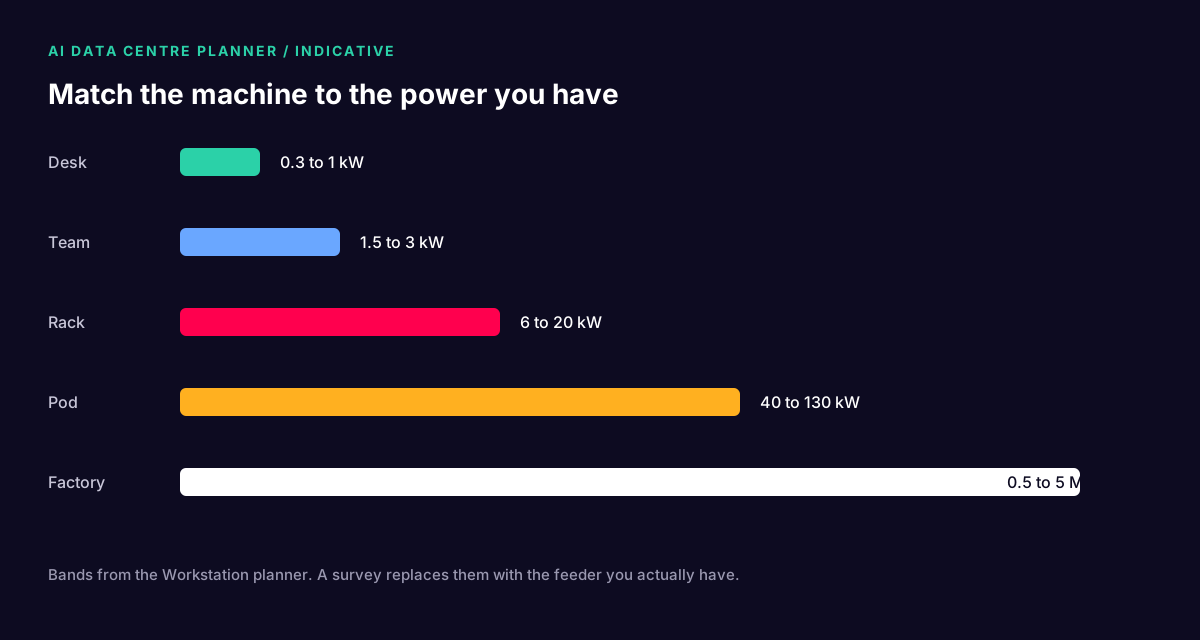
| Tier | Indicative power | What usually fits |
|---|---|---|
| Desk | 0.3 to 1 kW | A DGX Spark or a Mac Studio for a pilot |
| Team | 1.5 to 3 kW | One or two RTX PRO 6000 workstations, or a DGX Station |
| Rack | 6 to 20 kW | GPU servers in a rack you already have, with containment if the row is dense |
| Pod | 40 to 130 kW | Several 8-GPU systems, storage and a fabric. Often a colo suite, not a cupboard |
| Factory | 0.5 to 5 MW | Rack-scale systems. Power, water and floor loading are the project |
These ranges are planning bands, not a quotation and not a measurement of your building. The planner uses them to stop a frontier-training brief landing on a desk, and to stop a pilot brief growing into a megawatt design.
The energy line, worked once
NVIDIA rates the air-cooled DGX B300 at about 14 kW. Left at that draw for a year, the arithmetic is 14 kW times 8,760 hours, which is 122,640 kWh before power usage effectiveness. PUE multiplies the whole line: if the hall uses 1.3 kWh at the meter for each 1 kWh at the IT load, the site energy is about 159,000 kWh. Your tariff, your utilisation and your PUE change the bill. A system that averages half that draw costs about half the energy.
Four of those systems in one rack is the density NVIDIA's B300 SuperPOD reference puts at about 56 kW. Many enterprise rooms were built for a fraction of that. The survey is where that fact becomes a design, or a reason to move the workload.
Cooling follows the watts
- Air for RTX PRO servers and for 8-GPU systems when the row can reject the heat. A four-GPU server is a few kilowatts. An 8-GPU air-cooled system near 14 kW needs high-density PDUs and, usually, containment.
- Rear-door heat exchangers when the air volume of the room is the limit and the platform is still air-cooled.
- Direct liquid for NVL72-class racks. The GPUs and CPUs sit on cold plates. That is a facility water loop, coolant distribution and leak detection, not an extra fan.
We do not specify liquid cooling to make a diagram look modern. We specify it when the platform requires it, or when air cannot leave the room.
How the consulting runs
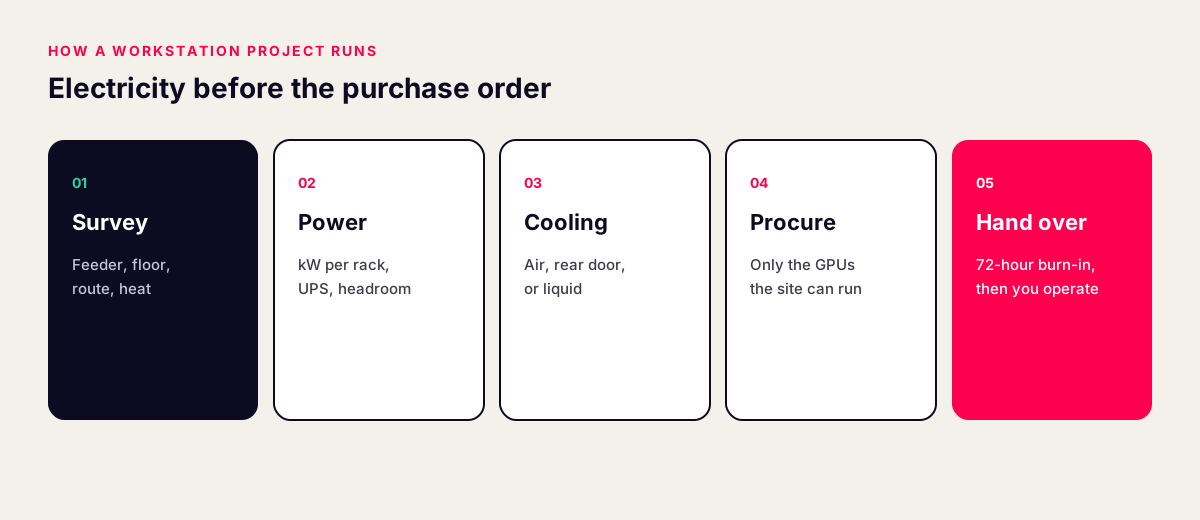
- Survey. Incoming power, spare capacity, floor loading, the delivery route for a 10U system on a pallet, cooling already in the room, and where the network enters.
- Power budget. Kilowatts per rack, PDU layout, UPS and generator cover, and the headroom you want left on the feeder.
- Cooling choice. Air, rear door, or liquid, written so a landlord or a colocation provider can sign it.
- Procurement against that cap. New or refurbished NVIDIA and AMD GPU servers, storage and networking, only in quantities the power budget can run. Quote-only systems such as HGX B200 and NVL72 stay on quote. Shop systems carry live prices.
- Build, 72-hour burn-in, handover. The rack is tested at load before you operate it. NDA first, before site drawings or a lot list change hands.
For operators and teams building their own capacity, that scope includes site acquisition: powered land, available megawatts, or colocation. For a company that wants the GPUs without the substation, the same sizing lands in a private GPU cloud. One conversation covers both. Start with the planner, or talk to an engineer.
What we will not put in a brochure
- A promise of electricity below the market rate. We plan the load. We do not sell you a tariff we have not priced.
- A megawatt campus on a fixed number of weeks. Lead time follows the site work. The planner's factory band is 16 to 40 weeks as an indication, and a survey can move it.
- A clean-energy certificate presented as if Workstation had generated the power. If you need a renewable match, that is a supply contract with your energy provider, named separately from the hardware.
- Peak performance treated as a measured energy saving. NVIDIA's throughput-per-megawatt figures are NVIDIA's. Your workload decides what you get.
Sources
- Workstation: AI data centre planner
- Workstation: NVIDIA AI data centre guide, including the 14 kW example and the cost-per-token energy line
- Workstation shop: NVIDIA DGX B300 (price and lead time on quote)
- NVIDIA: DGX B300
Trademarks. NVIDIA, DGX and NVL72 are trademarks of NVIDIA Corporation. AMD is a trademark of Advanced Micro Devices, Inc. Power bands are Workstation planning ranges. The 14 kW figure is NVIDIA's system rating for DGX B300, used here as an example, not as a measurement of a customer site.