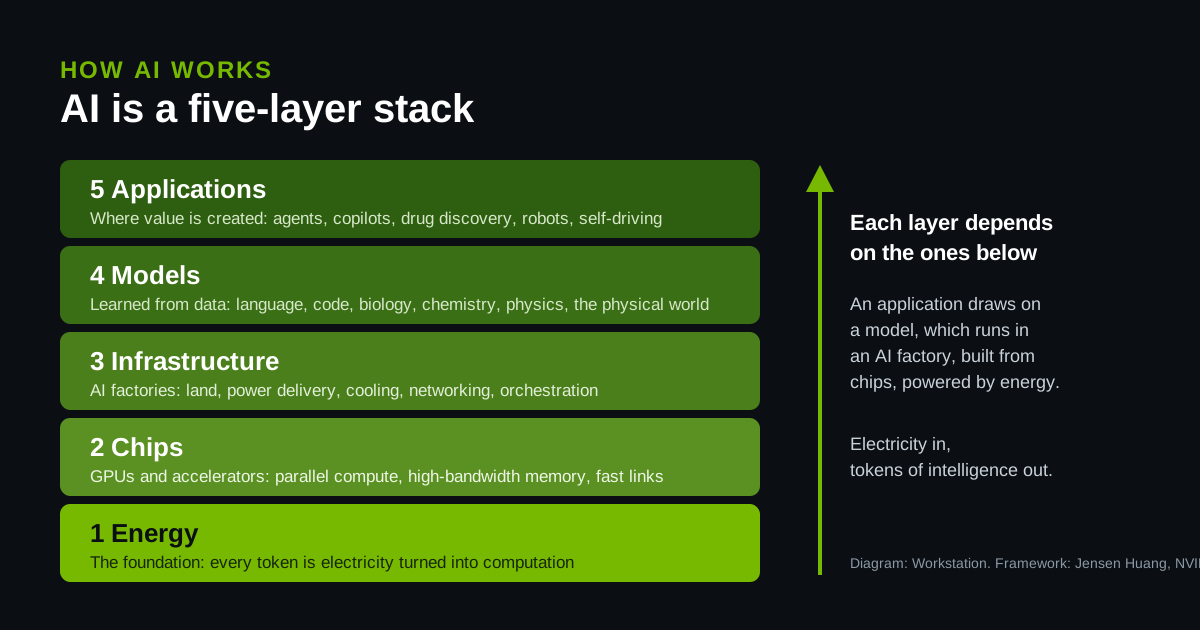
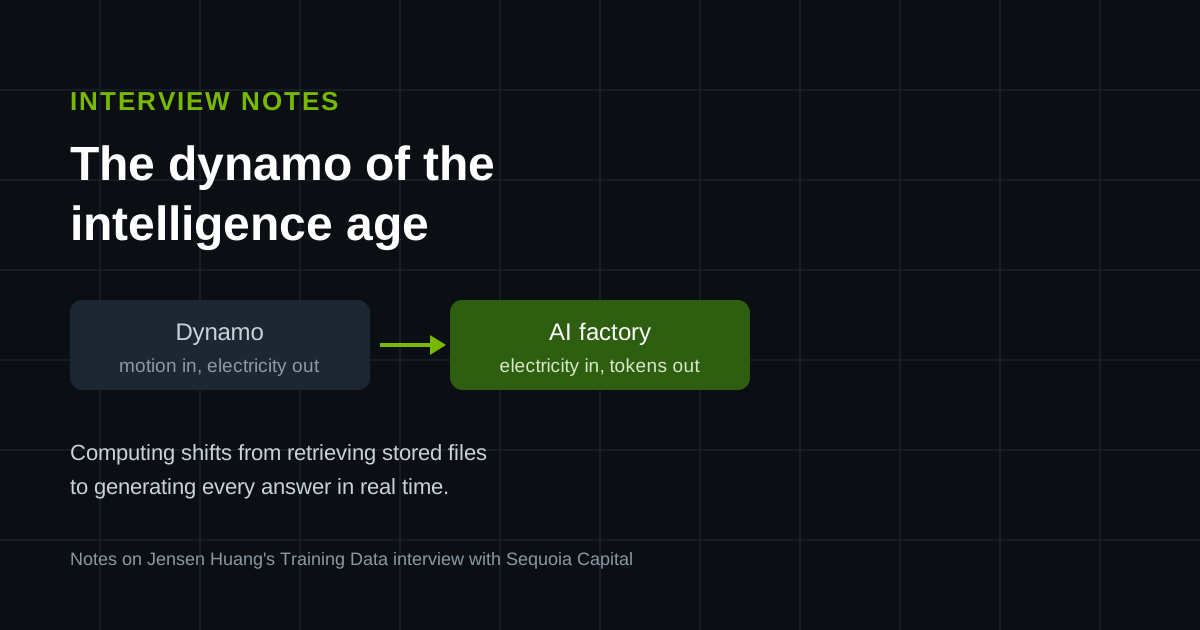
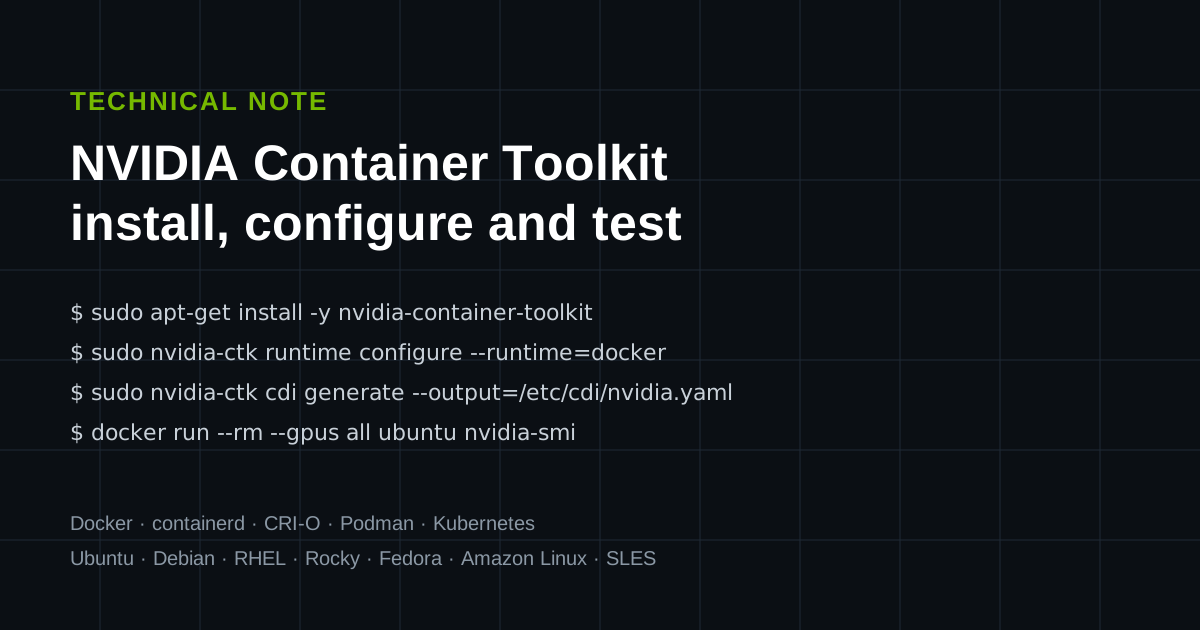
The first half of Jensen Huang's GTC Berlin keynote, on 21 October 2026, was the factory. NVIDIA DSX is the reference design for building one. The slides behind him then put Europe's companies on that factory in layers, and a wheel of markets around a single CUDA architecture. Workstation engineers photographed those slides. This article says what is on them, which numbers are NVIDIA's, and where a desk-side machine still sits.
Chips alone do not make a factory
Huang's setup line: great chips do not make a great AI factory. NVIDIA DSX is a full-stack reference architecture, co-designed with infrastructure companies, covering compute, networking, storage, software, power and cooling as one system. It starts in a digital twin, so the building is designed before it is poured. He also described DSX Max, a control layer, and a rethink of cooling. One figure he stated: at 2 gigawatts, DSX can save 54 million litres of water a day. That is NVIDIA's claim from the keynote. We have not audited the water model.
The same day he announced DSX Pod: Vera Rubin racks, integrated and cabled in the factory, so a site is not wiring a hall of loose switches. The transcript mentions on the order of Spectrum-X cables in a Vera Rubin DSX Pod. He called the result an AI factory that is "responsible by design," and said pods let factories be built at the speed of light. Read "speed of light" as a slogan, not a construction schedule.
On the generation step, he said Vera Rubin is another 30 times greater than Blackwell in two years. The newsroom, more carefully, says Vera Rubin NVL72 delivers 30 times higher throughput per megawatt on agentic workloads. Both sentences are NVIDIA's. They are not a Workstation measurement of a named model.
What the DSX platform slide showed
One slide was titled "The NVIDIA DSX Full-Stack AI Factory Platform." Across the top: CUDA-X libraries, platform libraries, and open models. Across the floor, the racks were labelled, from the photograph:
- Vera Rubin NVL72
- NVLink 6 switch
- Vera BlueField-4 compute
- Spectrum-6 switch
- a rack labelled Groq 3 LPX
- Vera BlueField-4 storage
- Vera RTX compute
The side of the Rubin rack also showed Rubin, Vera, BlueField-4 and ConnectX-9. We are listing labels we could read. We are not inventing port speeds or rack power for the ones the slide did not print in the photograph.
One CUDA architecture, six markets
A later wheel was titled "One CUDA Architecture. Many Markets. Productive, Fungible, and Durable." The centre was "Full-Stack AI Factory." Six segments sat around it. The callout boxes named companies. This is the set we could read, not a claim that the list was exhaustive. The startups box itself said "10K+."
- Enterprise and industrial. Auto, defence, healthcare, manufacturing, energy, financial services, gaming, public sector, retail and logistics, media and entertainment, supercomputing, telecoms.
- Cloud providers. AWS, Google Cloud, Microsoft Azure, Oracle Cloud, Meta, SpaceX Super Intelligence.
- AI natives. A long startup list, including AMI Labs, Black Forest Labs, Cognition, Cohere, Cursor, ElevenLabs, Figure, Harvey, Hugging Face, Inception Labs, Ineffable, Inherent Labs, Lovable, Mistral, Perplexity, Physical Intelligence, Reflection, Runway, Sakana, SSI, Thinking Machines Lab.
- Neoclouds. Baseten, CoreWeave, Crusoe, Firebird, Fireworks, Firmus, GMI, IREN, Lambda, Mistral, Nebius, Nscale, Together AI, Volta.
- ODMs and OEMs. ASUS, Bull, Dell, Foxconn, Gigabyte, HPE, Inventec, Lenovo, Pegatron, Quanta, Supermicro, Wistron, Wiwynn, and others on the same card.
- AI labs. Anthropic, Gemini, Meta, OpenAI, SpaceX Super Intelligence.
Fungible, in Huang's earlier explanation, means the same installed base runs training and inference and the next model, because the software ecosystem is already there. Durable means that installed base does not get thrown away every generation. Productive was the word he saved for agents.
Europe, in five bands
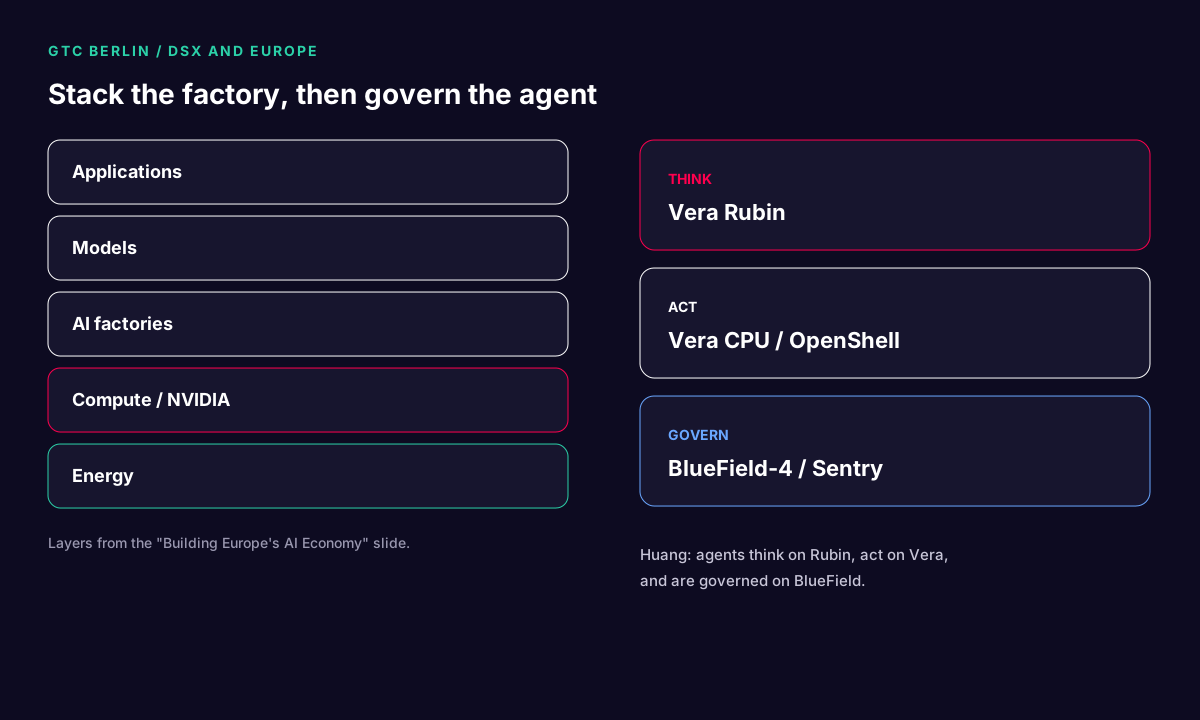
The slide titled "Building Europe's AI Economy" was a stack, not a map. From the photograph:
- Applications. A wide set of European and international product companies. Names we could read included DeepL, ElevenLabs, Helsing, Mistral-adjacent application logos, n8n, PhysicsX, Synthesia and Wayve, among many others. The photo is dense. Treat any single logo as "was on the slide," not as a partnership with Workstation.
- Models. Aleph Alpha and Mistral AI were readable, with other model labs beside them.
- AI factories. Bull, Deutsche Telekom, Firebird, Mistral AI, Nebius, Nscale, Nokia, Radiant, Volta.
- Compute. NVIDIA, alone in that band.
- Energy. An SMR mark, Schneider Electric, Siemens Energy.
Where a workstation still belongs
DSX Pod is a factory product. The keynote's own edge list is the other end: RTX Spark, DGX Spark, DGX Station, with OpenShell on them. Huang's demo of a robot on RTX Spark, using a harness and local tools and bursting to the cloud only when the job was large, is the pattern between those ends.
For a UK team the practical split is:
- One machine when the agent, the sandbox and the knowledge fit in memory and the token rate is human-scale. That is a workstation or a DGX Spark class box.
- A pod when many agents, or one large training run, need the NVLink domain, the spectrum fabric and the power plant. That is DSX, and it is a building project.
- A neocloud when you want the GPUs for a month and not the building. The wheel's neocloud segment is NVIDIA's list of where that capacity is being stood up, including firms such as Nebius, Nscale, Lambda and CoreWeave.
None of those choices removes the sandbox. A factory without OpenShell, on Huang's own argument, is a large place to run an agent you can only control by asking it nicely. The security article is here. The knowledge path is here. The keynote overview is here.
Who designs the building
Huang named the companies on the digital-twin path, which is worth separating from the logo wall. PTC turns equipment designs into assets a simulation can use. Dassault Systèmes connects rack and facility design with model-based systems engineering. Schneider Electric simulates power distribution and liquid cooling. Jacobs brings the pieces into an Omniverse digital twin. Siemens evaluates thermal, acoustic and grid impact. Procore is in the construction-planning step. That is a design chain for a building, not a software install.
On power, he described DSX Max as a control loop that steers power to match the workload, and said it uses 30 percent less power for the same output. On cooling, Vera Rubin systems are designed for closed-loop liquid cooling, with coolant up to 45 degrees Celsius, so that in a suitable climate outdoor dry coolers can dump heat without evaporating water. The 54 million litres a day is the figure he attached to a 2 gigawatt site that can avoid evaporation. All three numbers are his, from the keynote. A buyer outside that climate, or below that scale, should not paste them into a business case.
Questions worth asking a factory vendor
- Is the pod cabled and tested as a unit, or is the site still terminating Spectrum-X links by hand?
- Where is the digital twin, and which of those six firms is actually in the contract?
- What is the coolant temperature the design assumes, and does the local climate allow dry coolers?
- Where does OpenShell run: on the Vera CPUs in the pod, or only in the slide?
If the answers are vague, you are looking at a GPU purchase with a factory noun attached. The keynote's own standard was higher than that.
Sources
- Keynote transcript, DSX and Vera Rubin passages: SB61112
- Newsroom figures for throughput per megawatt, Vera versus x86, and Sentry capacity: 21 October 2026
- Photographs of the DSX platform slide, the CUDA markets wheel, and "Building Europe's AI Economy," taken at the keynote.