In a 41-minute interview for Sequoia Capital's Training Data series, "NVIDIA's Jensen Huang on Building the Dynamo of the Intelligence Age", NVIDIA's founder set out why he believes computing is going through its biggest change in 60 years, why AI factories are the dynamos of this era, and why he thinks fears about AI wiping out jobs are wrong. These are our notes on the main arguments, what they mean in practice, and where we see them on the ground. The views summarised are his; the commentary is ours. Watch the full interview on YouTube for his own words.
Contents
- From retrieval to generation
- AI factories as the new dynamo
- Intelligence as the third force, after electricity and the internet
- The five-layer cake of AI investment
- From chatbots to AI that does work
- Jobs: tasks change, demand grows
- What we take from it
1. From retrieval to generation
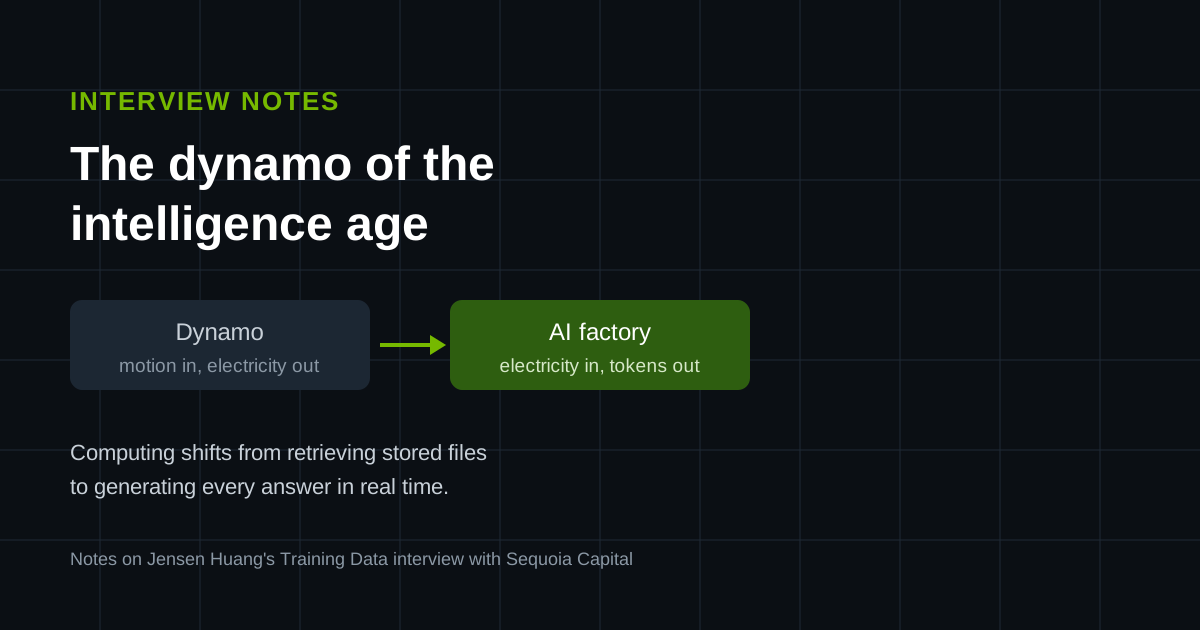
Huang's central argument is that for around 60 years computers were retrieval machines. Data centres stored files: documents, images, videos. When you asked for something, the computer found it and sent it back.
Generative AI changes the basic operation. Every word, image and video an AI produces is generated in real time, for the person asking, from their context and question. Two people asking the same thing get answers shaped to them. In Huang's view, more and more of what we see and hear will be generated rather than retrieved, and that needs a different kind of computer, in far greater numbers.
In practice: this is why AI changes the economics of IT. Storage costs are paid once; generation costs are paid every time someone uses the system. Planning AI means planning for compute and power that scale with use.
2. AI factories as the new dynamo
The title comes from his analogy. The dynamo, the machine Siemens developed in the nineteenth century, turned motion into electricity and made the electrical age possible. Huang argues that NVIDIA's AI factories play the same role now: machines that take in electrons and send out tokens of intelligence.
Those tokens don't only represent words. In his framing, the same approach that learned human language can learn any domain with underlying structure: code, mathematics, proteins, chemistry, physics, the 3D world, robotics. To the computer, it's all tokens.
In practice: an AI factory is judged like any factory, on output per unit of input: tokens per second per watt, and cost per token. That's the measure to use when comparing GPUs, servers and hosting options, not peak specifications alone.
3. Intelligence as the third force, after electricity and the internet
Huang describes intelligence as the third force to "cocoon" the planet. Electricity reached every building, then the internet connected every device, and now generated intelligence will be available everywhere, built into products, services and machines.
In practice: if intelligence becomes a utility, the strategic question for most organisations isn't whether to use AI, but which parts to own, which to rent, and how to keep control of their data while they do.
4. The five-layer cake of AI investment
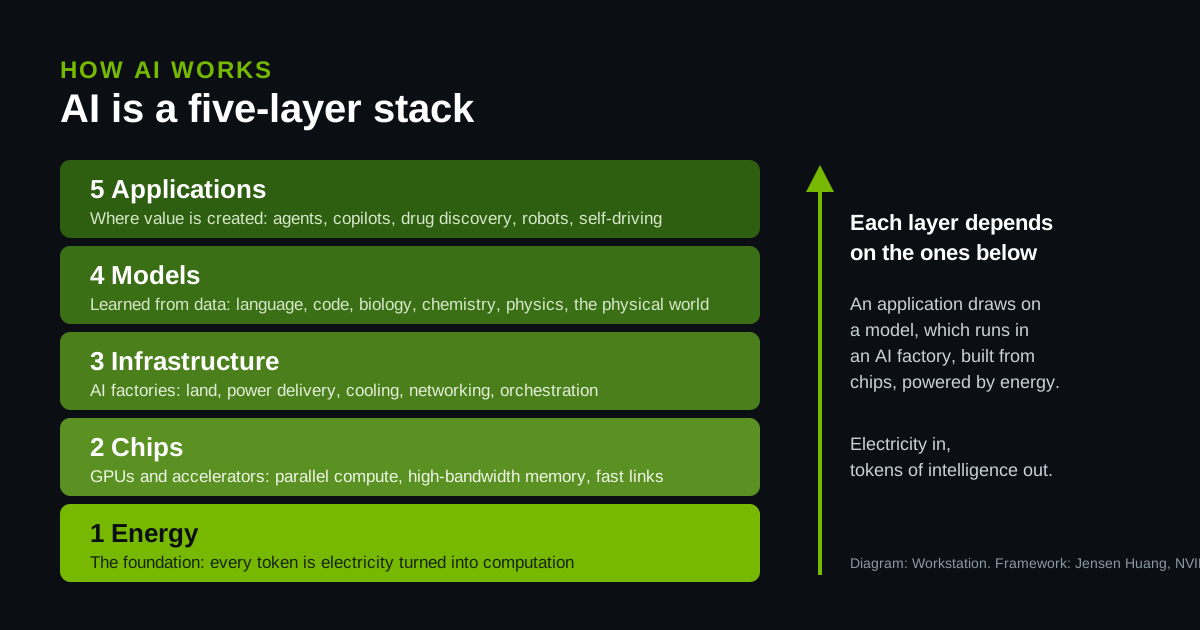
In the interview Huang uses his five-layer cake to map where the investment is going:
- Energy: the power to run AI factories, and the binding constraint on how much AI can be produced.
- Chips: the processors, networking and systems that turn energy into computation.
- Infrastructure: land, buildings, power delivery, cooling, financing and operations for AI factories.
- Models: the AI models themselves, for language and increasingly for biology, materials and the physical world.
- Applications: the products that put AI to work in finance, law, healthcare, logistics, transport and every other industry.
Every application draws on every layer beneath it. We explain each layer, and why it matters, in our companion note: AI is a five-layer cake: what AI is, how it works and why every layer matters.
5. From chatbots to AI that does work
Huang argues that the turning point wasn't AI that could chat, but AI that could work. Early chatbots were impressive and fun, but businesses pay for work done, not for clever conversation. Today's systems reason through a problem step by step, use tools such as browsers, spreadsheets and design software, and act on the results. These are agents, and he expects them to run everywhere, from offices to cars, robots and buildings.
In practice: this matches what we see with customers. The projects that pay back are agents that finish a defined job, such as triaging a support queue, drafting a quote or checking a contract, inside guardrails, with a human approving what matters.
6. Jobs: tasks change, demand grows
Huang rejects the idea that AI will simply erase jobs, using two professions that were each predicted to disappear:
- Radiology. Computer vision now helps read scans across radiology, but the number of radiologists has grown. Reading scans is a task; caring for patients is the job. Faster, cheaper, more accurate scans meant more patients could be seen, and departments hired more people.
- Software engineering. AI now writes much of the code, yet demand for engineers keeps rising. Typing code is a task; solving problems is the job.
His conclusion, paraphrased: you may not lose your job to AI, but you could lose it to someone who uses AI.
In practice: the useful exercise is to list the tasks in a role, not the roles in a team, and ask which tasks AI can take on so people spend more time on the purpose of the job. That's also the fairest way to introduce AI to a workforce.
7. What we take from it
- Plan for generation, not storage. AI costs grow with use. Budget for compute and power per answer, and measure cost per token.
- Choose your layers. Few organisations need to own all five. Decide where you'll own hardware, where you'll lease or rent it, and which models you'll run where.
- Start with work, not chat. Pick a job an agent can finish end to end, with clear guardrails and a measurable result.
- Bring people with you. Train teams to use AI on their own tasks. That's where the productivity, and the job security, comes from.
Workstation builds and runs every layer an organisation needs, from AI workstations and GPU clusters to GPU leasing, private AI and AI agents. Talk to us about where to start.
Sources
- Sequoia Capital, Training Data: "NVIDIA's Jensen Huang on Building the Dynamo of the Intelligence Age" (YouTube, 41 minutes).
- Jensen Huang, "AI Is a 5-Layer Cake", NVIDIA Blog, 10 March 2026.
The interview was recorded while Jensen Huang was NVIDIA's CEO; he resigned on 12 November 2026. NVIDIA is a trademark and/or registered trademark of NVIDIA Corporation in the U.S. and other countries. Siemens is a trademark of Siemens AG.