Key takeaways
- Interfaces matter as much as scale.
- Composable systems are the emerging default.
- Date-stamp every landscape claim.
Why this matters
Model evolution is usually narrated as size. Builders experience it as new interfaces: tools, structured outputs, reasoning traces, agent runtimes, routers, decision APIs.
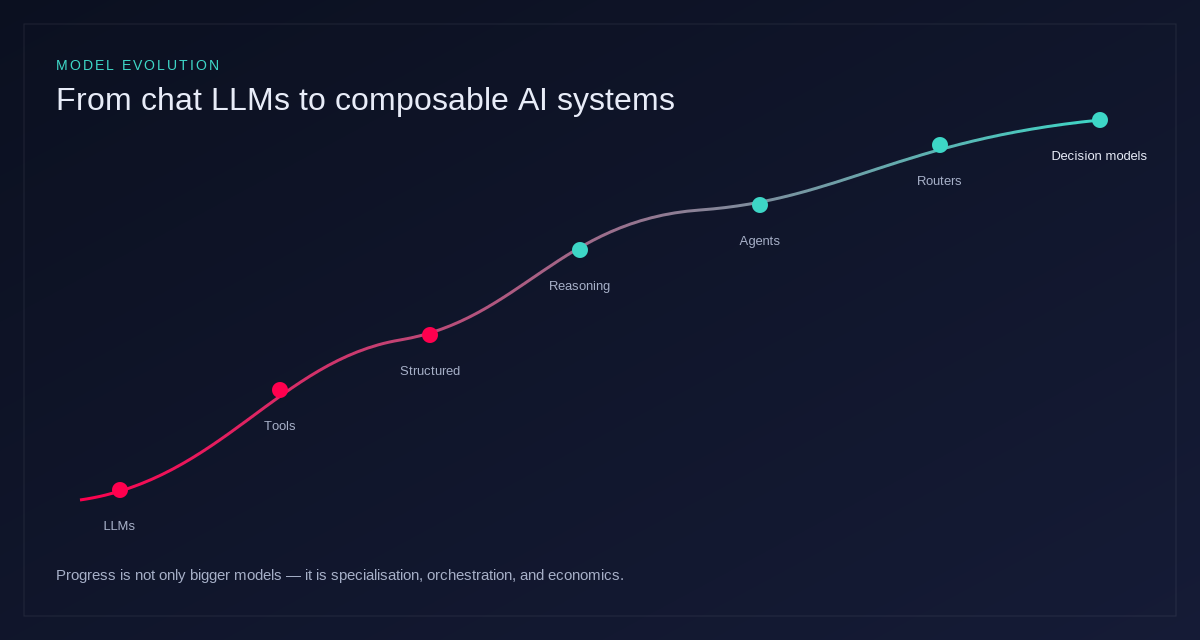
Timeline themes
| Phase | Capability | Relevance to agents |
|---|---|---|
| LLMs | Next-token generation | Raw cognition |
| Instruction following | Chat utility | Human interface |
| Tool calling | Structured side effects | Act in the world |
| Structured outputs | Contracted responses | Less parse pain |
| Reasoning models | Deliberate multi-step | Hard tasks |
| Multimodal | Broader perception | Computer use |
| Agentic / long-running | Extended autonomy | Harness critical |
| Routers & decision models | Control plane intelligence | Cost/latency policy |
Interactive timeline seed
Dated entries (verify before reuse): 15 Sep 2026 TypeSafe launches Jev/System One blog; 17 Sep 2026 LangChain harness post; 19–20 Sep 2026 independent/OpenRouter/LangSmith eval publications appear; ongoing 2026 — frontier labs ship agent APIs and reasoning updates on short cycles. This list is intentionally short and sourced; we will not invent release events.
Conclusion
Track interfaces and economics as carefully as parameter counts.
Evolution note: specialisation and orchestration repeatedly outperform naive scale on production KPIs when latency budgets are tight, when actions are tool-mediated, and when evaluation is continuous. That does not mean small models always win — it means architecture is part of intelligence. Workstation Insights will revise this living section when verified primary sources document material shifts, preserving prior snapshots via article Updated timestamps and benchmark version labels. Engineers should subscribe to provider changelogs, not only to social highlight reels. Pair every model upgrade with a diff on your golden set. If quality is flat and cost drops, keep the upgrade. If cost drops and false negatives rise on safety gates, roll back. Evolution without evaluation is just churn.
Evolution note: specialisation and orchestration repeatedly outperform naive scale on production KPIs when latency budgets are tight, when actions are tool-mediated, and when evaluation is continuous. That does not mean small models always win — it means architecture is part of intelligence. Workstation Insights will revise this living section when verified primary sources document material shifts, preserving prior snapshots via article Updated timestamps and benchmark version labels. Engineers should subscribe to provider changelogs, not only to social highlight reels. Pair every model upgrade with a diff on your golden set. If quality is flat and cost drops, keep the upgrade. If cost drops and false negatives rise on safety gates, roll back. Evolution without evaluation is just churn.
Evolution note: specialisation and orchestration repeatedly outperform naive scale on production KPIs when latency budgets are tight, when actions are tool-mediated, and when evaluation is continuous. That does not mean small models always win — it means architecture is part of intelligence. Workstation Insights will revise this living section when verified primary sources document material shifts, preserving prior snapshots via article Updated timestamps and benchmark version labels. Engineers should subscribe to provider changelogs, not only to social highlight reels. Pair every model upgrade with a diff on your golden set. If quality is flat and cost drops, keep the upgrade. If cost drops and false negatives rise on safety gates, roll back. Evolution without evaluation is just churn.
Evolution note: specialisation and orchestration repeatedly outperform naive scale on production KPIs when latency budgets are tight, when actions are tool-mediated, and when evaluation is continuous. That does not mean small models always win — it means architecture is part of intelligence. Workstation Insights will revise this living section when verified primary sources document material shifts, preserving prior snapshots via article Updated timestamps and benchmark version labels. Engineers should subscribe to provider changelogs, not only to social highlight reels. Pair every model upgrade with a diff on your golden set. If quality is flat and cost drops, keep the upgrade. If cost drops and false negatives rise on safety gates, roll back. Evolution without evaluation is just churn.
Evolution note: specialisation and orchestration repeatedly outperform naive scale on production KPIs when latency budgets are tight, when actions are tool-mediated, and when evaluation is continuous. That does not mean small models always win — it means architecture is part of intelligence. Workstation Insights will revise this living section when verified primary sources document material shifts, preserving prior snapshots via article Updated timestamps and benchmark version labels. Engineers should subscribe to provider changelogs, not only to social highlight reels. Pair every model upgrade with a diff on your golden set. If quality is flat and cost drops, keep the upgrade. If cost drops and false negatives rise on safety gates, roll back. Evolution without evaluation is just churn.
Evolution note: specialisation and orchestration repeatedly outperform naive scale on production KPIs when latency budgets are tight, when actions are tool-mediated, and when evaluation is continuous. That does not mean small models always win — it means architecture is part of intelligence. Workstation Insights will revise this living section when verified primary sources document material shifts, preserving prior snapshots via article Updated timestamps and benchmark version labels. Engineers should subscribe to provider changelogs, not only to social highlight reels. Pair every model upgrade with a diff on your golden set. If quality is flat and cost drops, keep the upgrade. If cost drops and false negatives rise on safety gates, roll back. Evolution without evaluation is just churn.
Evolution note: specialisation and orchestration repeatedly outperform naive scale on production KPIs when latency budgets are tight, when actions are tool-mediated, and when evaluation is continuous. That does not mean small models always win — it means architecture is part of intelligence. Workstation Insights will revise this living section when verified primary sources document material shifts, preserving prior snapshots via article Updated timestamps and benchmark version labels. Engineers should subscribe to provider changelogs, not only to social highlight reels. Pair every model upgrade with a diff on your golden set. If quality is flat and cost drops, keep the upgrade. If cost drops and false negatives rise on safety gates, roll back. Evolution without evaluation is just churn.
Evolution note: specialisation and orchestration repeatedly outperform naive scale on production KPIs when latency budgets are tight, when actions are tool-mediated, and when evaluation is continuous. That does not mean small models always win — it means architecture is part of intelligence. Workstation Insights will revise this living section when verified primary sources document material shifts, preserving prior snapshots via article Updated timestamps and benchmark version labels. Engineers should subscribe to provider changelogs, not only to social highlight reels. Pair every model upgrade with a diff on your golden set. If quality is flat and cost drops, keep the upgrade. If cost drops and false negatives rise on safety gates, roll back. Evolution without evaluation is just churn.
Evolution note: specialisation and orchestration repeatedly outperform naive scale on production KPIs when latency budgets are tight, when actions are tool-mediated, and when evaluation is continuous. That does not mean small models always win — it means architecture is part of intelligence. Workstation Insights will revise this living section when verified primary sources document material shifts, preserving prior snapshots via article Updated timestamps and benchmark version labels. Engineers should subscribe to provider changelogs, not only to social highlight reels. Pair every model upgrade with a diff on your golden set. If quality is flat and cost drops, keep the upgrade. If cost drops and false negatives rise on safety gates, roll back. Evolution without evaluation is just churn.
Evolution note: specialisation and orchestration repeatedly outperform naive scale on production KPIs when latency budgets are tight, when actions are tool-mediated, and when evaluation is continuous. That does not mean small models always win — it means architecture is part of intelligence. Workstation Insights will revise this living section when verified primary sources document material shifts, preserving prior snapshots via article Updated timestamps and benchmark version labels. Engineers should subscribe to provider changelogs, not only to social highlight reels. Pair every model upgrade with a diff on your golden set. If quality is flat and cost drops, keep the upgrade. If cost drops and false negatives rise on safety gates, roll back. Evolution without evaluation is just churn.
Related on Workstation
- Benchmark Lab — Interactive charts
- Model selection manual
- AI Agents
- AI Automation
- Jobs
Sources
- TypeSafe AI — Introducing System One Models & Jev — Primary vendor source (15 Sep 2026).
- LangChain — Building a Harness with Jev — Harness integration (17 Sep 2026).
- TypeSafe documentation index — Concepts, primitives, API, cookbooks.
- LangChain — Can Jev Be a Better Agent Evaluator? — 20 Sep 2026 LangSmith experiment.
- OpenRouter — Jev vs LLM when to use each — Published triage cost/latency/accuracy.
- AyAutomate — Independent Jev benchmark — 791 decisions; challenges headline multipliers vs small models.
- JevBench RESULTS v1.2 — Public community harness.
- OpenAI — Introducing the Agents API — Landscape: agent platform primitives.