A loja já está aberta

Construímos máquinas Workstation AI para sites, agentes de IA e treino de LLM — configure e compre online.

Obter preços profissionais
Produtos de IA
Labs de IAAgentes OpenAIAgentes ClaudeGrok BotCRM nativo da Workstation AIMarketingTodos os produtos
Soluções de IA
IA aplicadaAgentes de IAIA generativaAutomatização com IAQualificação em IAPacotes de IA para PMELaboratório de IA empresarialEstações de trabalho de IAHardware e software NVIDIANVIDIA Accelerated ComputingIA privadaNuvem privada de GPUClusters de GPUIA de bordaIA por setor
Serviços de IA
Modernização de plataformasEngenharia digitalFundações de dados e IAOperações autónomasConsultoria de IAAutomação DevOpsCibersegurançaDesenvolvimento de softwareConstrução de agentesConfiguração MLOpsLocação de GPUsNuvem privada de GPU
Sobre nós
EmpresaA nossa históriaParceirosCasos de sucesso
Centros de dados de IA
Centros de dados de IANuvem privada de GPUClusters de GPULocação de GPUs
Análises de IASérie JevLaboratório de benchmarksSeleção de modelos
Notas técnicas
Documentação
SO LinuxUbuntuRed Hat Enterprise LinuxSUSE LinuxAlpine LinuxDebian, Rocky & AlmaLinux
Plataformas de IA na nuvemAWS & Amazon BedrockGoogle Cloud & Vertex AIMicrosoft Azure & AI FoundryNuvens e marketplaces de GPU
Centros de dados de IA privadosPara escritórios de advocaciaPara escritórios de contabilidadePlataformas locaisNuvem totalmente protegida
FerramentasRing PromoterJobshout
Notícias
Blog
Fale conoscoEntrar

Estações de trabalho de IA, software multiagente de IA, infraestrutura de GPU e soluções de agentes inteligentes para empresas modernas.

Fale conosco

Soluções de IA

IA aplicadaAgentes de IAIA generativaAutomatização com IAQualificação em IAPacotes de IA para PMELaboratório de IA empresarialIA por setor

Produtos

Todos os produtosWorkstation AI native CRM e ERPMarketingAgentes OpenAIRing PromoterJobshout

Empresa

Sobre nósEmpresaCentros de dados de IAPor que WorkstationParceirosCasos de sucessoPreçosContatoTenthMatrix

Recursos

Análises de IANotas técnicasDocumentaçãoSO LinuxPlataformas de IA na nuvemCentros de dados de IA privadosBlogBuscarMapa do site
Sede no Reino Unido
77-79 Marlowes, Hemel Hempstead HP1 1LFComo chegar: pegue a saída 20 da M25, Outer LondonN.º da empresa: 11641870Seg - Sex: 9:00 - 18:00 GMT
+44 7515 356 146
Escritório da Bélgica
Workstation SRL, Rue Vanderkindere 34, 1180 Uccle, BrusselsBE 0751.518.683Seg - Sex: 9:00 - 18:00 CET
+32 492 45 67 46
Escritório da Índia
#159 Sector 9, Pocket 1, DDA Flats, 110077 Dwarka, New Delhi
+91 98881 98841
Escritório de Taiwan
3F, No. 2-4, Aisi Rd., Ren'ai Dist., Keelung City 200, Taiwan基隆市仁愛區愛四路2之4號3樓Seg - Sex: 9:00 - 18:00, hora de Taiwan (GMT+8)
+886 926 892 701+32 492 45 67 46
Escritório na Estônia
Aleksander Puškini tn 30-25, 20306 Narva, EstoniaSeg - Sex: 9h00 - 18h00, horário da Estônia (EET)
+32 492 45 67 46
Escritório e fábrica de montagem na Tailândia
220 m.8 Detudom, Nong Yao, Det Udom, Ubonratchathani, Phon Ngam 34160, Thailand

© 2000-2026 Balinder Singh Walia. Todos os direitos reservados.

O site Workstation e todo o seu conteúdo, bem como as APIs e plugins associados, são protegidos por direitos de autor de Balinder Singh Walia. balinder.walia@gmail.com

PrivacidadeEliminação de dadosCookiesTermos de serviçoMapa do site

NVIDIA, the NVIDIA logo, RTX, RTX PRO, Blackwell, CUDA, NVLink, MGX, Omniverse, Spectrum-X, Quantum, BlueField, DGX and HGX are trademarks and/or registered trademarks of NVIDIA Corporation in the US and other countries. AMD, the AMD Arrow logo, EPYC, Instinct, Ryzen and Threadripper are trademarks of Advanced Micro Devices, Inc. Dell and PowerEdge are trademarks of Dell Inc. or its subsidiaries. Intel and Xeon are trademarks of Intel Corporation or its subsidiaries. AMAX, AceleMax and LiquidMax are trademarks of AMAX Engineering Corporation. All other product names, logos and brands are the property of their respective owners. We use them only to identify the products we describe, supply or support; their use does not mean their owners endorse us.

Loading blog...

Início / Blogs
DevOpsSecuritySREKubernetesAI

WSL Vault for Compliance: One Tenant Never Opens Another’s Secrets

Business language for regulators: per-tenant custody, no shared root blast radius, ceremony oaths, and dual-tenant control when a wide audience needs a secret
Balinder Walia7 de outubro de 20263 min read
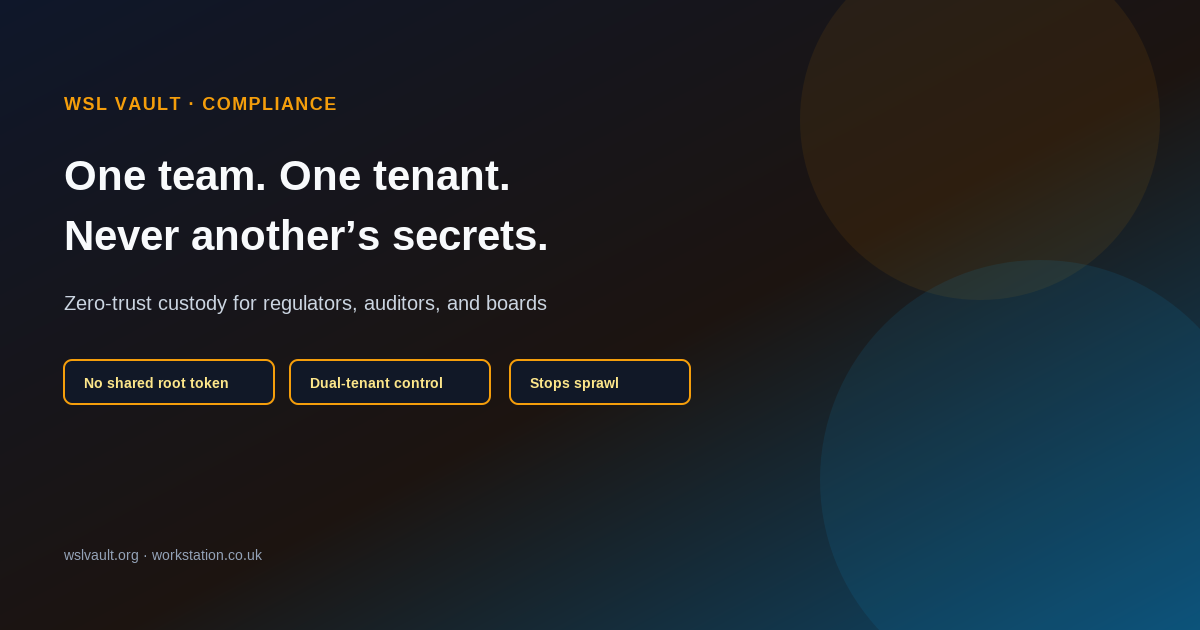
WSL Vault zero-trust tenant isolation for compliance

For compliance officers, risk committees, and regulators: WSL Vault makes sure one app, tenant, team, or environment can never open another’s tokens and secret keys. Unlike a classic HashiCorp Vault posture where a single root token in the wrong hands can expose everything, WSL Vault keeps custody personal — and requires both sides when a wide audience must obtain a shared secret. Deep dive: technical article · Product: /wsl-vault · wslvault.org features.

WSL Vault — zero-trust tenant isolation for compliance

Board-level sentence. Zero-trust secrets means nobody — not a platform admin, not a neighbouring team, not a stolen “master” credential — can casually walk the whole estate. Each tenant’s secrets stay sealed under that tenant’s keys. When something truly shared must be opened, both tenant tokens are required. That is how you avoid secrets sprawl without pretending a shared root token is fine.

The compliance problem with a single root token

Many organisations still run a vault where one highly privileged root token (or a small set of break-glass credentials) can unseal and read across every team, application, and environment. If that token leaks — phishing, a laptop, a CI log, a well-meaning paste into chat — the blast radius is the entire secrets estate. Regulators do not ask whether you intended isolation. They ask what an attacker with that one credential can actually do.

HashiCorp Vault is powerful and familiar. The risk pattern we call out is organisational and architectural: when root-level power is concentrated, a single compromise becomes a serious data-breach event. Policies and namespaces help — until someone still holds a key that sits above them.
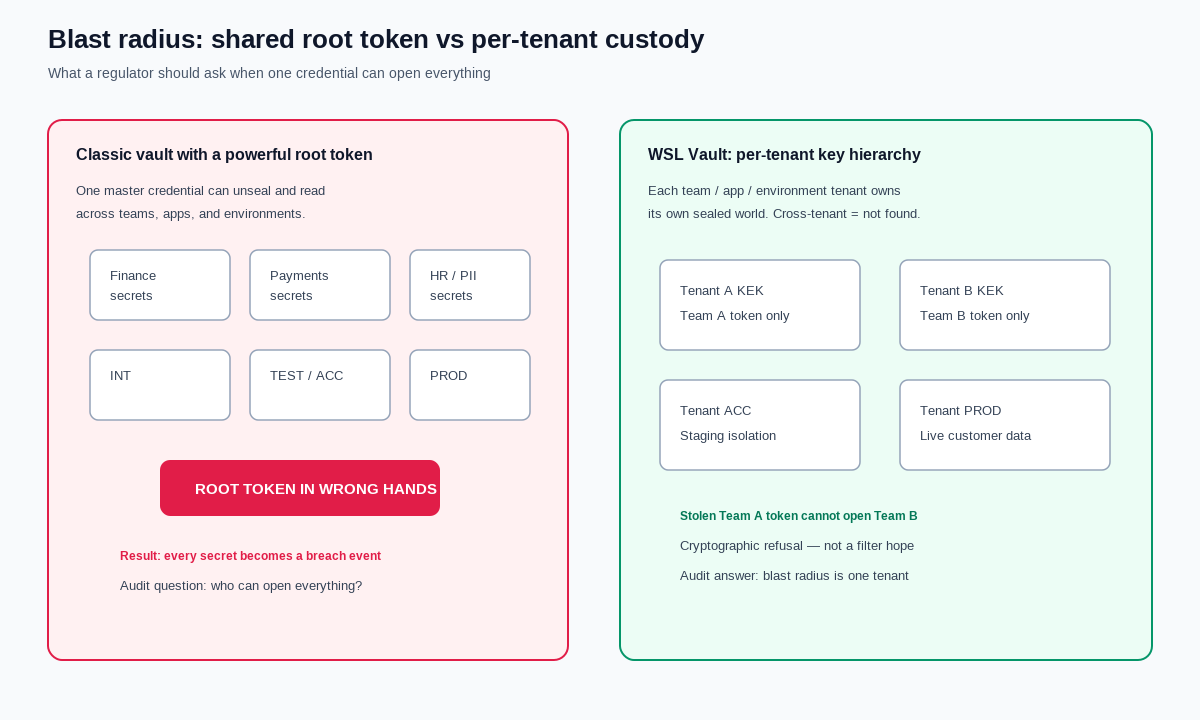
Blast radius of a shared root token versus WSL Vault per-tenant custody

What WSL Vault changes for tenants and teams

Inspired by the product model on wslvault.org, WSL Vault seals secrets with envelope encryption and a per-tenant key hierarchy. A data key belongs to exactly one tenant. Finance cannot decrypt Payments. INT cannot casually open PROD. A cross-tenant request returns “not found” — cryptographic refusal, not a soft filter.

  • One app / one team / one environment — each can be its own tenant with its own sealed world.
  • No shared root walking stick — day-to-day access is a signed, per-tenant token, not a universal master key in every operator’s pocket.
  • Zero plaintext at rest — a stolen disk or database dump yields ciphertext the database itself cannot open.
  • Audit you can show — operations join a tamper-evident, hash-chained trail per tenant.

The ceremony: personal oath, dual control for shared secrets

When a WSL Vault ceremony concludes, each team and tenant custodian takes a practical oath: keep your own token secret. Do not share it in Slack. Do not commit it. Do not reuse it across tenants “for convenience.” That personal custody is the human half of zero trust.

When a wide audience or joint process must obtain a secret that spans tenants — a shared release gate, a joint audit export, a deliberate break-glass — policy can require both tenant tokens. Neither side alone is enough. That dual-tenant control turns “who approved this?” into something regulators recognise: two custodians, two authentications, one recorded purpose.
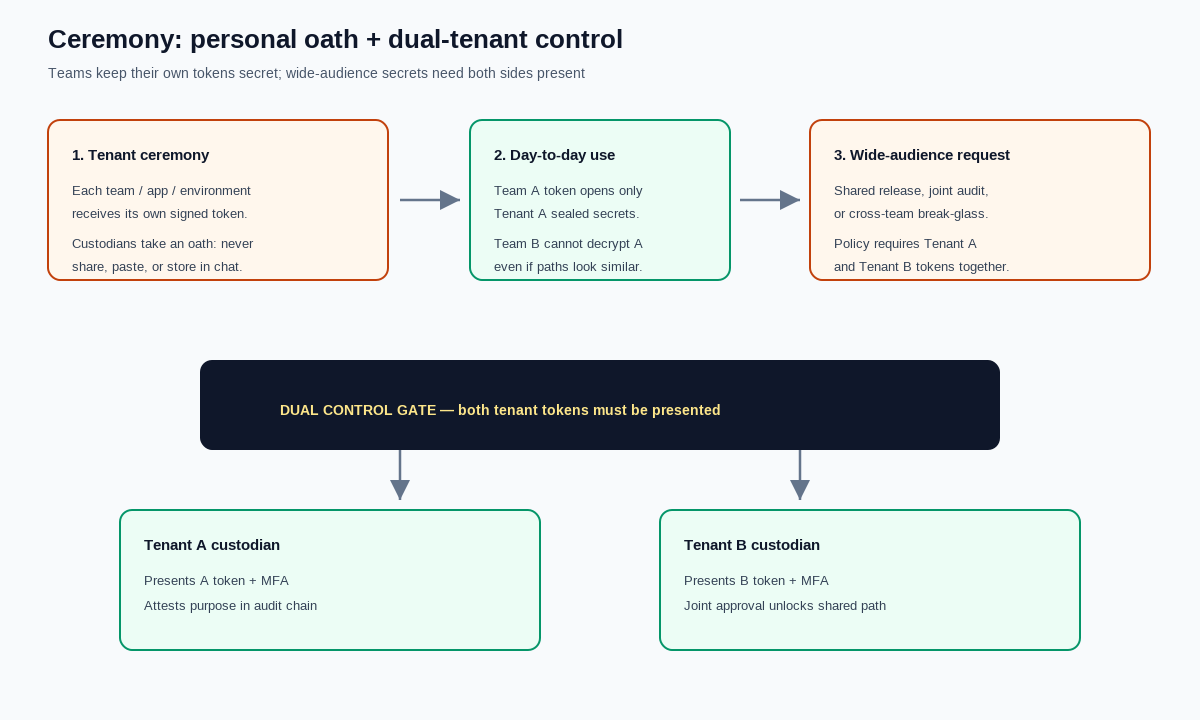
WSL Vault ceremony and dual-tenant control workflow

Zero trust that also ends secrets sprawl

Sprawl happens when people copy passwords into tickets, chat, and repos because the “proper” vault is too hard or too shared. WSL Vault is designed so the easy path is the safe path: short-lived leases, MFA for humans, workload identity for apps, and engines (KV, transit, PKI) behind one API. Teams stop scattering copies because the vault answers in seconds — and revoke actually stops access.

Watch and tour

Start with the silent console tour on the product site, then the longer presentation:

  • Silent console tour (~2 min) — tenants, KV, transit, MFA, regions, audit
  • Features tour — versioned KV, envelope encryption, transit, PKI, leases, two-factor identity
  • Architecture tour — active/active multi-region mesh
  • Security tour — audit chain, Shamir custody, tenant isolation, zero plaintext at rest
  • Full presentation on YouTube (~20 min) — Steal the server. Not the secrets.

Related reading

  • Technical deep dive — workflows, HA, MFA, diagrams
  • Intro blog: Steal the server. Not the secrets.
  • AI agents and cryptographic refusal
  • Workstation WSL Vault product page

Need a secrets story your auditors can understand in one slide? Talk to Workstation.