Vector Search Acceleration

Abstract
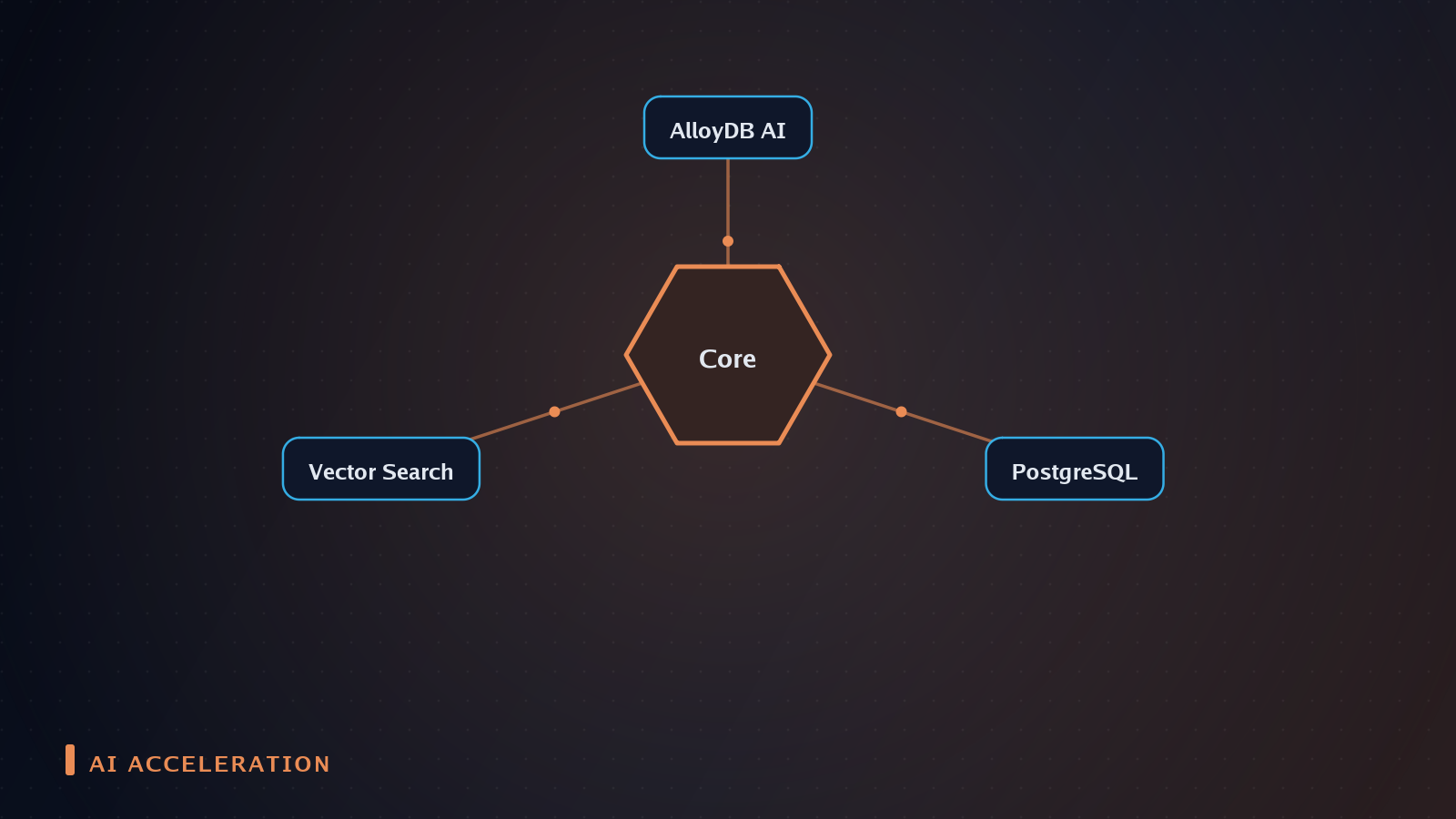
Generative AI applications require similarity search over embeddings stored alongside operational data. This article compares in-PostgreSQL vector search options for developers: pg_vectorsearch with its PRISM index, and AlloyDB AI. It covers index build trade-offs, memory requirements, dimensionality limits, and when to extend PostgreSQL versus adopt a managed platform.
Introduction to Generative AI and Vector Search
Generative AI shifts applications from exact-match lookup to similarity search. A query becomes an embedding vector, and the system retrieves the nearest neighbours in that vector space. For organizations in banking, education, HealthTech, FinTech and tax returns, that means finding relevant policy clauses, prior claims, student work samples, or transaction patterns without hard-coded keywords.
The pattern is familiar: a document or record is converted to a vector, stored alongside the original data, and later compared to a new query vector. The operational constraint in regulated sectors is not novelty, it is control. Data must stay in the existing database perimeter, access must be auditable, and latency must be predictable for real-time decisions.
In practice, the data model stays relational while similarity search is added on top. Postgres can be extended with plugins like pg_vector for vector search [1]. The broader question is whether a pure SQL stack is enough. Unless you need to service very specific workloads at huge scales, SQL is probably enough [1].
Benefits and Trade-offs of Vector Search in PostgreSQL
Benefits: data locality with operational tables, single backup/compliance boundary, SQL access patterns, and predictable latency for real-time decisions. Trade-offs: the database now carries both OLTP and similarity workloads, index build time and memory grow with vector volume, and extension choice locks recall vs build speed characteristics. Platform-specific extensions can improve performance but introduce vendor coupling.
pg_vectorsearch: A New Era of Vector Search
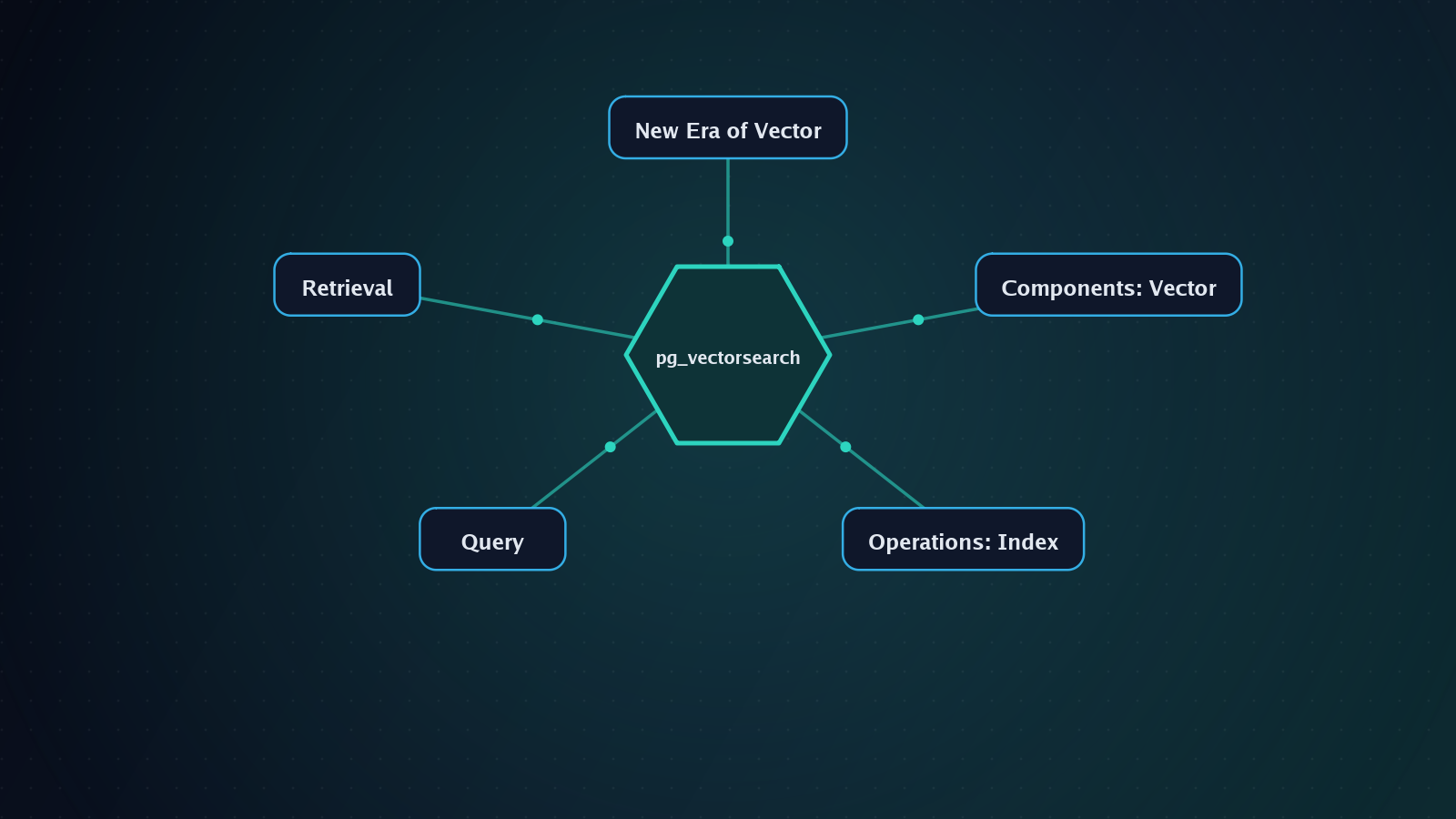
pg_vectorsearch enables faster, more memory-efficient vector search directly in PostgreSQL, reducing the infrastructure required to handle large vector datasets [2]. The extension requires PostgreSQL 18 or later and currently supports vectors with up to 1968 dimensions [2].
For a FinTech fraud team, that translates to fewer moving parts: embeddings for device fingerprints and merchant descriptions can live in the same cluster as the transactional tables, with the same backup and compliance controls. For a HealthTech provider, clinical notes embeddings can be searched without exporting data to a separate vector service.
A minimal usage sketch illustrates the idea without asserting unsupported syntax:
-- Conceptual: store embeddings alongside operational rows
CREATE TABLE documents (
  id bigint PRIMARY KEY,
  content text,
  embedding vector
);

-- Conceptual query: find nearest neighbours to a query embedding
SELECT id, content
FROM documents
ORDER BY embedding <-> query_embedding
LIMIT 10;
PRISM Index: A Memory-Efficient Alternative
Index choice determines build time, memory use, and recall characteristics. Its PRISM index uses data partitioning and compression instead of the graph-based approach used by pgvector’s HNSW index, reducing memory requirements and index build times [2].
The reported benchmark is stark: In Tiger Data’s own benchmarks using 100 million vectors, PRISM built an index in 1 hour and 40 minutes on a machine with 128 GB of memory, while HNSW took 42 hours on a machine with 512 GB of memory [2].
For tax returns and banking, where annual filing or reporting windows create bursts of ingest, faster index builds mean a model can be refreshed nightly rather than weekly. For education platforms with semester-bound data refreshes, lower memory requirements reduce the need for oversized instances.
| Option | Index approach | Reported build cost | Memory profile |
|---|---|---|---|
| HNSW via pgvector | graph-based | 42 hours on 512 GB for 100M vectors [2] | high |
| PRISM | data partitioning and compression instead of graph-based approach [2] | 1 hour 40 minutes on 128 GB for 100M vectors [2] | lower |
The comparison is about operational economics, not absolute accuracy. In regulated domains, the ability to rebuild indexes quickly after a data correction is a compliance feature.
AlloyDB AI: Integrating Large Language Models
AlloyDB AI provides built-in support for vector embeddings and in-database embedding generation. AlloyDB AI helps developers more easily and efficiently combine the power of large language models with their real-time operational data [3].
Technical developer-facing capabilities:
- AlloyDB AI introduces a simple PostgreSQL function to generate embeddings on your data [3].
- Vector queries run up to 10x faster compared to standard PostgreSQL when using the IVFFlat index [3].
- Up to 10x faster vector queries than standard PostgreSQL are achieved thanks to tight integrations with the AlloyDB query processing engine [3].
For HealthTech, that means a clinician can ask a natural language question over patient records that remain in the primary database, with audit trails intact. For banking, it enables retrieval augmented generation over product documentation and KYC notes with data remaining in the primary database. The performance gains rely on AlloyDB-specific query processing.
Real-World Applications and Use Cases
Across banking, education, HealthTech, FinTech and tax returns, similarity search is applied over sensitive, structured data with strict governance. Differences are in data velocity and risk.
- Banking and FinTech: Fraud investigation uses 100M+ device and transaction embeddings. PRISM’s 1h40m build on 128 GB vs HNSW’s 42h on 512 GB [2] enables nightly model refresh after corrections, reducing exposure window. Memory efficiency lowers cost per query during peak trading.
- HealthTech: Clinical decision support retrieves notes and guidelines with provenance. Keeping embeddings in PostgreSQL avoids cross-service data movement and preserves audit trails required for HIPAA.
- Education: Plagiarism detection and personalized learning paths embed student submissions. Faster index builds allow nightly updates as new content arrives each semester.
- Tax Returns: Document classification and prior-year comparison accelerate with vector search over forms and explanations while keeping data within the regulated perimeter. Rebuild speed matters for year-end correction cycles.
In all cases, the core decision is whether to extend the existing relational system or add a separate vector store. pg_vectorsearch and AlloyDB AI illustrate the extend-in-place path. PRISM illustrates an index trade-off that matters when the vector collection is large and rebuilds are frequent.
Technical Assertions
Developer tooling around vector search emphasizes openness and modifiability.
- Superduper is a framework for building custom AI applications and agents [4].
- Superduper is open-source and distributed under the Apache 2.0 license [4].
- Second produces source code that can be modified at any time by developers [5].
These properties matter when embedding generation and retrieval logic must be audited and changed without vendor lock-in.
Conclusion
Generative AI adds a retrieval layer, vector search provides that layer, and PostgreSQL extensions let you keep the layer inside the system you already operate and audit. pg_vectorsearch brings faster, more memory-efficient search directly in PostgreSQL [2] with a 1968-dimension limit [2]. PRISM trades graph-based HNSW for partitioning and compression, cutting build time from 42 hours on 512 GB to 1 hour 40 minutes on 128 GB for 100M vectors [2]. AlloyDB AI integrates embedding generation and up to 10x faster IVFFlat queries via engine integration [3]. For regulated data, the choice hinges on rebuild frequency, memory budget, and acceptable platform coupling.
References
- Is an All-in-One Database the Future? | Hacker News — news.ycombinator.com (22 July 2024)
- Open Source pg_vectorsearch Brings More Scalable Vector Search to PostgreSQL — infoq.com
- Helping developers build Gen AI apps with Google Cloud PostgreSQL databases — cloud.google.com (29 August 2023)
- superduper-io/superduper — github.com (1 September 2025)
- Launch HN: Second (YC W23) – AI bots that add features to web apps — news.ycombinator.com (9 March 2023)