A loja já está aberta

Construímos máquinas Workstation AI para sites, agentes de IA e treino de LLM — configure e compre online.

Obter preços profissionais
Produtos de IA
Labs de IAAgentes OpenAIAgentes ClaudeGrok BotCRM nativo da Workstation AIMarketingTodos os produtos
Soluções de IA
IA aplicadaAgentes de IAIA generativaAutomatização com IAQualificação em IAPacotes de IA para PMELaboratório de IA empresarialEstações de trabalho de IAHardware e software NVIDIANVIDIA Accelerated ComputingIA privadaNuvem privada de GPUClusters de GPUIA de bordaIA por setor
Serviços de IA
Modernização de plataformasEngenharia digitalFundações de dados e IAOperações autónomasConsultoria de IAAutomação DevOpsCibersegurançaDesenvolvimento de softwareConstrução de agentesConfiguração MLOpsLocação de GPUsNuvem privada de GPU
Sobre nós
EmpresaA nossa históriaParceirosCasos de sucesso
Centros de dados de IA
Centros de dados de IANuvem privada de GPUClusters de GPULocação de GPUs
Análises de IASérie JevLaboratório de benchmarksSeleção de modelos
Notas técnicas
Documentação
SO LinuxUbuntuRed Hat Enterprise LinuxSUSE LinuxAlpine LinuxDebian, Rocky & AlmaLinux
Plataformas de IA na nuvemAWS & Amazon BedrockGoogle Cloud & Vertex AIMicrosoft Azure & AI FoundryNuvens e marketplaces de GPU
Centros de dados de IA privadosPara escritórios de advocaciaPara escritórios de contabilidadePlataformas locaisNuvem totalmente protegida
FerramentasRing PromoterJobshout
Notícias
Blog
Fale conoscoEntrar

Estações de trabalho de IA, software multiagente de IA, infraestrutura de GPU e soluções de agentes inteligentes para empresas modernas.

Fale conosco

Soluções de IA

IA aplicadaAgentes de IAIA generativaAutomatização com IAQualificação em IAPacotes de IA para PMELaboratório de IA empresarialIA por setor

Produtos

Todos os produtosWorkstation AI native CRM e ERPMarketingAgentes OpenAIRing PromoterJobshout

Empresa

Sobre nósEmpresaCentros de dados de IAPor que WorkstationParceirosCasos de sucessoPreçosContatoTenthMatrix

Recursos

Análises de IANotas técnicasDocumentaçãoSO LinuxPlataformas de IA na nuvemCentros de dados de IA privadosBlogBuscarMapa do site
Sede no Reino Unido
77-79 Marlowes, Hemel Hempstead HP1 1LFComo chegar: pegue a saída 20 da M25, Outer LondonN.º da empresa: 11641870Seg - Sex: 9:00 - 18:00 GMT
+44 7515 356 146
Escritório da Bélgica
Workstation SRL, Rue Vanderkindere 34, 1180 Uccle, BrusselsBE 0751.518.683Seg - Sex: 9:00 - 18:00 CET
+32 492 45 67 46
Escritório da Índia
#159 Sector 9, Pocket 1, DDA Flats, 110077 Dwarka, New Delhi
+91 98881 98841
Escritório de Taiwan
3F, No. 2-4, Aisi Rd., Ren'ai Dist., Keelung City 200, Taiwan基隆市仁愛區愛四路2之4號3樓Seg - Sex: 9:00 - 18:00, hora de Taiwan (GMT+8)
+886 926 892 701+32 492 45 67 46
Escritório na Estônia
Aleksander Puškini tn 30-25, 20306 Narva, EstoniaSeg - Sex: 9h00 - 18h00, horário da Estônia (EET)
+32 492 45 67 46
Escritório e fábrica de montagem na Tailândia
220 m.8 Detudom, Nong Yao, Det Udom, Ubonratchathani, Phon Ngam 34160, Thailand

© 2000-2026 Balinder Singh Walia. Todos os direitos reservados.

O site Workstation e todo o seu conteúdo, bem como as APIs e plugins associados, são protegidos por direitos de autor de Balinder Singh Walia. balinder.walia@gmail.com

PrivacidadeEliminação de dadosCookiesTermos de serviçoMapa do site

NVIDIA, the NVIDIA logo, RTX, RTX PRO, Blackwell, CUDA, NVLink, MGX, Omniverse, Spectrum-X, Quantum, BlueField, DGX and HGX are trademarks and/or registered trademarks of NVIDIA Corporation in the US and other countries. AMD, the AMD Arrow logo, EPYC, Instinct, Ryzen and Threadripper are trademarks of Advanced Micro Devices, Inc. Dell and PowerEdge are trademarks of Dell Inc. or its subsidiaries. Intel and Xeon are trademarks of Intel Corporation or its subsidiaries. AMAX, AceleMax and LiquidMax are trademarks of AMAX Engineering Corporation. All other product names, logos and brands are the property of their respective owners. We use them only to identify the products we describe, supply or support; their use does not mean their owners endorse us.

Loading blog...

Início / Blogs
AIAmdData CentreGPUNvidia

Chipping Away at Nvidia's Lead: Lisa Su's AMD Plan, Two Years On
Workstation14 de novembro de 20264 min read
79f02641 8b11 4fbd babc e97a18613314

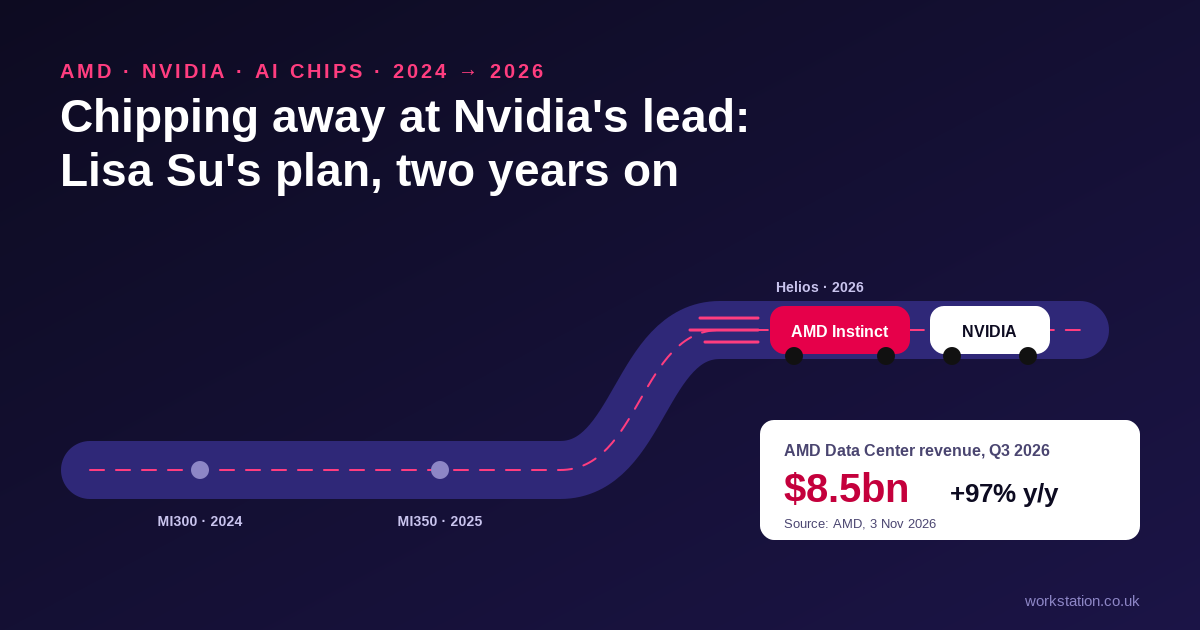
In December 2024, Bloomberg's Emily Chang visited AMD's labs in Austin to ask Lisa Su, ten years into her time as CEO, how she planned to chip away at Nvidia's lead in AI. Almost two years on, AMD's own results let us check the plan against what happened, and ask what it means for UK organisations buying AI infrastructure today.

Watch the interview. AMD's CEO Wants to Chip Away at Nvidia's Lead | The Circuit with Emily Chang (Bloomberg Originals, 24 minutes, published 6 December 2024).

What Lisa Su said

The episode is part company profile, part race story, and Su's lines are worth hearing in full. The points that matter for anyone buying AI hardware:

  • The pace. She called AI "the most transformational technology that I've seen in my career", ahead of the internet, PCs, mobile and cloud, and said the industry had made more progress in the previous 18 months than in the ten years before.
  • The product. She showed the Instinct MI300, already in production and running work such as GPT-4o on Microsoft Azure and Meta's Llama models.
  • The underdog question. Asked whether being seen as the next-best option to Nvidia was good enough, she said AMD has always "punched well above our weight" in technology. Bloomberg's chip reporter Ian King described AMD as "a solid number two".
  • Custom chips. On hyperscalers designing their own silicon: "This is a huge market... There's like more than enough chips for everybody to build."
  • Export controls and supply. She accepted there is "a national security element" to limits on AI chip exports, while wanting "as open a market as possible", and stressed resilience in a supply chain concentrated in Taiwan.

The rest covers her ten years turning AMD around (the Zen architecture was "the most important moment"), the Mercedes Formula 1 partnership, a Porsche collection named after AMD products, and her advice to young engineers: "run towards problems".

Two years on: the scorecard
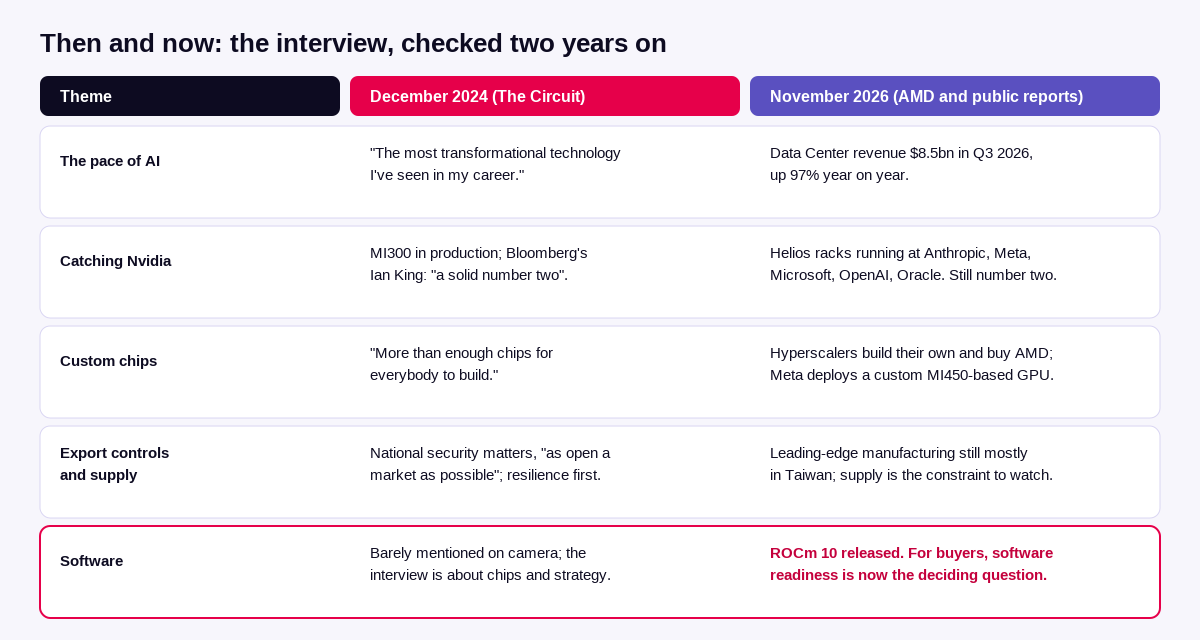
What Lisa Su said in December 2024, and what has happened since. Five themes from the interview checked against November 2026. AI pace: she called AI the most transformational technology of her career; AMD's Data Center revenue has nearly doubled year on year. Competing with Nvidia: Bloomberg called AMD a solid number two; Helios now ships to five of the largest AI buyers, though Nvidia remains far larger. Custom chips: she said there are more than enough chips for everybody; hyperscalers build their own and also buy AMD, and Meta is deploying a custom MI450-based GPU. Supply resilience and export controls: she backed national-security controls with as open a market as possible, and stressed supply-chain resilience; manufacturing is still concentrated in Taiwan. Software: not covered in depth on camera; ROCm 10 is now the deciding factor for most buyers.
Five themes from the December 2024 interview checked against November 2026. Sources: the Bloomberg Originals episode and AMD's third-quarter 2026 results.

AMD's third-quarter 2026 results, published on 3 November, are the clearest check. Data Center revenue reached a record $8.5bn, up 97% year on year, driven by EPYC server processors and the launch of the Instinct MI450 Series. Anthropic, Meta, Microsoft, OpenAI and Oracle Cloud Infrastructure are running models on the first Helios racks, AMD's answer to Nvidia's rack-scale systems. AMD expects around $17bn of total revenue in the fourth quarter.
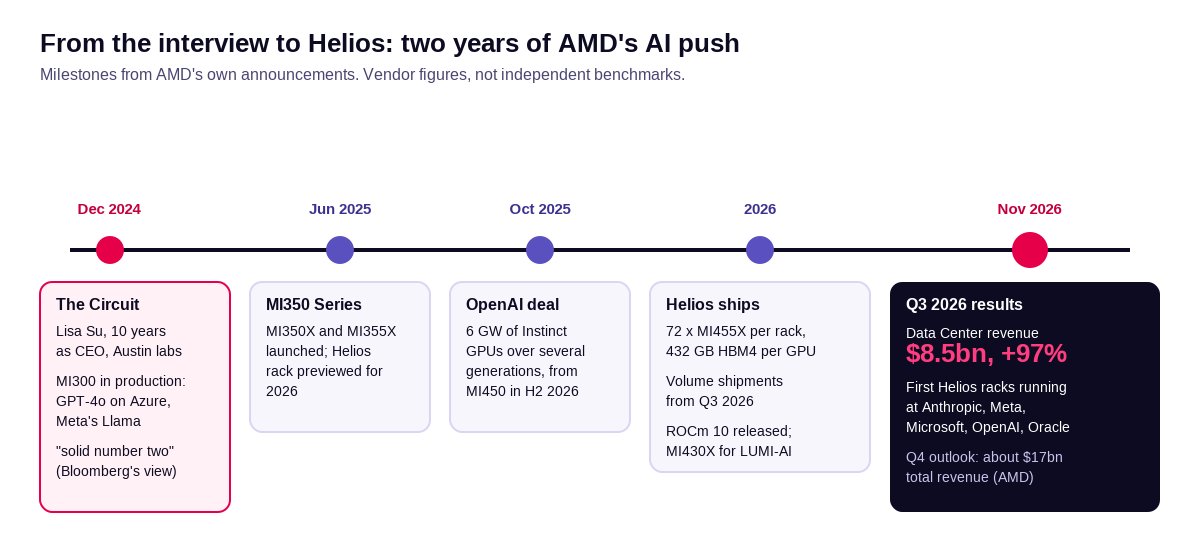
AMD's AI data-centre push, December 2024 to November 2026. A timeline. December 2024: Lisa Su on Bloomberg's The Circuit, ten years as CEO, with the Instinct MI300 in production and running GPT-4o on Microsoft Azure and Meta's Llama. June 2025: Instinct MI350 Series launched. October 2025: multi-year agreement with OpenAI for 6 gigawatts of Instinct GPUs. 2026: Helios rack-scale system with 72 Instinct MI455X GPUs enters production and ships in volume in the third quarter; ROCm 10 released. November 2026: third-quarter Data Center revenue a record 8.5 billion dollars, up 97 percent year on year, with Anthropic, Meta, Microsoft, OpenAI and Oracle running workloads on the first Helios racks.
From the interview to Helios: MI350 in June 2025, the OpenAI agreement in October 2025, Helios shipping in volume from the third quarter of 2026. Milestones from AMD's announcements.

Helios packs 72 Instinct MI455X GPUs into one rack, each with 432 GB of the newest HBM4 memory, for 31 TB per rack. AMD claims it beats Nvidia's Vera Rubin NVL72 on compute, memory and tokens per dollar. Those are AMD's numbers, and Nvidia remains far larger, with the deeper software ecosystem. But "solid number two" now means a second full platform that the biggest AI companies run in production, not a niche alternative.

What it means if you are buying AI infrastructure in the UK

  1. You have a real choice. For many workloads, especially serving large language models with long contexts, AMD's larger memory per GPU can mean fewer GPUs per model. That is worth testing, not assuming.
  2. Software is the deciding question. Code written in PyTorch, or served with vLLM or SGLang, usually runs on AMD's ROCm software with little change. Custom CUDA code and Nvidia-only tools are where the work is.
  3. Two vendors give you leverage. Teams that can run on both negotiate better prices and are less exposed when one vendor's lead times stretch.
  4. Supply risk has not gone away. As Su said, the industry depends on a concentrated supply chain. Plan lead times into AI projects whichever vendor you choose.
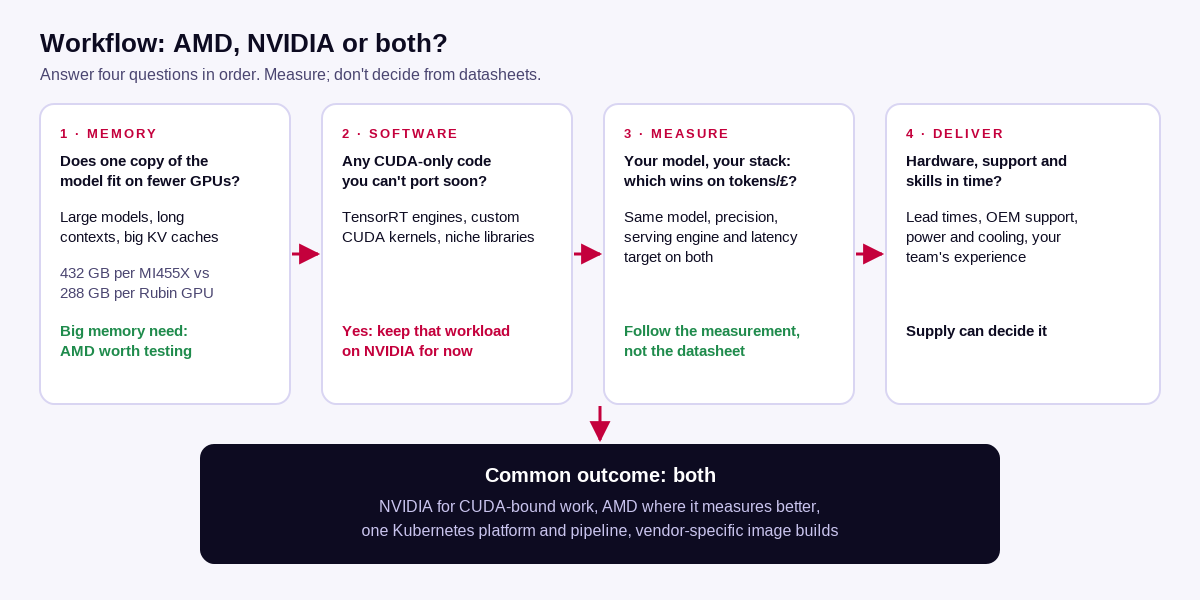
Workflow: choosing AMD, NVIDIA or both for an AI project. Four questions in sequence. Does the model need more memory per GPU than you can comfortably get, for example very large models or long contexts? If so, AMD's 432 GB per GPU can reduce how many GPUs each copy of the model needs. Does your software depend on CUDA-only libraries or custom kernels you cannot port soon? If so, stay on NVIDIA for that workload. Does a benchmark of your own model, on your own serving stack, show better tokens per pound on one vendor? Follow the measurement, not the datasheet. Can you get the hardware, support and skills in time? Supply, lead times and your team's experience can decide it. Many organisations end with both: NVIDIA for CUDA-bound work and AMD where it measures better.
Four questions to decide between AMD, Nvidia or both: memory, software dependencies, a benchmark on your own model, and whether hardware and skills arrive in time.

For the full engineering detail, with the platforms compared layer by layer, memory arithmetic, the CUDA-to-ROCm software map, a porting workflow with commands, running both vendors on one Kubernetes platform and a fair benchmarking method, read our technote: AMD Instinct vs NVIDIA for AI infrastructure: evaluate, port and run both.

How Workstation helps

We design and run GPU infrastructure for UK organisations and help teams evaluate AMD alongside Nvidia: a like-for-like benchmark of your own model on both, a check of your code for CUDA-only dependencies, and a Kubernetes platform that runs either. See our GPU private cloud guide, which includes AMD's official Helios video, compare leasing and buying at gpuleasing.co.uk, or talk to us.

Quotes are from the Bloomberg Originals video. Company figures are from AMD's announcements and are vendor claims, not independent benchmarks. This post is independent and not endorsed by Bloomberg, AMD or Nvidia.

Acknowledgement of rights: AMD, Instinct, EPYC, ROCm, Helios and Zen are trademarks of Advanced Micro Devices, Inc. NVIDIA and Vera Rubin are trademarks of NVIDIA Corporation. Bloomberg is a trademark of Bloomberg Finance L.P. Other names are the property of their respective owners.