Key takeaways
- Cheaper decisions increase demand for decisions.
- Governance and evaluation become core product surfaces.
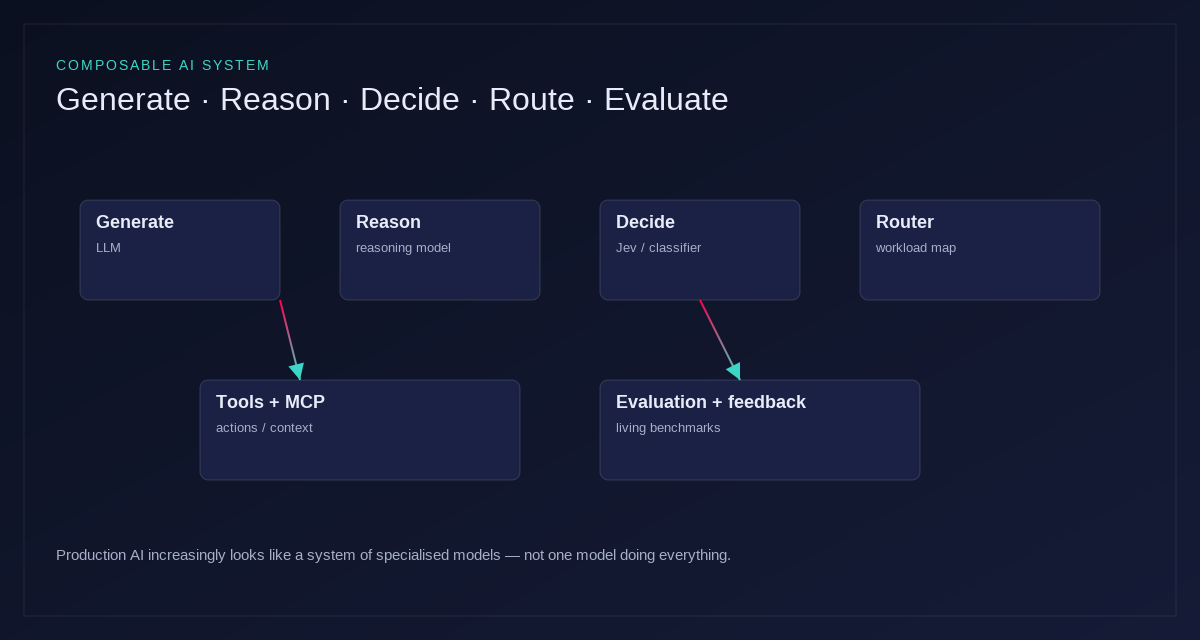
- Composable architectures outlast individual models.
Why this matters
TypeSafe explicitly invokes Jevons’ paradox: cheaper intelligence may increase consumption. If decision calls become nearly free, software will sprout millions of micro-judgements — monitoring, ranking, gating, triage — that were previously uneconomic.
What cheaper intelligence unlocks
- Continuous agent self-checks
- Real-time routing on every event
- Large-scale classification over archives
- Always-on safety scanners
- Fine-grained personalisation policies
What still breaks
- Bad ontologies
- Missing labels
- Unclear ownership
- Security boundaries
- Long-horizon planning
Conclusion
The future of automation belongs to teams who instrument decisions. Models are necessary; measurement is decisive.
Forward-looking scenario planning should include failure modes: provider outages, sudden price changes, regulatory constraints on automated decisions, and user trust collapses after a single high-impact false negative. Build kill switches. Prefer progressive delivery of automation — suggest, then shadow, then enforce. Connect Insights research to Jobs and Teams pages so organisational capability grows with technical capability. The most durable advantage is not access to a single model API; it is a culture that can swap models without rewriting the business.
Forward-looking scenario planning should include failure modes: provider outages, sudden price changes, regulatory constraints on automated decisions, and user trust collapses after a single high-impact false negative. Build kill switches. Prefer progressive delivery of automation — suggest, then shadow, then enforce. Connect Insights research to Jobs and Teams pages so organisational capability grows with technical capability. The most durable advantage is not access to a single model API; it is a culture that can swap models without rewriting the business.
Forward-looking scenario planning should include failure modes: provider outages, sudden price changes, regulatory constraints on automated decisions, and user trust collapses after a single high-impact false negative. Build kill switches. Prefer progressive delivery of automation — suggest, then shadow, then enforce. Connect Insights research to Jobs and Teams pages so organisational capability grows with technical capability. The most durable advantage is not access to a single model API; it is a culture that can swap models without rewriting the business.
Forward-looking scenario planning should include failure modes: provider outages, sudden price changes, regulatory constraints on automated decisions, and user trust collapses after a single high-impact false negative. Build kill switches. Prefer progressive delivery of automation — suggest, then shadow, then enforce. Connect Insights research to Jobs and Teams pages so organisational capability grows with technical capability. The most durable advantage is not access to a single model API; it is a culture that can swap models without rewriting the business.
Forward-looking scenario planning should include failure modes: provider outages, sudden price changes, regulatory constraints on automated decisions, and user trust collapses after a single high-impact false negative. Build kill switches. Prefer progressive delivery of automation — suggest, then shadow, then enforce. Connect Insights research to Jobs and Teams pages so organisational capability grows with technical capability. The most durable advantage is not access to a single model API; it is a culture that can swap models without rewriting the business.
Forward-looking scenario planning should include failure modes: provider outages, sudden price changes, regulatory constraints on automated decisions, and user trust collapses after a single high-impact false negative. Build kill switches. Prefer progressive delivery of automation — suggest, then shadow, then enforce. Connect Insights research to Jobs and Teams pages so organisational capability grows with technical capability. The most durable advantage is not access to a single model API; it is a culture that can swap models without rewriting the business.
Forward-looking scenario planning should include failure modes: provider outages, sudden price changes, regulatory constraints on automated decisions, and user trust collapses after a single high-impact false negative. Build kill switches. Prefer progressive delivery of automation — suggest, then shadow, then enforce. Connect Insights research to Jobs and Teams pages so organisational capability grows with technical capability. The most durable advantage is not access to a single model API; it is a culture that can swap models without rewriting the business.
Forward-looking scenario planning should include failure modes: provider outages, sudden price changes, regulatory constraints on automated decisions, and user trust collapses after a single high-impact false negative. Build kill switches. Prefer progressive delivery of automation — suggest, then shadow, then enforce. Connect Insights research to Jobs and Teams pages so organisational capability grows with technical capability. The most durable advantage is not access to a single model API; it is a culture that can swap models without rewriting the business.
Forward-looking scenario planning should include failure modes: provider outages, sudden price changes, regulatory constraints on automated decisions, and user trust collapses after a single high-impact false negative. Build kill switches. Prefer progressive delivery of automation — suggest, then shadow, then enforce. Connect Insights research to Jobs and Teams pages so organisational capability grows with technical capability. The most durable advantage is not access to a single model API; it is a culture that can swap models without rewriting the business.
Forward-looking scenario planning should include failure modes: provider outages, sudden price changes, regulatory constraints on automated decisions, and user trust collapses after a single high-impact false negative. Build kill switches. Prefer progressive delivery of automation — suggest, then shadow, then enforce. Connect Insights research to Jobs and Teams pages so organisational capability grows with technical capability. The most durable advantage is not access to a single model API; it is a culture that can swap models without rewriting the business.
Forward-looking scenario planning should include failure modes: provider outages, sudden price changes, regulatory constraints on automated decisions, and user trust collapses after a single high-impact false negative. Build kill switches. Prefer progressive delivery of automation — suggest, then shadow, then enforce. Connect Insights research to Jobs and Teams pages so organisational capability grows with technical capability. The most durable advantage is not access to a single model API; it is a culture that can swap models without rewriting the business.
Forward-looking scenario planning should include failure modes: provider outages, sudden price changes, regulatory constraints on automated decisions, and user trust collapses after a single high-impact false negative. Build kill switches. Prefer progressive delivery of automation — suggest, then shadow, then enforce. Connect Insights research to Jobs and Teams pages so organisational capability grows with technical capability. The most durable advantage is not access to a single model API; it is a culture that can swap models without rewriting the business.
Forward-looking scenario planning should include failure modes: provider outages, sudden price changes, regulatory constraints on automated decisions, and user trust collapses after a single high-impact false negative. Build kill switches. Prefer progressive delivery of automation — suggest, then shadow, then enforce. Connect Insights research to Jobs and Teams pages so organisational capability grows with technical capability. The most durable advantage is not access to a single model API; it is a culture that can swap models without rewriting the business.
Forward-looking scenario planning should include failure modes: provider outages, sudden price changes, regulatory constraints on automated decisions, and user trust collapses after a single high-impact false negative. Build kill switches. Prefer progressive delivery of automation — suggest, then shadow, then enforce. Connect Insights research to Jobs and Teams pages so organisational capability grows with technical capability. The most durable advantage is not access to a single model API; it is a culture that can swap models without rewriting the business.
Related on Workstation
- Benchmark Lab — Interactive charts
- Model selection manual
- AI Agents
- AI Automation
- Jobs
Sources
- TypeSafe AI — Introducing System One Models & Jev — Primary vendor source (15 Sep 2026).
- LangChain — Building a Harness with Jev — Harness integration (17 Sep 2026).
- TypeSafe documentation index — Concepts, primitives, API, cookbooks.
- LangChain — Can Jev Be a Better Agent Evaluator? — 20 Sep 2026 LangSmith experiment.
- OpenRouter — Jev vs LLM when to use each — Published triage cost/latency/accuracy.
- AyAutomate — Independent Jev benchmark — 791 decisions; challenges headline multipliers vs small models.
- JevBench RESULTS v1.2 — Public community harness.
- OpenAI — Introducing the Agents API — Landscape: agent platform primitives.