Private AI Hosting in the UK: AWS Bedrock vs Microsoft Azure vs Your Own GPUs
 Workstation14 พฤศจิกายน 25696 min read
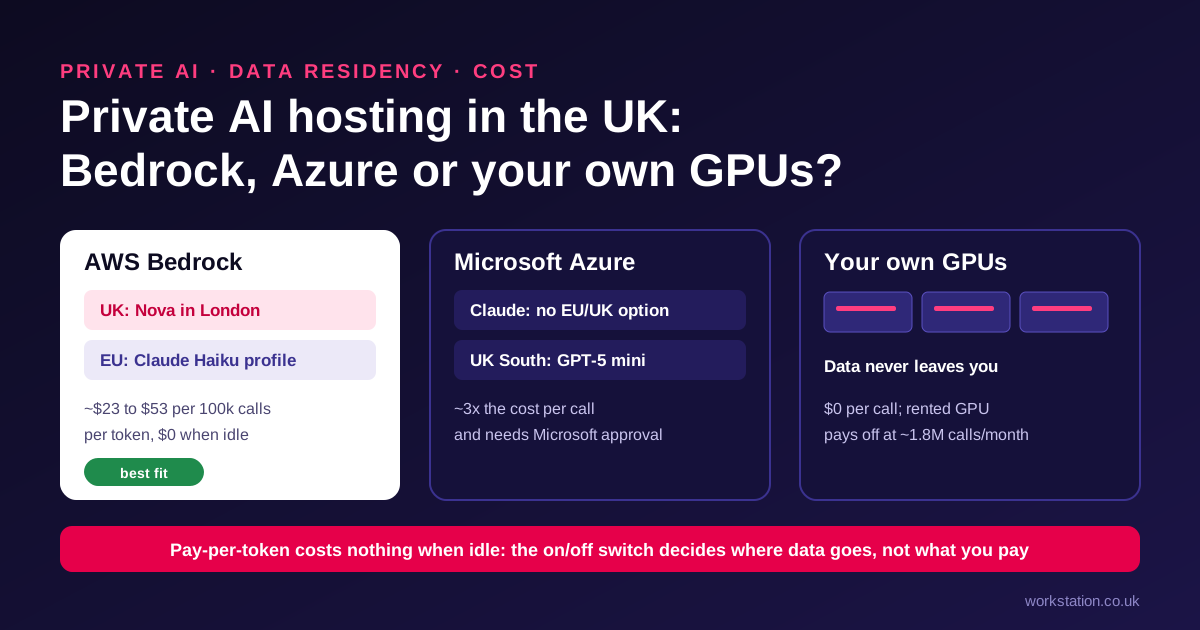
If your product sends customer financial data to an AI model, two questions decide almost everything: where is that data processed, and what does each call cost? We compared AWS Bedrock, Microsoft Azure, UK and EU AI providers and running your own GPUs for a typical UK finance workload. The short answer: pay-per-token AI costs nothing when idle, Bedrock is the best fit for most UK firms, and the first decision is not technical at all.
The workload
Our worked example is a UK bookkeeping or tax application. Most of its AI spend is classifying bank transactions: one call per transaction, with about 3,600 tokens of instructions and context going in and about 250 tokens coming out. It also reads scanned receipts, which needs a model that understands images, and runs a chat assistant for customers.
The rule the business set: customer financial data must not go to public consumer AI services. It must be processed in the UK, or at least the EU, with no training on it and no long retention.
Myth: switch AI off at night to save money
Both Bedrock and Azure's standard deployments charge per token. When nothing is being classified, they cost nothing. Switching them off saves money only for services billed by the hour: reserved capacity (Bedrock Provisioned Throughput, Azure PTU) or a rented GPU. On a pay-per-token service, the on/off switch decides where your data goes, not what you pay.
Start with where the data may go
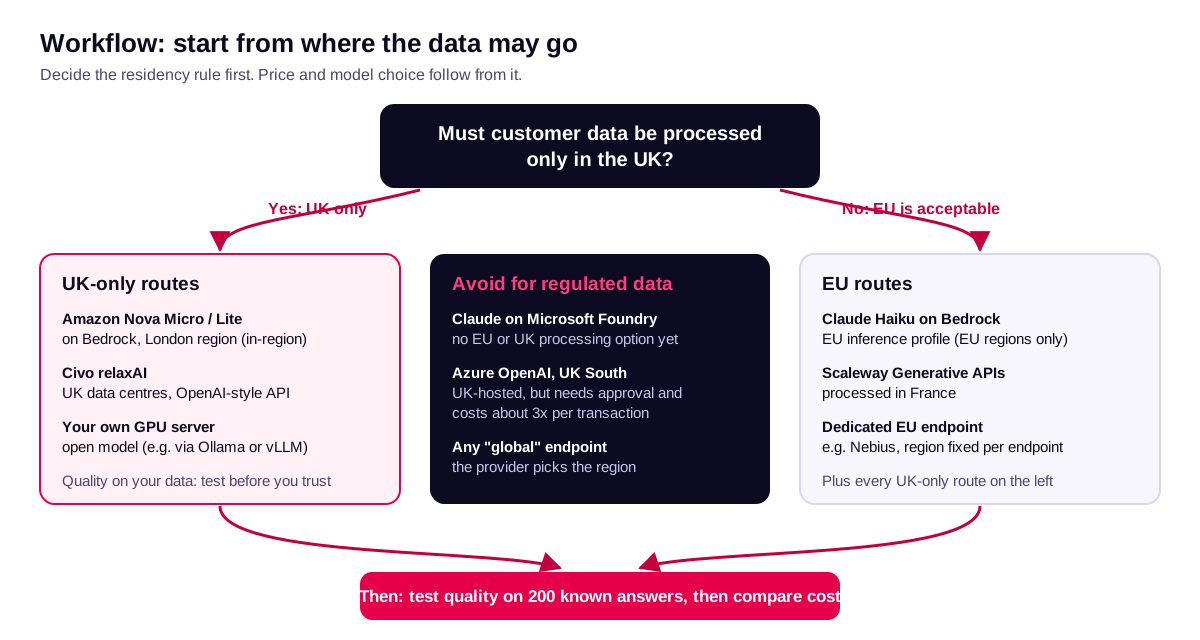
- AWS Bedrock runs Amazon's Nova Micro and Nova Lite models in-region in London, so data stays in the UK. Claude Haiku is available through an EU inference profile, processed across EU regions but not pinned to the UK.
- Microsoft Azure offers Claude on Microsoft Foundry, but at the time of writing with no EU or UK processing option. Its UK South region runs OpenAI models such as GPT-5 mini, but customers report it needs Microsoft's approval and capacity is not guaranteed.
- UK and EU providers such as Civo's relaxAI (UK data centres) and Scaleway (France) offer open models through an OpenAI-compatible interface.
- Your own GPU server keeps data entirely under your control.
What each route costs
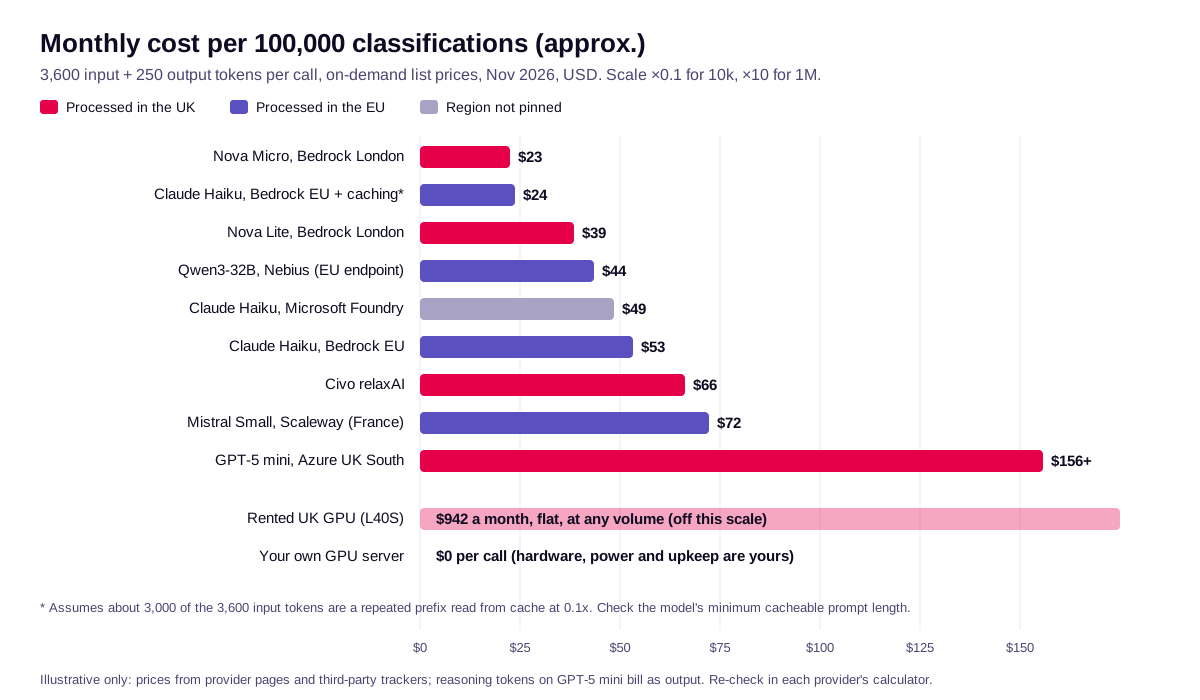
For 100,000 transactions a month, the per-token routes range from about $23 (Nova Micro in London) to about $53 (Claude Haiku through Bedrock's EU profile), with UK-hosted GPT-5 mini on Azure around $156 before its hidden reasoning tokens. A rented UK GPU costs about $942 a month whatever the volume.
Price is only half the story. The cheapest model is only cheap if it classifies correctly. Nova and the open models are untested on most firms' data, while Claude Haiku is the strongest of the low-cost options and reads images. That is why the next step is a quality test, not a purchase order.
Cut the bill before you pick the model
- Rules first. Obvious payees and merchant codes need no AI at all.
- Remember answers. The same supermarket every week does not need a fresh AI call each time.
- Prompt caching. Every call repeats the same category list and rules. Cached, that part costs about a tenth of the normal price on Claude; for this workload that roughly halves the bill.
- Batch overnight work. Reclassifying old transactions is half price as batch work on Bedrock.
Together these can cut a $53 monthly bill to under $10 for the same 100,000 transactions, depending on how repetitive your customers' spending is.
When does your own GPU pay off?
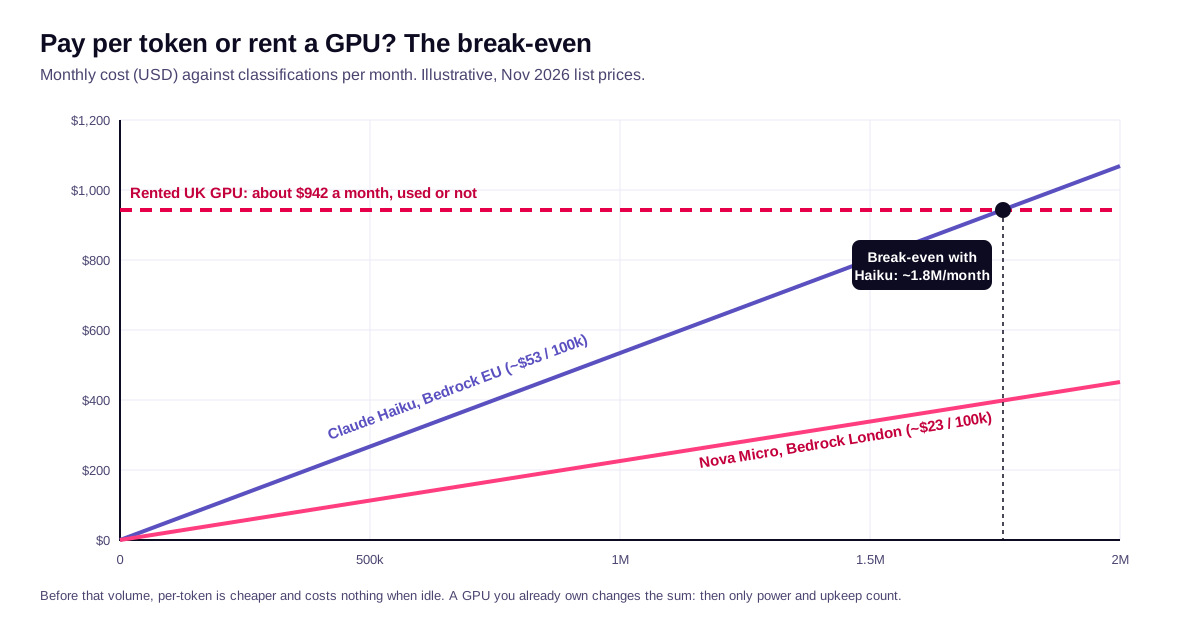
For most SMEs, pay-per-token wins on cost until volumes are very high. A dedicated GPU makes sense when you already own the hardware, when data must never leave your control, or when one server can carry several AI workloads at once: classification, document reading, search and internal assistants.
Our recommendation
- Decide the data rule with whoever owns data protection: UK only, or EU allowed.
- Test quality before price on about 200 transactions with known right answers, across every route the rule allows.
- Default to AWS Bedrock: Nova in London if UK-only, Claude Haiku through the EU profile if EU is allowed. Add prompt caching and a monthly budget alert from day one.
- Keep Azure for cases where you specifically need OpenAI models processed in the UK, or Microsoft contracts matter to your customers.
- Keep a UK fallback, such as your own GPU or a UK provider, so one provider's outage or model retirement does not stop the business.
The full working, with the cost tables at three volumes, Bedrock and Azure residency details, IAM and code examples, the request pipeline and the evaluation harness, is in our technote: Private AI for financial data: residency, routing and cost on Bedrock, Azure and your own GPUs.
How Workstation helps
We help UK organisations run AI on sensitive data: choosing residency-aware routes on Bedrock, Azure and UK providers, building the quality tests, cutting cost with caching and rules, and supplying or hosting GPU servers when running your own model makes sense. See our GPU private cloud guide, compare leasing and buying at gpuleasing.co.uk, or talk to us.
Prices are approximate November 2026 list prices in US dollars (£1 = $1.30, €1 = $1.15), from provider pages and third-party trackers; check each provider's calculator before committing. Figures are illustrative for the workload described, not a quote.
Acknowledgement of rights: AWS, Amazon Bedrock and Amazon Nova are trademarks of Amazon.com, Inc. or its affiliates. Microsoft, Azure and Microsoft Foundry are trademarks of the Microsoft group of companies. Claude is a trademark of Anthropic, PBC. OpenAI and GPT are trademarks of OpenAI. Other names are the property of their respective owners.