Key takeaways
- Latency compounds inside agent loops; fast decision layers make routing and gating affordable.
- Read with the Benchmark Lab open.
- Prefer primary sources.
Why this matters
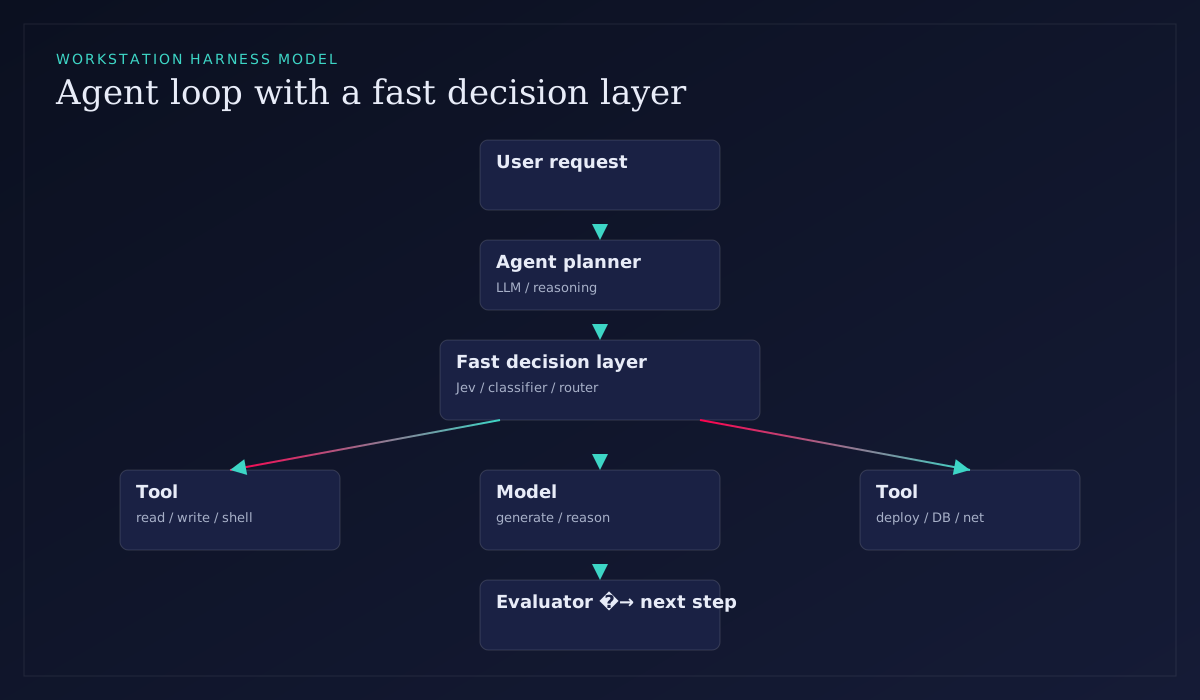
Latency compounds inside agent loops; fast decision layers make routing and gating affordable.
Deep dive
See also the long-form essay and interactive lab for full tables and citations.
Why agent harnesses need fast decisions — detailed note 1. In production AI, latency choices should be evidenced with paired evaluations, explicit latency definitions, and clear separation between vendor claims and independent measurements. Workstation repeats this discipline across Insights pages so engineers can trust the surrounding narrative when they deep-link from Jobs, Agents, or Automation pages. When in doubt, open the Benchmark Lab filters and read the “what this does not prove” panel before citing a number externally.
Why agent harnesses need fast decisions — detailed note 2. In production AI, latency choices should be evidenced with paired evaluations, explicit latency definitions, and clear separation between vendor claims and independent measurements. Workstation repeats this discipline across Insights pages so engineers can trust the surrounding narrative when they deep-link from Jobs, Agents, or Automation pages. When in doubt, open the Benchmark Lab filters and read the “what this does not prove” panel before citing a number externally.
Why agent harnesses need fast decisions — detailed note 3. In production AI, latency choices should be evidenced with paired evaluations, explicit latency definitions, and clear separation between vendor claims and independent measurements. Workstation repeats this discipline across Insights pages so engineers can trust the surrounding narrative when they deep-link from Jobs, Agents, or Automation pages. When in doubt, open the Benchmark Lab filters and read the “what this does not prove” panel before citing a number externally.
Why agent harnesses need fast decisions — detailed note 4. In production AI, latency choices should be evidenced with paired evaluations, explicit latency definitions, and clear separation between vendor claims and independent measurements. Workstation repeats this discipline across Insights pages so engineers can trust the surrounding narrative when they deep-link from Jobs, Agents, or Automation pages. When in doubt, open the Benchmark Lab filters and read the “what this does not prove” panel before citing a number externally.
Why agent harnesses need fast decisions — detailed note 5. In production AI, latency choices should be evidenced with paired evaluations, explicit latency definitions, and clear separation between vendor claims and independent measurements. Workstation repeats this discipline across Insights pages so engineers can trust the surrounding narrative when they deep-link from Jobs, Agents, or Automation pages. When in doubt, open the Benchmark Lab filters and read the “what this does not prove” panel before citing a number externally.
Why agent harnesses need fast decisions — detailed note 6. In production AI, latency choices should be evidenced with paired evaluations, explicit latency definitions, and clear separation between vendor claims and independent measurements. Workstation repeats this discipline across Insights pages so engineers can trust the surrounding narrative when they deep-link from Jobs, Agents, or Automation pages. When in doubt, open the Benchmark Lab filters and read the “what this does not prove” panel before citing a number externally.
Why agent harnesses need fast decisions — detailed note 7. In production AI, latency choices should be evidenced with paired evaluations, explicit latency definitions, and clear separation between vendor claims and independent measurements. Workstation repeats this discipline across Insights pages so engineers can trust the surrounding narrative when they deep-link from Jobs, Agents, or Automation pages. When in doubt, open the Benchmark Lab filters and read the “what this does not prove” panel before citing a number externally.
Why agent harnesses need fast decisions — detailed note 8. In production AI, latency choices should be evidenced with paired evaluations, explicit latency definitions, and clear separation between vendor claims and independent measurements. Workstation repeats this discipline across Insights pages so engineers can trust the surrounding narrative when they deep-link from Jobs, Agents, or Automation pages. When in doubt, open the Benchmark Lab filters and read the “what this does not prove” panel before citing a number externally.
Why agent harnesses need fast decisions — detailed note 9. In production AI, latency choices should be evidenced with paired evaluations, explicit latency definitions, and clear separation between vendor claims and independent measurements. Workstation repeats this discipline across Insights pages so engineers can trust the surrounding narrative when they deep-link from Jobs, Agents, or Automation pages. When in doubt, open the Benchmark Lab filters and read the “what this does not prove” panel before citing a number externally.
Why agent harnesses need fast decisions — detailed note 10. In production AI, latency choices should be evidenced with paired evaluations, explicit latency definitions, and clear separation between vendor claims and independent measurements. Workstation repeats this discipline across Insights pages so engineers can trust the surrounding narrative when they deep-link from Jobs, Agents, or Automation pages. When in doubt, open the Benchmark Lab filters and read the “what this does not prove” panel before citing a number externally.
Why agent harnesses need fast decisions — detailed note 11. In production AI, latency choices should be evidenced with paired evaluations, explicit latency definitions, and clear separation between vendor claims and independent measurements. Workstation repeats this discipline across Insights pages so engineers can trust the surrounding narrative when they deep-link from Jobs, Agents, or Automation pages. When in doubt, open the Benchmark Lab filters and read the “what this does not prove” panel before citing a number externally.
Why agent harnesses need fast decisions — detailed note 12. In production AI, latency choices should be evidenced with paired evaluations, explicit latency definitions, and clear separation between vendor claims and independent measurements. Workstation repeats this discipline across Insights pages so engineers can trust the surrounding narrative when they deep-link from Jobs, Agents, or Automation pages. When in doubt, open the Benchmark Lab filters and read the “what this does not prove” panel before citing a number externally.
Why agent harnesses need fast decisions — detailed note 13. In production AI, latency choices should be evidenced with paired evaluations, explicit latency definitions, and clear separation between vendor claims and independent measurements. Workstation repeats this discipline across Insights pages so engineers can trust the surrounding narrative when they deep-link from Jobs, Agents, or Automation pages. When in doubt, open the Benchmark Lab filters and read the “what this does not prove” panel before citing a number externally.
Why agent harnesses need fast decisions — detailed note 14. In production AI, latency choices should be evidenced with paired evaluations, explicit latency definitions, and clear separation between vendor claims and independent measurements. Workstation repeats this discipline across Insights pages so engineers can trust the surrounding narrative when they deep-link from Jobs, Agents, or Automation pages. When in doubt, open the Benchmark Lab filters and read the “what this does not prove” panel before citing a number externally.
Why agent harnesses need fast decisions — detailed note 15. In production AI, latency choices should be evidenced with paired evaluations, explicit latency definitions, and clear separation between vendor claims and independent measurements. Workstation repeats this discipline across Insights pages so engineers can trust the surrounding narrative when they deep-link from Jobs, Agents, or Automation pages. When in doubt, open the Benchmark Lab filters and read the “what this does not prove” panel before citing a number externally.
Why agent harnesses need fast decisions — detailed note 16. In production AI, latency choices should be evidenced with paired evaluations, explicit latency definitions, and clear separation between vendor claims and independent measurements. Workstation repeats this discipline across Insights pages so engineers can trust the surrounding narrative when they deep-link from Jobs, Agents, or Automation pages. When in doubt, open the Benchmark Lab filters and read the “what this does not prove” panel before citing a number externally.
Why agent harnesses need fast decisions — detailed note 17. In production AI, latency choices should be evidenced with paired evaluations, explicit latency definitions, and clear separation between vendor claims and independent measurements. Workstation repeats this discipline across Insights pages so engineers can trust the surrounding narrative when they deep-link from Jobs, Agents, or Automation pages. When in doubt, open the Benchmark Lab filters and read the “what this does not prove” panel before citing a number externally.
Why agent harnesses need fast decisions — detailed note 18. In production AI, latency choices should be evidenced with paired evaluations, explicit latency definitions, and clear separation between vendor claims and independent measurements. Workstation repeats this discipline across Insights pages so engineers can trust the surrounding narrative when they deep-link from Jobs, Agents, or Automation pages. When in doubt, open the Benchmark Lab filters and read the “what this does not prove” panel before citing a number externally.
Conclusion
Return to the series hub for the full path.
Related on Workstation
- Benchmark Lab — Interactive charts
- Model selection manual
- AI Agents
- AI Automation
- Jobs
Sources
- TypeSafe AI — Introducing System One Models & Jev — Primary vendor source (15 Sep 2026).
- LangChain — Building a Harness with Jev — Harness integration (17 Sep 2026).
- TypeSafe documentation index — Concepts, primitives, API, cookbooks.
- LangChain — Can Jev Be a Better Agent Evaluator? — 20 Sep 2026 LangSmith experiment.
- OpenRouter — Jev vs LLM when to use each — Published triage cost/latency/accuracy.
- AyAutomate — Independent Jev benchmark — 791 decisions; challenges headline multipliers vs small models.
- JevBench RESULTS v1.2 — Public community harness.
- OpenAI — Introducing the Agents API — Landscape: agent platform primitives.