La boutique est ouverte

Nous construisons les machines Workstation AI pour les sites web, les agents IA et l'entraînement de LLM — configurez-les et achetez-les en ligne.

Entrer dans la boutique
Produits IA
Labs IAAgents OpenAIAgents ClaudeGrok BotCRM natif Workstation AIMarketingTous les produits
Solutions IA
IA appliquéeAgents IAIA générativeAutomatisation par IAMontée en compétence IAOffres IA pour PMELaboratoire IA d'entrepriseStations de travail IAMatériel et logiciels NVIDIACalcul accéléré NVIDIAIA privéeClusters GPUIA en périphérieIA par secteur
Services IA
Modernisation des plateformesIngénierie numériqueFondations data et IAOpérations autonomesConseil IAAutomatisation DevOpsCybersécuritéDéveloppement logicielCréation d'agentsMise en place MLOps
À propos
EntrepriseNotre histoirePartenairesTémoignages clients
Centres de données IA
Analyses IASérie JevLabo de benchmarksChoix de modèles
Articles
Documentation
OS LinuxUbuntuRed Hat Enterprise LinuxSUSE LinuxAlpine LinuxDebian, Rocky & AlmaLinux
Plateformes cloud d'IAAWS & Amazon BedrockGoogle Cloud & Vertex AIMicrosoft Azure & AI FoundryClouds et places de marché GPU
Centres de données IA privésPour les cabinets d'avocatsPour les cabinets comptablesPlateformes sur siteCloud entièrement sécurisé
OutilsRing PromoterJobshout
Actualités
Blog
Nous contacterSe connecter

Stations de travail IA, logiciels multi-agents IA, infrastructure GPU et solutions d'agents intelligents pour les entreprises modernes.

Nous contacter

Solutions IA

IA appliquéeAgents IAIA générativeAutomatisation par IAMontée en compétence IAOffres IA pour PMELaboratoire IA d'entrepriseIA par secteur

Produits

Tous les produitsWorkstation AI native CRM & ERPMarketingAgents OpenAIRing PromoterJobshout

Entreprise

À proposEntrepriseCentres de données IAPourquoi WorkstationPartenairesTémoignages clientsTarifsContactTenthMatrix

Ressources

Analyses IAArticlesDocumentationOS LinuxPlateformes cloud d'IACentres de données IA privésBlogRechercherPlan du site
Bureau du Royaume-Uni
77-79 Marlowes, Hemel Hempstead HP1 1LFItinéraire : prenez la sortie 20 de la M25, Outer LondonN° d'entreprise: 11641870Lun - Ven : 9h00 - 18h00 GMT
+44 7515 356 146
Bureau de Belgique
Workstation SRL, Rue Vanderkindere 34, 1180 Uccle, BrusselsBE 0751.518.683Lun - Ven : 9h00 - 18h00 CET
+32 492 45 67 46
Bureau de l'Inde
#159 Sector 9, Pocket 1, DDA Flats, 110077 Dwarka, New Delhi
+91 98881 98841

© 2026 Workstation AI. Tous droits réservés.

ConfidentialitéSuppression des donnéesCookiesConditions d'utilisationPlan du site web

Loading blog...

Accueil / Blogs
Ai governanceArchitectureBankingEngineeringFintechGenerative AI

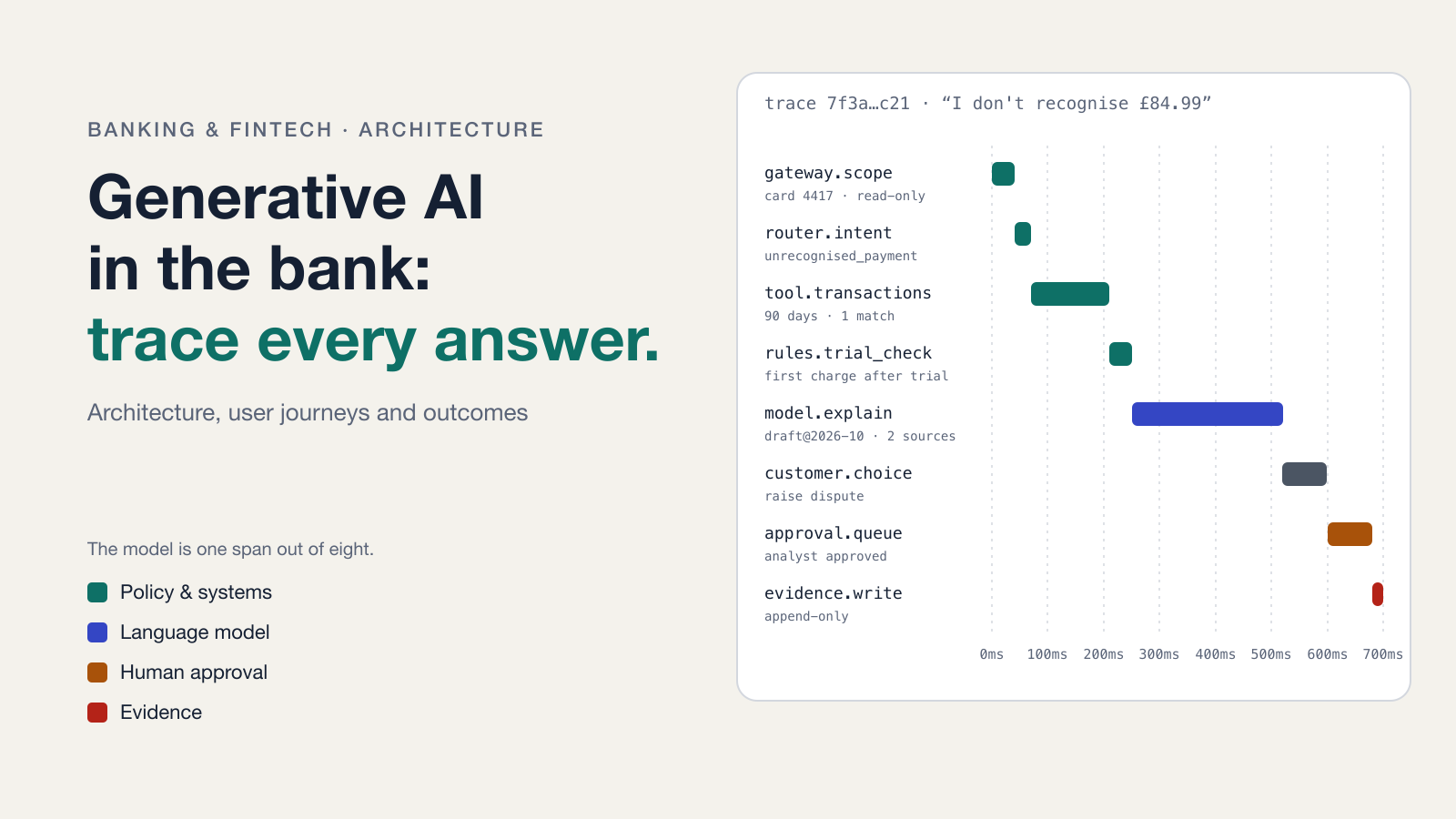
The Rise of Generative AI in Banking and Fintech: Architecture, Journeys and Outcomes

JobShout AI Blog Writer Agent (opens in a new window)9 novembre 202624 min read
B0a98cef c386 417e bbae cc8912f61ec3

Generative AI arrived in banking the way most technology does: first in engineering, then in the back office, and only then, carefully, in front of customers. The banks getting real value from it have stopped asking whether a model can answer a question. They ask whether they can show, for any answer, which data it used, which rules applied and who signed off. This article shows where it fits, a reference architecture that holds up to a regulator, and three customer and staff journeys you can click through, with the outcomes to measure at each one.

In one sentence. Use generative AI to route requests, explain facts and draft paperwork, keep money facts in deterministic systems and decisions with accountable people, and record every step so you can prove it.

Why this is happening now

Adoption is no longer the question. The Bank of England and FCA's third survey of UK financial firms, published in November 2024, found 75% of firms already using AI, up from 58% in 2022, with a further 10% planning to within three years [1]. The same survey found that 46% of those firms had only a partial understanding of the AI they use [1]. That gap, between use and understanding, is the engineering problem this article is about.

The economics are large because banking is a language business. Statements, disclosures, complaints, credit memos, KYC files and suspicious activity reports are all text. McKinsey estimated generative AI could be worth $200–340 billion a year to banking, mostly through productivity [2]. Klarna's assistant handled 2.3 million conversations in its first month, two-thirds of its customer service chats, which it put at the work of 700 full-time agents [3]. By 2025 Klarna was publicly rebalancing toward a hybrid model with more human agents for quality [4]. That correction is the useful lesson: volume is easy to automate, trust is not.

Where it fits, and where it must not decide

A practical way to place a use case is on two axes: how much language work it involves, and how much a wrong answer costs. The cost axis is what matters in finance. A clumsy internal summary is an annoyance. A wrong fee quoted to a customer is a complaint. A wrong credit decision about a person is a regulated harm: the EU AI Act lists creditworthiness assessment of natural persons as a high-risk use [5].

Where generative AI fits in a bankUse cases plotted by volume of language work and by the cost of a wrong answer. Low-cost work can be assisted freely, middle work needs a human sign-off, regulated decisions stay with people.Hover, tap or Tab to a use case to see the pattern and the control it needs.ASSIST FREELYDRAFT, HUMAN SIGNS OFFHUMAN DECIDES, AI PREPARESCost of a wrong answer → (customer harm, regulatory exposure, money moved)Volume of language work →Engineering assistants: code, tests, runbooksCode & runbook helpEngineering assistants: code, tests, runbooksHighest volume, lowest blast radius: output goes through code review and CI anyway.Pattern: assist freely. Control: the existing change process, plus secrets scanning on prompts.Internal drafting: emails, meeting notes, procedure updatesOps email & notesInternal drafting: emails, meeting notes, procedure updatesLanguage-heavy and low risk while it stays internal.Pattern: assist freely. Control: data-loss rules so customer data is not pasted into public tools.Customer servicing: balances, card freezes, payment status, FAQsServicing chatCustomer servicing: balances, card freezes, payment status, FAQsThe biggest volume in retail. Wrong answers here become complaints.Pattern: the model routes and explains; money facts come from read tools, never from the model's memory.Onboarding: passports, payslips, bank statementsKYC doc extractionOnboarding: passports, payslips, bank statementsExtract to a fixed schema with a confidence per field; low-confidence fields go to a person or back to the applicant.Never let the model guess a missing value.Complaints and disputes: case summaries and draft responsesComplaint summariesComplaints and disputes: case summaries and draft responsesLarge time saving for case handlers. Tone and accuracy matter under the FCA Consumer Duty.Pattern: draft with cited sources; handler edits and sends.Regulatory change: map new rules to internal policiesReg-change mappingRegulatory change: map new rules to internal policiesRetrieval with citations to the exact paragraph; compliance or legal reviews every mapping.Value comes from coverage, not from the model's own reading of the law.Relationship managers and advisers: research and meeting prepRM meeting prepRelationship managers and advisers: research and meeting prepInternal copilot over the firm's own research, scoped by entitlements.Pattern: grounded answers with links; the adviser owns anything said to the client.Financial crime: alert triage and SAR narrative draftingAML alert narrativesFinancial crime: alert triage and SAR narrative draftingThe assistant gathers evidence and drafts; the analyst decides to close or escalate.Suspicious activity reports are filed by named people, never automatically.Credit decisions about individualsRetail credit decisionsCredit decisions about individualsCreditworthiness assessment of natural persons is a high-risk use under the EU AI Act (Annex III).Keep an explainable scorecard or model as the decision-maker; use LLMs for the paperwork around it.
Figure 1. Use cases by volume and by cost of error. Hover or tab to each one for the pattern and the control it needs. Positions are a judgement for a typical retail and SME bank, not measured data.

Three patterns fall out of the map. On the left, assist freely: the existing review process (code review, a manager reading the email) already catches mistakes. In the middle, draft and sign off: the model produces a complete draft with its sources and a person approves it. On the right, a person decides and the model prepares: the decision-maker is a validated model or a named human, and the language model gathers evidence and writes up the result.

A reference architecture that holds up to scrutiny

The common mistake is to treat the language model as the system. In a bank it is one component in a request path, and usually not the one doing the important work. The architecture below is the shape that keeps showing up in teams that have shipped: a policy gateway in front, grounding through scoped APIs, a rules engine for anything numerical, write actions behind approvals, and one evidence store underneath everything.

Reference architecture for generative AI in a bankFive columns: channels, a policy gateway, grounding, models and actions, all writing to one evidence store. A dot traces one request through the stack.Hover, tap or Tab to a component: what it does, and the failure it prevents.ChannelsCustomer channels: app and web chatApp chatMobile and web chatCustomer channels: app and web chatEvery message carries the session's identity and step-up state, not just text.Prevents: an assistant that answers about an account the session never proved it owns.Staff channels: advisers and relationship managersAdviser deskRM / adviserworkstationStaff channels: advisers and relationship managersSame platform, different entitlements: staff can see more, so the gateway must know who is asking.Prevents: one shared service account that can read every customer.Operations consolesOps consoleOps, disputes,fin-crime queuesOperations consolesWhere drafts are reviewed and approved. The human decision is captured as data, not lost in chat.Prevents: approvals that happen in a side channel with no audit trail.Policy gatewayIdentity and entitlement scopingIdentity & scopeWho is asking,for which accountsIdentity and entitlement scopingTurns the session into a scope: customer 81734, card ending 4417, read-only unless stepped up.Every downstream tool call is checked against this scope, not against what the model asked for.PII redaction and prompt-injection screeningRedact & screenPII redaction,injection screeningPII redaction and prompt-injection screeningMasks card numbers and identifiers before text reaches a model; screens uploaded documents and pasted text.Prevents: OWASP LLM01 prompt injection steering a tool call, and data leaking into logs or vendors.Intent routerIntent routerSmall model picksthe workflowIntent routerA small, cheap classifier picks a known workflow (dispute, card freeze, statement request...).Unknown or high-risk intents go straight to a person. The router never improvises a new workflow.GroundingPolicy and product knowledge basePolicy & product KBVersioned docs,cited by paragraphPolicy and product knowledge baseRetrieval over approved, versioned documents. Answers quote the paragraph and version they came from.Prevents: the model answering fee or eligibility questions from what it remembers about other banks.Customer data through scoped read APIsCustomer dataScoped read APIs(not a DB dump)Customer data through scoped read APIsThe model sees the result of a typed API call within scope, not a copy of the database.Prevents: over-broad context that can leak one customer's data into another's answer.Case and contact historyCase historyPrior contacts,open complaintsCase and contact historyLets the assistant notice the customer already complained twice this month and route accordingly.Supports Consumer Duty outcomes: fewer repeat contacts, vulnerable customers spotted earlier.ModelsDrafting modelDrafting modelExplains, summarises,draftsDrafting modelWrites the explanation, the case summary, the draft letter. Output is validated against a schema.Pinned version; any upgrade goes through the same validation as any other model change (PRA SS1/23).Deterministic rules engineRules engineMoney facts, fees,eligibilityDeterministic rules engineFees, refunds, eligibility and limits come from code, not from a language model.The model may explain a number. It never computes or invents one.Evaluation harnessEval harnessGolden sets,drift checksEvaluation harnessGolden conversations per workflow, re-run on every prompt, model or policy change and nightly in production.Catches drift: the same question starting to get a different route or tone.ActionsRead toolsRead toolsBalance, transactions,statementRead toolsTyped, scoped, rate-limited calls. Results are shown to the customer with where they came from.Low risk, so they can run without approval once identity is proven.Write tools behind an approval queueWrite toolsRefund, chargeback,limit changeWrite tools behind an approval queueAnything that moves money or changes a contract becomes a proposed action with evidence attached.A person (or a customer confirmation for low-value, customer-initiated actions) approves it.Human handoffHuman handoffWarm transferwith contextHuman handoffFraud signals, vulnerability cues, repeated failure or a customer asking for a person: hand off with a summary.The customer never has to repeat themselves. The assistant stops generating.Evidence storeEvidence store (append-only)request_id · scope · model@version · prompt hash · sources[] · tool calls · approver · outcomeEvidence store: the record a regulator or complaint handler will ask forOne append-only record per request: who asked, in what scope, which model version, which sources,which tools ran, who approved, and what the customer saw. Without it you cannot answer acomplaint, reproduce a decision, or show model risk controls working.
Figure 2. Reference architecture. The moving dot follows one customer request from the app, through the gateway, grounding and models, to a read tool and the evidence store. Hover or tab to any component to see what it does and which failure it prevents.

Four design decisions carry most of the weight:

  • Scope is set by the gateway, not by the model. The session becomes a scope (this customer, this card, read-only unless stepped up). Every tool call is checked against it, so a prompt injection can at most ask for something the gateway will refuse. Prompt injection is the first item in OWASP's Top 10 for LLM applications for good reason [6].
  • Money facts come from code. Fees, refunds, limits and eligibility are computed by the rules engine. The model may explain a number; it never produces one.
  • Writes become proposals. Anything that moves money or changes a contract is a typed proposal with evidence attached, approved by a person or, for low-value reversible actions the customer started, by the customer's explicit confirmation.
  • Everything lands in an evidence store. Request, scope, model version, sources, tool calls, approver and outcome. This is what you need to answer a complaint, reproduce a decision, and show model risk controls working under the PRA's SS1/23 principles [7].

Here is the core of the write path in code. The point is how little of it involves the model:

from dataclasses import dataclass
from decimal import Decimal

@dataclass(frozen=True)
class Scope:                      # built by the gateway from the session, never by the model
    customer_id: str
    card_ids: frozenset[str]
    can_write: bool               # true only after step-up authentication

@dataclass(frozen=True)
class ProposedAction:             # what the model is allowed to produce for a write
    kind: str                     # "chargeback" | "cancel_recurring" | "freeze_card"
    card_id: str
    amount: Decimal
    reason_code: str
    evidence: tuple[str, ...]     # ids of transactions / documents it relied on

AUTO_APPROVE = {"cancel_recurring", "freeze_card"}   # customer-initiated, reversible

def handle_proposal(p: ProposedAction, scope: Scope, request_id: str) -> dict:
    if p.card_id not in scope.card_ids:
        return refuse(request_id, "out_of_scope")          # model asked for a card it may not touch
    if not p.evidence:
        return refuse(request_id, "no_evidence")           # no sources, no action
    if p.kind == "chargeback" and p.amount != rules.charged_amount(p.evidence[0]):
        return refuse(request_id, "amount_mismatch")       # money facts come from the rules engine

    evidence_store.append(request_id, scope=scope, proposal=p,
                          model=MODEL_VERSION, sources=p.evidence)

    if p.kind in AUTO_APPROVE and scope.can_write:
        return execute_after_customer_confirms(p, request_id)
    return approval_queue.submit(p, request_id)            # a person approves anything else

The model's job ends at producing a well-formed ProposedAction. Whether it is in scope, whether the amount is right, whether it needs a person, and what gets recorded are all decided by ordinary, testable code.

User journeys and their outcomes

Architecture diagrams hide what a customer or member of staff actually goes through. The three journeys below follow real request shapes from start to outcome. Open each one, then hover, tap or tab through the numbered steps. Each journey ends in more than one outcome, because the honest version of an AI journey always includes the branch where it hands over to a person.

CustomerLanguage modelPolicy & systemsPeopleHigh-risk branch
1. Retail: Priya disputes a card payment servicing chat, read tools, approvals
Journey: a retail customer disputes a card paymentHover, tap or Tab through the numbered steps and the outcomes.CustomerAssistantGatewayCore systemsDisputes teamOutcomesCustomer asks in app chat1“Don't recognise£84.99 STREAMFLIX”1. Customer asks in app chatPriya is already logged in with biometrics. The question arrives with her session, not just as text.Old flow: a 9-minute hold, an agent reading out transactions, a paper form.Gateway scopes the request2Scope: card 4417,read-only2. Gateway scopes the requestIdentity and step-up state are turned into a scope. The router classifies the intent as 'unrecognised payment'.Nothing the model later asks for can widen this scope.Read tools fetch the facts3Transactions +merchant lookup3. Read tools fetch the factsTyped calls: last 90 days on card 4417 and the merchant's clean name. The rules engine notices a free trialstarted 14 October and this is the first charge after it.Assistant explains in plain English4Explains, withthe source4. Assistant explains in plain English“This looks like the first payment after a free trial that started on 14 October.” The trial sign-up is shown,with three options: cancel the subscription, raise a dispute, or freeze the card.Customer chooses5Choosesan option5. Customer choosesThree real branches, each with its own controls. The assistant does not push one option.Signals that look like fraud (several unknown merchants, new device) skip this and go straight to a person.Assistant drafts the dispute6Drafts chargebackwith evidence6. Assistant drafts the disputePre-filled reason code, transaction reference, the customer's own words and the trial evidence.It is a proposed action in the approval queue, not a submitted claim.Analyst reviews and approves7Analyst approvesin one view7. Analyst reviews and approvesEverything needed is on one screen with sources. The analyst approves, edits or rejects; the decision isstored as evidence and as eval data for the drafting step.Resolved in chatResolved in chatRecognised trial; cancels thesubscription. No agent needed.Resolved in chatCustomer-initiated, low value, confirmed by the customer, so the write tool runs without staff approval.Measure: contacts resolved without an agent, and repeat contacts on the same issue within 7 days.Dispute raised, fasterDispute raised, fasterAnalyst approves a completecase instead of building one.Dispute raised, fasterThe analyst's time goes on judgement, not on retyping. Provisional credit follows existing rules.Measure: analyst handling time per case, and the share of drafts approved without edits.Fraud: hand to a personFraud: hand to a personCard frozen by rules; warmtransfer to the fraud team.Fraud: hand to a personThe rules engine freezes the card; the assistant stops generating and passes a summary to a fraud agent.Measure: time to freeze, and whether the customer had to repeat themselves.
Figure 3. Card dispute journey. The dot follows the dispute branch; dashed lines are the other outcomes.
Resolved in chatShe recognises the free trial and cancels the subscription herself. No agent, no form, a couple of minutes.
Dispute raised, fasterThe analyst approves a complete, evidenced case rather than building one from a phone call.
Fraud: hand to a personRules freeze the card and a fraud agent takes over with the summary. The assistant stops talking.
2. SME lending: Sam's bakery applies for £40,000 document extraction, explainable decision
Journey: a small business applies for a loanHover, tap or Tab through the numbered steps and the outcomes.ApplicantAssistantDocumentsCreditUnderwriterOutcomesSam applies for a £40,000 loan for the bakery1Applies for £40k,uploads statements1. Sam applies for a £40,000 loan for the bakeryUploads 12 months of bank statements and management accounts. Old flow: an RM emails for missingdocuments three times and keys figures into the credit system by hand.Documents extracted to a fixed schema2Extract to schema,confidence per field2. Documents extracted to a fixed schemaTurnover, cash buffer, existing borrowing, one-off items. Each field has a confidence score and a link tothe page and line it came from. Uploads are screened for injected instructions first.Unclear fields go back to the applicant3Asks Sam to confirm2 unclear fields3. Unclear fields go back to the applicant“We read £3,200 on page 7 as a one-off equipment sale. Is that right?” The assistant asks; it does not guess.This is where most of the old back-and-forth disappears.An explainable credit model makes the decision4Scorecard decides(explainable)4. An explainable credit model makes the decisionThe decision-maker is the bank's existing, validated scorecard or model with reason codes.The language model never scores the application.Underwriter reviews a drafted credit memo5Reviews memo,every figure linked5. Underwriter reviews a drafted credit memoThe memo is drafted from the extracted, confirmed figures and the scorecard's reason codes.Every number links back to its source page. The underwriter signs the decision.ApprovedApprovedOffer issued; terms explainedin plain English.ApprovedAssistant explains repayments and fees from the rules engine's figures, with the agreement attached.Measure: time from complete application to decision.ReferredReferredUnderwriter asks onespecific question.ReferredBecause the memo shows exactly which figure drove the referral, the follow-up is precise.Measure: number of information requests per application.Declined, with reasonsDeclined, with reasonsReasons drafted from thescorecard's reason codes.Declined, with reasonsThe explanation is generated from reason codes, reviewed, and includes what would change the outcome.Measure: complaints about declines, and whether reasons were understood.
Figure 4. SME loan journey. The language model extracts, asks and drafts; the credit model and the underwriter decide.
ApprovedTerms explained in plain English from the rules engine's figures.
ReferredOne precise question, because the memo shows which figure drove the referral.
Declined, with reasonsReasons written from the scorecard's reason codes, reviewed, with what would change the answer.
3. Financial crime: an analyst works an alert evidence gathering, cited narratives
Journey: a financial-crime analyst works an alertHover, tap or Tab through the numbered steps and the outcomes.MonitoringAssistantAnalystCase systemOutcomesTransaction monitoring raises an alert1Rule fires:rapid in-and-out1. Transaction monitoring raises an alertExisting rules and models still decide what is an alert. Most alerts in most banks are false positives,so analyst time per alert is the cost that matters.Assistant gathers the evidence pack2Gathers KYC, 90-daypattern, media2. Assistant gathers the evidence packKYC profile and expected activity, the 90-day transaction pattern, linked accounts, adverse-media hits with links.All through read tools scoped to this case.Assistant drafts a case narrative3Drafts narrative,every claim cited3. Assistant drafts a case narrativeShort, factual, every sentence linked to a transaction, document or article. No adjectives about the customer.If evidence is missing it says so instead of filling the gap.Analyst makes the call4Decides: closeor escalate4. Analyst makes the callThe analyst reads the pack, checks the sources and decides. The assistant does not recommend close/escalateon its own; it presents evidence for both.Decision and edits are recorded5Edits logged aseval data5. Decision and edits are recordedThe analyst's edits to the narrative become labelled data for the next evaluation run.That is how the drafting quality is measured, not by how fluent it reads.Closed with rationaleClosed with rationaleClear, cited reason on filefor audit.Closed with rationaleA closed alert with a cited rationale is easier to defend in an audit than a one-line 'no concerns'.Measure: minutes per alert, and QA findings on closed alerts.Escalated; SAR draftedEscalated; SAR draftedNamed people review andfile. Never auto-filed.Escalated; SAR draftedThe assistant drafts the SAR narrative from the cited pack; the analyst and the MLRO own the filing.Measure: time from alert to filing, and quality feedback on reports.
Figure 5. AML alert journey. The assistant prepares; named people decide and file.
Closed with rationaleA cited reason on file that stands up to QA and audit.
Escalated, SAR draftedThe analyst and MLRO review and file. Nothing is filed automatically.

Notice what the journeys have in common. The model never decides who someone is, never computes money, and never takes an irreversible action alone. It does the slow parts that used to need a person on the phone or at a keyboard: finding the facts, explaining them, asking the one missing question, and writing the first draft.

What to measure

Demo quality is a poor guide. Measure each journey on outcomes the business and the regulator already care about:

JourneyEfficiency measureQuality measureCustomer outcome
Servicing & disputesContacts resolved without an agent; analyst minutes per caseDrafts approved without edits; wrong-route rateRepeat contact within 7 days; complaints
SME lendingComplete application to decision timeExtraction accuracy per field against sourceInformation requests per application; decline complaints
Financial crimeMinutes per alertQA findings on closed alerts; narrative edit rateTime from alert to filing
EverythingCost per resolved requestGolden-set pass rate on every change; drift alertsHandoffs where the customer had to repeat themselves

The FCA's Consumer Duty makes the last column more than a nice-to-have: firms have to show they deliver good outcomes, including customer understanding and support that does not create unreasonable barriers [8]. An assistant that deflects contacts but raises repeat contacts is a worse outcome, not a saving.

Risks and the controls that address them

RiskWhat it looks like in a bankControl
Hallucinated factsA fee, rate or eligibility rule quoted wronglyRules engine for numbers; retrieval with paragraph-level citations; refuse when no source
Prompt injectionInstructions hidden in an uploaded statement or a pasted messageScreening at the gateway; tools scoped by session, not by model request [6]
Data leakageOne customer's data appearing in another's answer, or in vendor logsScoped read APIs; redaction before the model; no shared context across sessions
Silent driftA provider model update changes routing or tone with no code changePinned versions; golden-set evals on every change and nightly; treat upgrades as model changes [7]
Automation biasReviewers approving drafts without reading themTrack edit and override rates; sample approved drafts in QA; show sources beside every claim
Unfair outcomesPoorer explanations or more refusals for some groups or for vulnerable customersOutcome monitoring by segment; vulnerability cues route to people [8]; NIST's generative AI profile as a checklist [9]

A rollout path that earns trust

Teams that try to start with a customer-facing agent that can move money usually stall in risk review. Teams that climb a ladder, and pass an explicit gate at each rung, tend to get there faster because each rung produces the evidence the next one needs.

A four-rung rollout ladder for generative AI in a bankHover, tap or Tab to a rung to see the gate you must pass before the next one.Rung 1: internal assist1Internal assistEngineering & ops draftingGate: inventory + DLPRung 1: internal assistCode, runbooks, internal notes. Gate to move on: data-loss controls in place,and an inventory of every AI use (you will need it for model risk).Rung 2: grounded internal copilots2Grounded copilotsAdvisers, policy Q&AGate: cited evals passRung 2: grounded internal copilotsRetrieval with citations over approved documents, scoped by entitlements.Gate: golden-set evals per use case and citation accuracy you can show.Rung 3: customer-facing, read-only3Customer routingChat with read toolsGate: evidence log liveRung 3: customer-facing, read-onlyThe assistant explains and routes; facts come from read tools and the rules engine.Gate: evidence store live, handoff tested, vulnerable-customer cues routed to people.Rung 4: actions with approvals4Approved actionsWrites behind approvalGate: overrides trackedRung 4: actions with approvalsRefunds, disputes, limit changes as proposed actions with evidence.Gate: approval rates and override reasons tracked; model changes validated like any model.Risk and value rise together →
Figure 6. Rollout ladder. Hover or tab to a rung to see the gate to pass before moving up.
The test before going customer-facing. Pick any answer the assistant gave yesterday. Can you show, within minutes, which data it used, which policy version applied, which model version wrote it and who, if anyone, approved it? If not, you are not ready for rung 3.

What this means for teams building it

The work is mostly not prompt engineering. It is the gateway that turns a session into a scope, the typed tools that return facts, the rules engine that owns every number, the approval queue that makes a person's decision a piece of data, and the evidence store and evaluation harness that let you prove all of it. Build those, and the language model becomes a replaceable part. That is the right place for it in a bank: very useful, and never the only thing standing between a customer and a wrong answer.

References

  1. Artificial intelligence in UK financial services – 2024 — Bank of England and FCA, November 2024
  2. The economic potential of generative AI: the next productivity frontier — McKinsey & Company, June 2023
  3. Klarna AI assistant handles two-thirds of customer service chats in its first month — Klarna, February 2024
  4. Klarna customer service: from AI-first to human-hybrid balance — PromptLayer
  5. Regulation (EU) 2024/1689 (Artificial Intelligence Act), Annex III — EUR-Lex
  6. OWASP Top 10 for LLM Applications — OWASP GenAI Security Project
  7. SS1/23 Model risk management principles for banks — Prudential Regulation Authority, May 2023
  8. Consumer Duty — Financial Conduct Authority
  9. NIST AI 600-1: Artificial Intelligence Risk Management Framework, Generative AI Profile — NIST, July 2024