AI Factories in Action

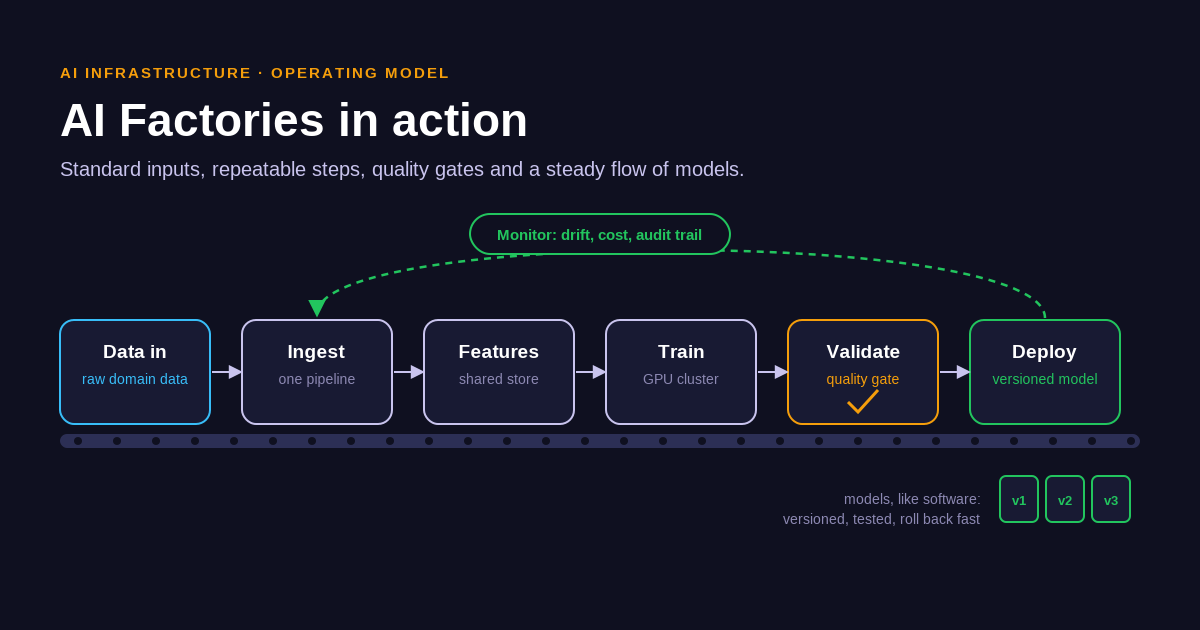
AI Factories are not a single product. They are an operating model: an organization treats the creation, training, and delivery of AI capabilities the same way it treats manufacturing — standardized inputs, repeatable processes, quality control, and continuous output.
For teams in Manufacturing, Supermarkets, Banking, Education, HealthTech, FinTech and Tax Returns, the subject means the same thing in practice: a reliable way to turn domain data into deployed models under constraints that matter in those sectors — latency, compliance, cost, and explainability. The vocabulary changes, the constraints do not. A supermarket cares about shelf-level demand; a bank cares about fraud latency; a tax firm cares about audit trails. The factory pattern stays.
What are AI Factories?
In developer terms, an AI Factory is a platform that owns the lifecycle from raw data to production inference. It centralizes data ingestion, feature engineering, training, validation, deployment, and monitoring so individual teams do not rebuild the same plumbing.
The idea is especially relevant to regulated industries. Manufacturing wants predictive maintenance without exposing plant networks. HealthTech wants clinical decision support with traceability. FinTech and Tax Returns need models that can be explained to auditors and rolled back quickly. Supermarkets and Education want personalization at scale without hand-tuning every experiment.
The core promise is consistency, not novelty. Models become artifacts with versioning, tests, and release gates, just like software.
How AI Factories Work
I can describe the pattern in my own voice because it is a design choice, not a mechanistic claim.
What actually runs where is implementation specific. I will not assert a specific data flow as fact without a source. The exact component wiring is a choice for the organization, and the right choice depends on data residency, latency budgets, and compute economics.
If you are evaluating hardware for a local factory node, the specifications are factual and citable. The NVIDIA DGX Spark is marketed as a desktop-scale AI workstation.
- It has a 10 GbE RJ-45 Ethernet port [1].
- It has two QSFP ports driven by NVIDIA ConnectX-7 NIC capable of up to 200 Gbps [1].
- It has 128 GB of coherent unified system memory [1].
- It has 20 Arm cores connected using C2C to a Blackwell generation GPU [2].
- It has 128GB of LPDDR5X shared memory, rated at 273GB/s [2].
- It is a 170W device [2].
- It supports 200GbE clustering with a second unit [2].
- It is designed for AI developers, researchers, data scientists, and students who need powerful, always-on AI compute on the desktop — without relying on cloud or data center access for every workload [3].
- It ships with DGX OS and additional NVIDIA tools [3].
- Up to 4 DGX Spark systems can be connected using NVIDIA ConnectX-7 networking [3].
- The enterprise manageability features developed for DGX Spark 128 GB can also be applied to DGX Spark 64 GB [3].
These numbers matter for a factory design because they define the unit economics of on-prem training and fine-tuning. For Banking and HealthTech, local compute can reduce data egress risk. For Manufacturing and Supermarkets with intermittent connectivity, a small cluster can run inference at the edge.
Benefits and Challenges of AI Factories
Benefits are organizational. Centralized tooling reduces duplicate work by providing shared data ingestion, feature stores and experiment tracking so teams do not rebuild pipelines per project. Model registry and promotion gates improve safety by enforcing versioning, automated tests and rollback procedures before production release. Monitoring creates feedback loops that let teams learn from production drift, latency and business KPIs and feed corrections back into training.
Challenges are also organizational. Data quality is the bottleneck; inconsistent schemas, missing lineage and retention gaps require data contracts and governance tooling before any model can be reliable. Governance becomes critical in HealthTech, Banking, FinTech and Tax Returns where a model decision can create legal exposure, requiring audit logs, explainability artifacts and human-in-the-loop review. Compute cost and power budgets matter in Manufacturing and Supermarkets where facilities are cost sensitive and on-prem hardware must fit existing power and cooling constraints.
A comparison of deployment targets helps teams choose trade-offs.
| Target | Latency | Data residency control | Operational cost | Typical fit |
|---|---|---|---|---|
| Cloud GPU cluster | Low to medium | Limited | Variable by usage | Experimentation, burst training |
| On-prem DGX Spark node | Low | Full | Fixed power ~170W per unit [2] | Local fine-tuning, sensitive data |
| Edge device | Very low | Full | Hardware + maintenance | Manufacturing line, store POS |
Building and Deploying AI Factories
Building starts with data contracts, not models. Define schemas, lineage, and retention. Then build pipelines that are reproducible.
A minimal training orchestration sketch looks like this:
# train_job.py
import argparse
from pipeline import load_data, preprocess, train, evaluate

def register(model, metrics, registry):
  # placeholder for model registry write
  print(f"Registering model to {registry}")

def main(args):
  ds = load_data(args.source)
  ds = preprocess(ds, args.config)
  model = train(ds, args.hparams)
  metrics = evaluate(model, args.val_set)
  if metrics["f1"] >= args.threshold:
  register(model, metrics, args.registry)
  else:
  raise SystemExit("quality gate failed")

if __name__ == "__main__":
  main()
Deployment is about packaging and observability. Containerize the model, version it, and attach metrics for drift, latency, and business KPIs. For sectors like Education and HealthTech, add audit logs for every prediction.
Real-World Applications of AI Factories
The pattern applies broadly with sector-specific constraints.
In Manufacturing, factories use predictive maintenance models trained on sensor data to reduce downtime. The factory pattern standardizes data ingestion from PLCs, feature engineering for vibration and temperature signals, and deployment to edge inference nodes with rollback on false positives.
In Supermarkets, demand forecasting and dynamic pricing models run on sales and inventory data. The AI Factory provides daily retraining pipelines, A/B testing for pricing policies, and monitoring for stock-out impact.
In Banking and FinTech, fraud detection and credit scoring models need real-time inference with explainability. Centralized registry and promotion gates ensure models meet audit requirements and can be rolled back quickly under regulatory pressure.
In Education, personalization models adapt content to learner progress. The factory enables experiment tracking across curricula, data governance for student privacy, and observability for learning outcomes.
In HealthTech, diagnostic support models require strict validation and traceability. Versioned datasets, model cards and audit logs are enforced by the factory controls.
In Tax Returns, classification models automate document extraction with audit trails. Data contracts guarantee retention policies and explainability for auditor review.
The Israel Defense Forces example illustrates industrialized AI at scale. Years before the Gaza war, Israel transformed its intelligence unit into an AI testing ground, triggering a debate among top commanders about whether humans were sufficiently in the loop [4]. To maintain the war’s breakneck pace, the IDF turned to an elaborate artificial intelligence tool called Habsora — or “the Gospel” — which could quickly generate hundreds of additional targets [4]. After the brutal Oct. 7, 2023, attack by Hamas, the Israel Defense Forces deluged Gaza with bombs, drawing on a database painstakingly compiled through the years that detailed home addresses, tunnels and other infrastructure critical to the militant group [4].
That is not a blueprint for civilian factories, but it illustrates a core lesson: when an organization industrializes AI, the factory does not just produce models, it produces decisions at speed. Governance, human oversight, and quality gates become the critical control points.
For civilian sectors, the lesson translates to: build the factory with safety rails first, then scale throughput.
Plan, cost and build your AI factory
The pattern is the same at any size; what changes is the hardware, where it runs and how you pay for it. These tools help you put numbers on it:
- AI factory systems: the servers, GPUs and racks we build and install, from a single node to a full cluster.
- AI data centre planner: how much power, cooling and rack space your GPUs need, and where to host them.
- GPU lease-or-buy calculator: compare on-demand cloud, reserved capacity, leasing and buying with your own quotes.
- GPU rental cost calculator: renting machines, per-hour cloud GPUs and rent-to-buy, for a project or a peak.
- GPU clusters: networking, storage and the software stack that turn servers into one factory.
References
- NVIDIA DGX Spark In-Depth Review: A New Standard for Local AI Inference - LMSYS Org — lmsys.org (14 October 2025)
- The NVIDIA DGX Spark is a Tiny 128GB AI Mini PC Made for Scale-Out Clustering — servethehome.com (1 April 2025)
- NVIDIA DGX Spark: AI Supercomputer on Your Desk — nvidia.com (24 August 2025)
- Israel built an ‘AI factory’ for war. It unleashed it in Gaza. — washingtonpost.com