Provable Correctness Fails in AI

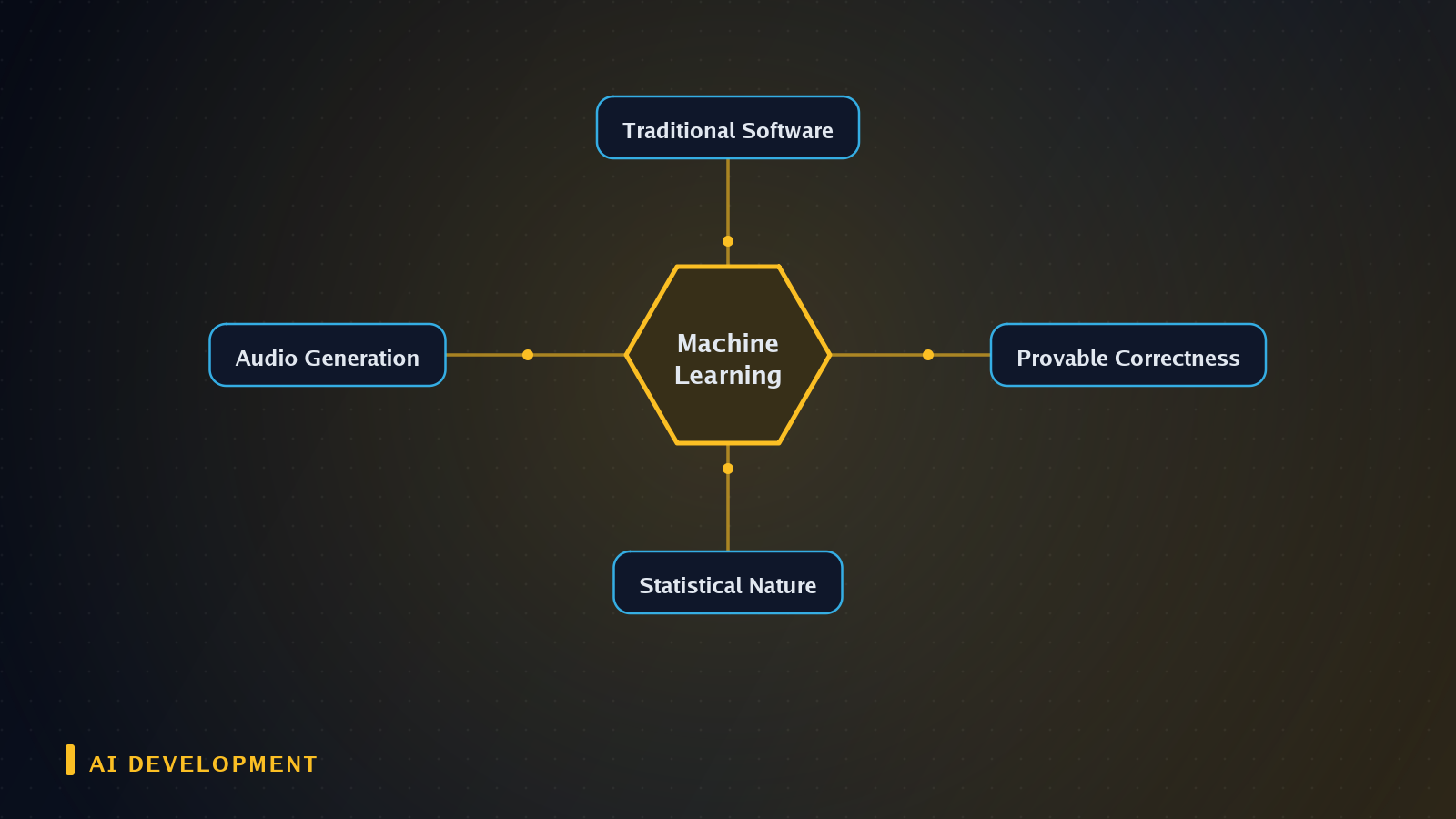
Traditional software engineering gives teams a contract: requirements, tests, and a proof that the code does what it says. Machine learning breaks that contract. For teams in banking, education, HealthTech, FinTech and tax returns, the consequence is not academic — it is regulatory exposure, patient safety, and financial risk when a model behaves statistically correctly but operationally wrong.
The Limits of Traditional Software Engineering
In conventional engineering, provable correctness means a specification can be shown to hold for all inputs via tests and formal checks. The property is deterministic and repeatable across runs.
The provable correctness of software engineering does not extend to AI and machine learning. That is not a tooling gap. It is a conceptual mismatch.
In banking and tax returns, this shows up when a rules engine is replaced by a model for fraud detection or refund eligibility. A rules engine can be audited line-by-line. A model can only be evaluated on distributions. In HealthTech and education, a model that scores risk or personalises learning cannot be proven correct for every individual patient or student; it can only be shown to perform within statistical bounds on a historical population.
The shift matters for governance. Regulators in finance and health expect traceability and deterministic decisions. A model that changes with retraining, data drift, and deployment context does not provide the same kind of evidence as a software release with unit tests.
Machine Learning's Statistical Nature
Software is built from specifications. Machine learning systems feed in lots of data in order to detect patterns and generate predictions. Put another way, the purpose of machine learning is to create a statistical proxy that can serve as a specification for one of these tasks.
That proxy is the product. It is learned, not written.
For FinTech credit models or tax-return classifiers, the specification is not "if income > X then approve". It is "find a function that approximates the target on this data distribution". When the distribution shifts — new products, new legislation, a pandemic — the proxy degrades silently.
This creates a different lifecycle:
The loop is continuous. Traditional software moves from validation to maintenance. ML moves from deployment back to monitoring and retraining.
A practical implication for banking and HealthTech teams is that quality is measured by distribution-level metrics, not pass/fail tests.
Traditional vs ML quality
| Dimension | Traditional Software | Machine Learning |
|---|---|---|
| Specification | Explicit requirements | Statistical proxy from data |
| Correctness | Provable, deterministic | Probabilistic, distribution-dependent |
| Validation | Unit/integration tests | Hold-out sets, metrics, drift monitoring |
| Change control | Code review + tests | Data + retraining + A/B evaluation |
Challenges in Audio Generation
Audio generation makes the limits visible. Generating high-fidelity audio of any kind requires modeling complex signals and patterns at varying scales. Music is arguably the most challenging type of audio to generate because it’s composed of local and long-range patterns, from a suite of notes to a global musical structure with multiple instruments.
Historically, generating coherent music with AI has often been addressed through the use of symbolic representations like MIDI or piano rolls. Symbolic methods are easier to verify, but they lose timbre, expressive timing, and acoustic nuance.
Modern approaches move toward raw waveform modeling. The AudioCraft family of models is capable of producing high-quality audio with long-term consistency, and it can be easily interacted with through a natural interface.
For HealthTech and education, this matters when voice is part of the product: medication adherence prompts, language learning pronunciation feedback, or accessibility narration in banking apps. A voice model that sounds plausible can still mispronounce drug names or produce unstable prosody across languages. The failure mode is not a crash; it is a subtle, statistically rare error with real-world harm.
In FinTech and tax returns, the parallel is synthetic voice for call centers or document narration. The controllable parameters are statistical knobs, not guarantees of intelligibility or compliance.
Alternative Approaches for Machine Learning
If provable correctness is unavailable, teams in regulated sectors adopt compensating practices.
Data-centric governance. Treat datasets as first-class artifacts with lineage, bias audits, and retention policies. For tax returns, this means documenting what filings were used and when laws changed. For health, it means consent and de-identification provenance.
Continuous monitoring and triage. Production ML needs observability of inputs, outputs, and performance. A minimal monitoring config for a model serving endpoint might look like:
model_monitor:
  inputs:
  - feature_drift: psi_threshold: 0.2
  - label_drift: ks_threshold: 0.15
  outputs:
  - prediction_distribution
  - latency_p95
  alerts:
  deduplication: true
  severity_triage: true
Human-in-the-loop and constraints. In banking and HealthTech, high-risk decisions require review. Models can propose, humans dispose. Guardrails can be expressed as constraints on outputs, not as tests on code.
Evaluation as a product. Replace a single accuracy number with a test suite of slices: demographic groups, edge cases, adversarial inputs. For education, evaluate per subject and per proficiency band. For FinTech, evaluate per product line and region.
Documentation and explainability. Model cards, data sheets, and risk registers become the auditable artifact that regulators can review when code proofs are impossible.
These approaches do not restore provable correctness. They replace it with statistical accountability, observable drift, and controlled human oversight — a different engineering discipline that fits the nature of machine learning.
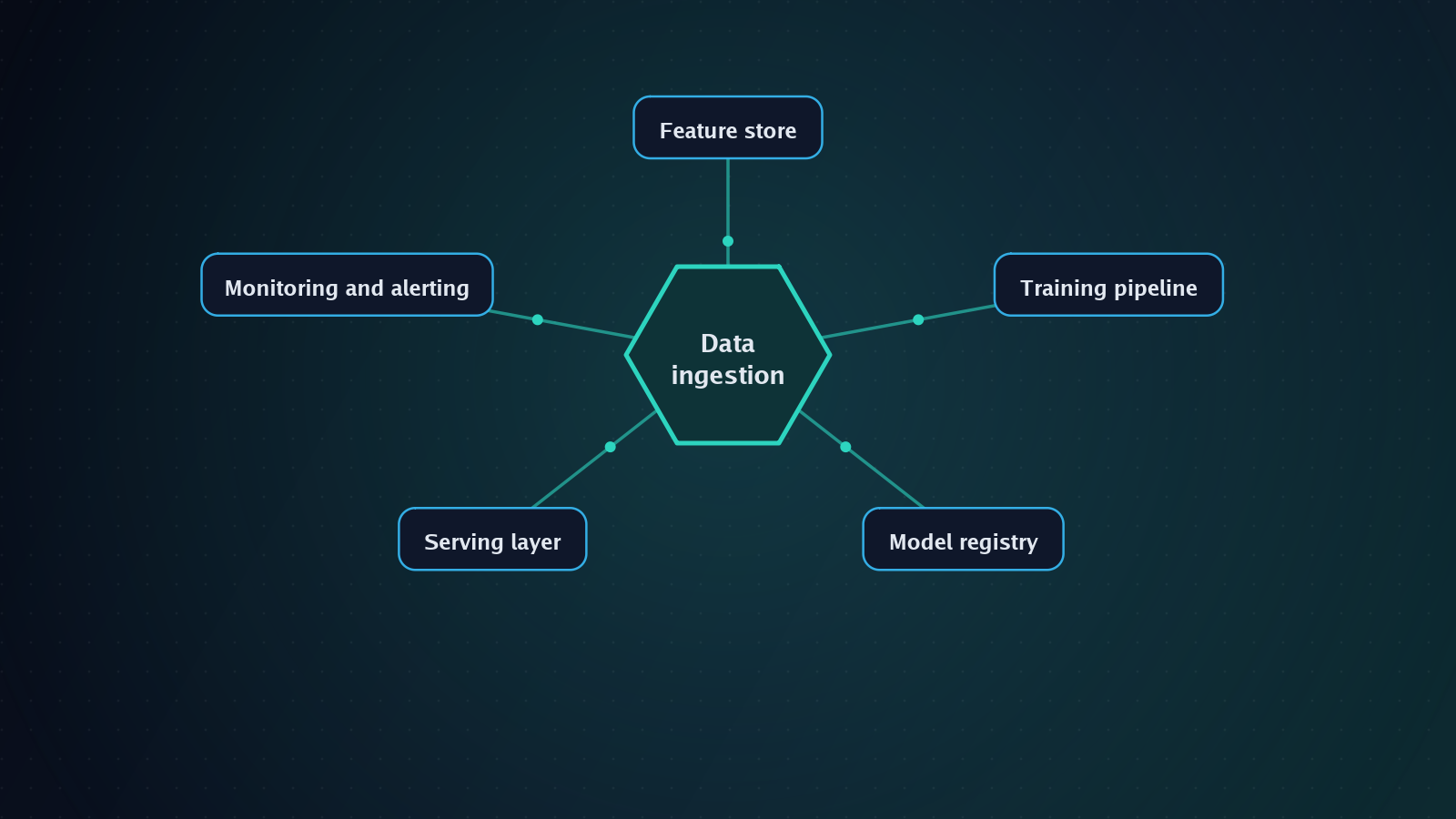
The industries you serve cannot wait for perfect proofs. They need systems that are transparent about uncertainty, monitored for drift, and governed for risk. That is the engineering reality when provable correctness fails in AI.