NVIDIA's Sub-50MB AI Engine

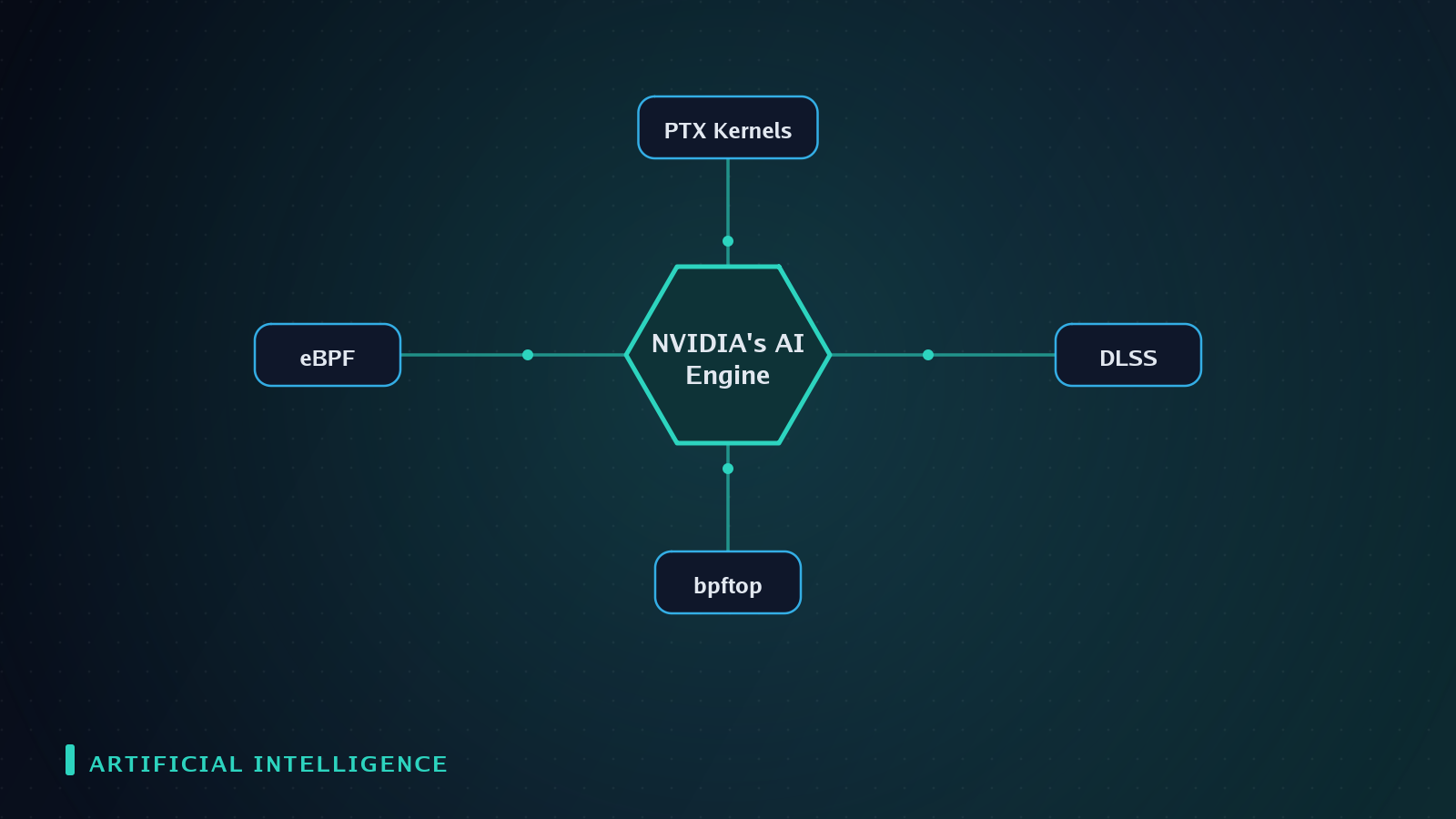
NVIDIA's Sub-50MB AI Engine: A Game-Changer for Consumer Devices
The landscape of artificial intelligence on consumer hardware is undergoing a significant shift. Traditionally, running advanced AI models required substantial computational resources, often relying on large, cloud-based services or high-end server clusters. However, recent developments suggest that sophisticated agentic, voice, and vision intelligence can now fit within remarkably small footprints. NVIDIA has developed a sub-50MB agentic, voice and vision intelligence for consumer devices [1]. This breakthrough indicates a move towards local-first AI, where complex inference tasks are executed directly on the user's hardware rather than being offloaded to remote servers.
For developers, the implications are profound. A package this small significantly reduces the barrier to entry for integrating advanced AI features into applications. The deployment model is straightforward. The package downloads and caches the engine and requested model weights on first use [1]. This ensures that subsequent executions are fast and do not require network latency for model loading, provided the cache is intact. Crucially, inference runs locally and does not require JAX [1]. This dependency reduction is a critical feature for developers targeting diverse consumer environments, as it simplifies the installation and maintenance process. The engine supports Python 3.9 or later [1], ensuring compatibility with modern Python ecosystems while maintaining a low system footprint.
PTX Kernels and DLSS Advancements
While the sub-50MB engine represents a step in general-purpose consumer AI, NVIDIA's advancements in graphics processing and deep learning super sampling (DLSS) continue to push the boundaries of performance in real-time rendering and simulation. These technologies rely on highly optimized kernel implementations that leverage specific hardware capabilities to achieve high throughput with minimal latency.
One area of focus is the development of PTX (Parallel Thread Execution) kernels. These kernels are designed to emit PTX code for the "fast route" of computation, utilizing specific instructions that are highly efficient on modern NVIDIA GPUs. NVIDIA's latest inventions include PTX kernels that emit PTX for the fast route: mma.sync E4M3 with f16 accumulation, cp.async rings, barrier-free chaining through device counters, split-K GEMMs, and streamed global attention [2]. This combination allows for high-precision calculations with reduced bandwidth requirements, a critical factor in memory-bound operations. Additionally, the implementation of cp.async rings enables asynchronous copy operations, which help in overlapping data transfer with computation, thereby reducing idle time on the GPU.
Another key advancement is barrier-free chaining through device counters [2]. This technique allows multiple kernels or stages of a pipeline to execute sequentially without the overhead of traditional synchronization barriers. By using device counters to track progress, the system can maintain high concurrency and minimize stalls, leading to smoother performance in continuous workloads. This is particularly beneficial in applications where latency is a primary concern, such as real-time video processing or interactive simulations.
Furthermore, the use of split-K GEMMs (General Matrix Multiplications) [2] optimizes the computation of large matrices by splitting them into smaller chunks. This approach allows for better parallelism and utilization of the GPU's cores, especially when dealing with large batch sizes or wide matrices. Finally, streamed global attention [2] enhances the processing of long sequences by allowing attention mechanisms to be applied globally across the entire sequence, rather than in localized windows. This is crucial for tasks like natural language processing or long-context video analysis, where understanding the full context is essential.
The integration of these advanced kernels into frameworks like Filament demonstrates the practical application of these techniques. The network inside a Filament (Apache-2.0) frame includes Filament patched for per-object motion vectors and a Vulkan interop hook, glTF scenes through gltfio, and ImGui controls [2]. This allows for efficient rendering of complex scenes with dynamic lighting and shadows. The use of glTF scenes through gltfio and ImGui controls [2] further enhances the developer experience, providing a robust pipeline for loading and interacting with 3D content. The dlss5vk tool runs single frames with no history, which is what the reference captures were made with [2].
bpftop: Streamlining eBPF Performance Optimization
While NVIDIA's advancements focus on GPU-accelerated AI and graphics, the underlying efficiency of such systems often depends on the performance of the operating system and kernel-level services. One tool that has gained attention for its role in streamlining eBPF (Extended Berkeley Packet Filter) performance optimization is bpftop. Developed by Netflix, bpftop is a command-line tool designed to streamline the performance optimization and monitoring of eBPF programs [3].
eBPF is a powerful technology that allows for safe, sandboxed programs to run in the Linux kernel without modifying the kernel source code. It is widely used for networking, security, and observability tasks. However, monitoring and optimizing eBPF programs can be challenging, as they run in kernel space and have a direct impact on system performance. bpftop addresses this by providing a dynamic real-time view of running eBPF programs [3].
The tool displays several key metrics for each program, including the average execution runtime, events per second, and estimated total CPU percentage [3]. This information is invaluable for developers and system administrators who need to identify performance bottlenecks or ensure that their eBPF programs are not consuming excessive resources. By providing a clear and concise view of these metrics, bpftop enables users to make informed decisions about optimizing their code or adjusting their deployment strategy.
One of the standout features of bpftop is its minimal overhead. The tool minimizes overhead by enabling performance statistics only while it is active [3]. This means that when bpftop is not in use, there is no additional performance cost to the system. This is a critical consideration for production environments, where even small overheads can add up to significant performance degradation over time. By design, bpftop ensures that the act of monitoring does not itself become a performance issue.
bpftop is written in Rust, leveraging the libbpf-rs and ratatui crates [3]. The use of Rust ensures that the tool is memory-safe and performant, while libbpf-rs provides a high-level API for interacting with the eBPF infrastructure. The ratatui crate is used to create the terminal user interface, providing a clean and responsive display of the performance data. This combination of technologies makes bpftop a robust and reliable tool for eBPF performance optimization.
Technical Details and Use Cases
To better understand the technical landscape, it is useful to compare the characteristics of these different tools and technologies. The following table provides a high-level overview of the key features of the sub-50MB AI engine, the PTX kernel advancements, and bpftop.
| Feature | NVIDIA Sub-50MB AI Engine | PTX Kernel Advancements | bpftop |
|---|---|---|---|
| Primary Function | Local AI inference (voice, vision, agentic) | Fast-route GPU computation via PTX | eBPF performance monitoring |
| Footprint | Sub-50MB | N/A (Code optimization) | Command-line tool |
| Dependencies | Python 3.9+, no JAX | Vulkan, Filament, gltfio, ImGui | Rust, libbpf-rs, ratatui |
| Key Technique | Local caching, local inference | mma.sync E4M3, cp.async, split-K GEMMs | Real-time stats, minimal overhead |
| Target Audience | Consumer app developers | Graphics/Rendering engineers | Systems/kernel developers |
The use cases for these technologies are distinct but complementary. The sub-50MB AI engine is targeted at consumer devices [1]. For developers, this implies a local-first approach where inference runs without JAX [1], and the engine and weights are cached on first use [1]. This supports offline-capable workflows, as inference runs locally [1].
The PTX kernel advancements are primarily targeted at developers working on high-performance graphics and simulation software. These techniques, such as mma.sync E4M3 with f16 accumulation and streamed global attention [2], are implemented within frameworks like Filament [2]. The dlss5vk tool, for instance, utilizes these capabilities to run single frames with no history [2], which aligns with specific reference capture scenarios [2]. This focus on optimized fast-route execution [2] allows for specific rendering and computation tasks to be handled efficiently on compatible hardware.
bpftop, on the other hand, is a tool for system administrators and developers who work with kernel-level services. It is particularly useful in environments where eBPF is used for networking, security, or observability. By providing a clear view of eBPF program performance [3], bpftop helps ensure that these critical services are running efficiently. It displays average execution runtime, events per second, and estimated total CPU % [3], allowing for precise identification of bottlenecks. The tool minimizes overhead by enabling performance statistics only while it is active [3], making it suitable for continuous monitoring in production environments.
Conclusion and Future Directions
The developments outlined in this article highlight a broader trend towards more efficient, localized, and optimized software solutions. NVIDIA's sub-50MB AI engine represents a significant step forward in making advanced AI accessible on consumer devices [1]. By reducing the footprint and dependencies of AI systems, NVIDIA is lowering the barrier to entry for developers. The engine runs locally [1] and does not require JAX [1], simplifying the integration process. The download and cache mechanism [1] ensures rapid subsequent access without network dependency.
The advancements in PTX kernels and DLSS further demonstrate NVIDIA's commitment to pushing the boundaries of GPU performance. Techniques such as barrier-free chaining through device counters and split-K GEMMs [2] are specific optimizations for the fast route of computation [2]. The integration of these advanced kernels into open-source frameworks like Filament [2] ensures that these benefits are available to developers working on rendering pipelines. Tools like dlss5vk [2] provide specific utilities for capturing and analyzing these optimizations in a controlled, single-frame environment [2].
Meanwhile, tools like bpftop are helping to streamline the performance optimization of critical system-level services. By providing a clear and concise view of eBPF program performance [3], bpftop enables developers to ensure that their systems are running efficiently. The tool’s design minimizes overhead [3], making it a practical choice for monitoring in performance-critical applications.
In conclusion, the developments discussed in this article represent a significant advancement in the field of software development. By focusing on efficiency, locality, and optimization, these technologies serve specific needs across consumer AI, high-performance graphics, and systems monitoring. As these technologies continue to evolve, they will play an increasingly important role in shaping the future of computing.
References
- cactus-compute/cactus — github.com (7 November 2026)
- maanHimself/OpenDLSS-NR — github.com (21 September 2026)
- Announcing bpftop: Streamlining eBPF performance optimization — netflixtechblog.com (27 February 2024)