From the Hall at GTC Berlin: Huang Says AI Is Now Productive
Workstation engineers were at STATION-Berlin for the 21 October 2026 keynote. Huang's turn was from factories to agents that spend tokens.
 Workstation teamNovember 9, 20261 min read
Workstation engineers were at STATION-Berlin on 21 October 2026 for Jensen Huang's GTC keynote. He treated the GPU factory as settled, then asked what to do with it. His answer was agents: they think in loops, they spend tokens, and they are why GPU demand has jumped.
The turn he named
Huang said this past year is when AI became productive. He pointed back to OpenClaw, earlier in the year, as the open-source agent that started the pattern now everywhere: software that reasons, iterates and calls tools. Useful, he said, because of that loop. Expensive, because every loop spends tokens. He did not put a token chart on that sentence. The direction was the point.
Five parts
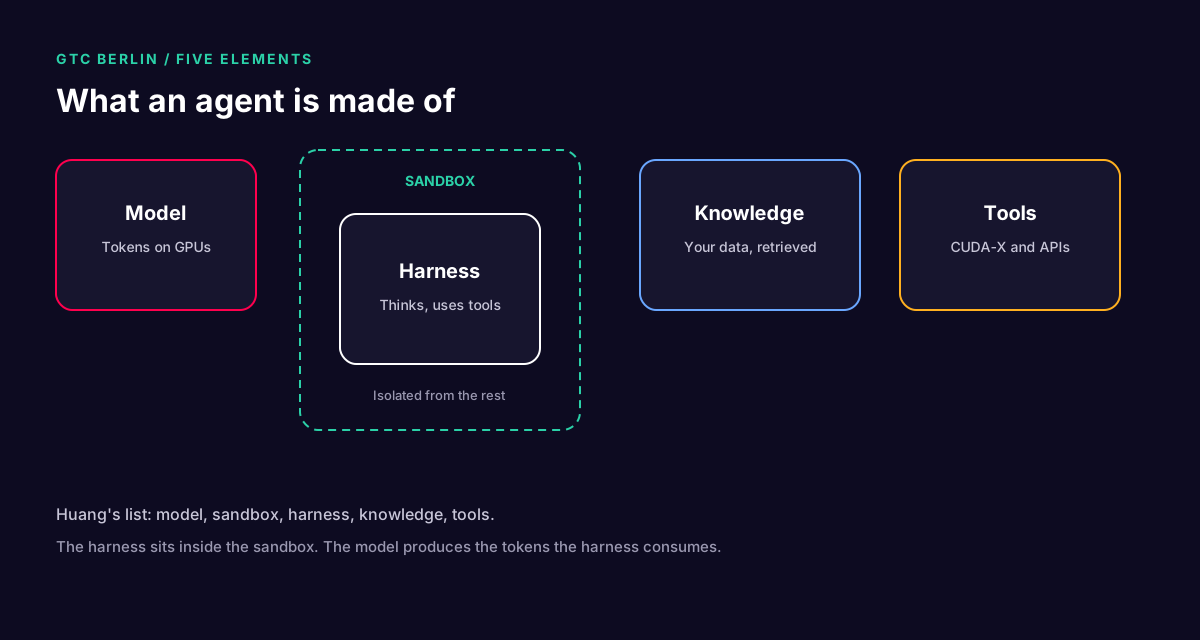
An agent, in his definition, is a model, a sandbox, a harness inside that sandbox, knowledge, and tools. The model runs on GPUs and produces tokens. The harness consumes them. The sandbox is what isolates the harness from the rest of the machine. Knowledge and tools are what make it specific to a company.
He would not talk about making agents useful until he had talked about making them safe. That announcement was OpenShell, with Sentry on BlueField-4. The long notes from the same keynote are:
- What he said, and what it means on one machine
- OpenShell and Sentry
- The knowledge foundation
- DSX and Europe's AI economy
NVIDIA's same-day press note is the source for the performance figures attached to Vera Rubin, Vera and Sentry. Those figures are theirs. The transcript is SB61112.