AI Guidance Gap Widens

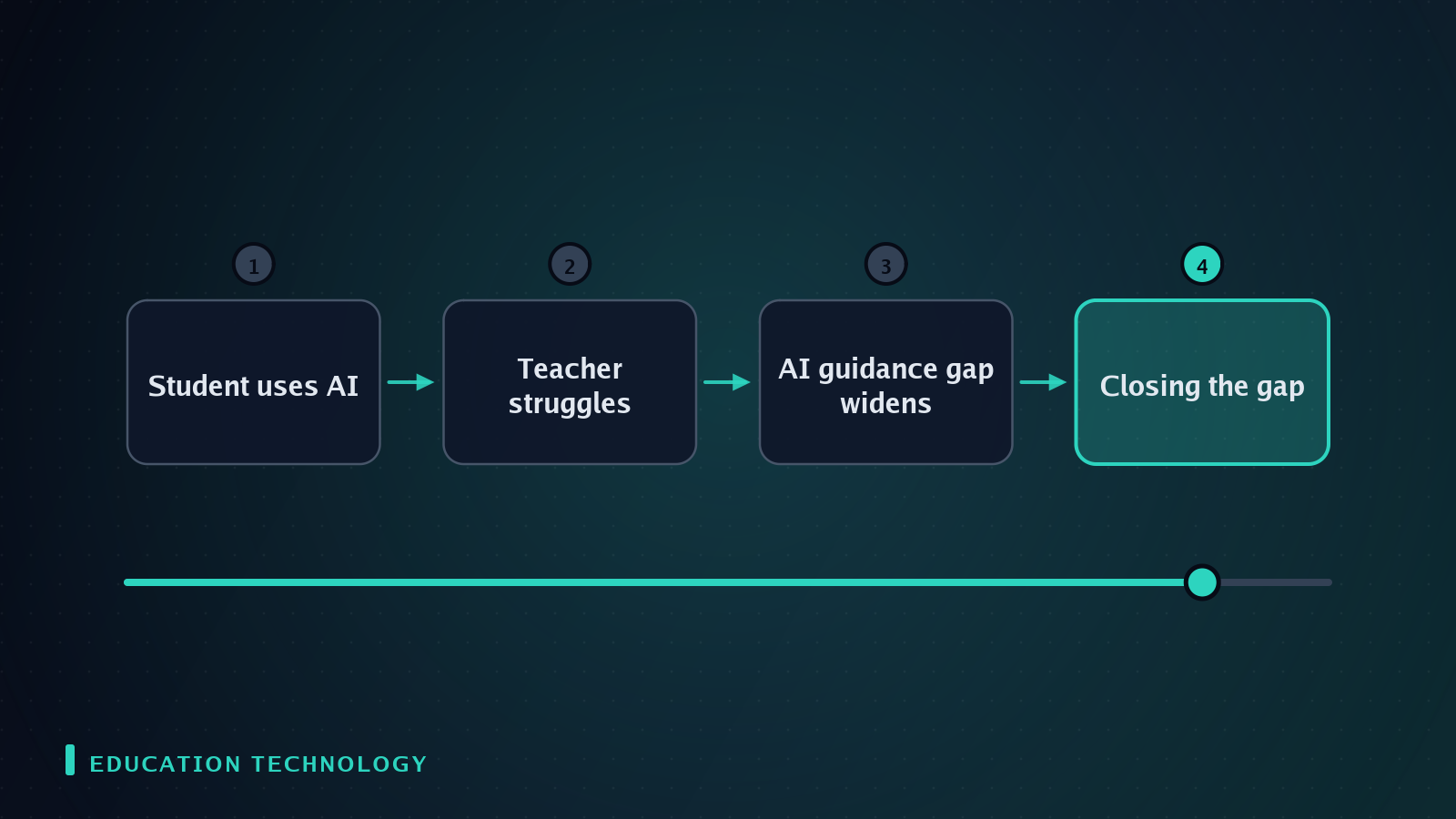
The gap between how widely AI is used in education and how well it is taught is widening. For professionals in banking, education, health tech, fintech and tax returns, the pattern is the same: students and early-career staff adopt tools first, and formal guidance arrives later, if at all. The consequences in regulated sectors are not just academic; they are compliance, risk and trust problems.
The AI Guidance Gap in Education
New research from ThinkYoung highlights a clear guidance gap: 79% of surveyed students reported using AI for homework or assignments, but only 47% reported being shown how [1]. Closing the AI guidance gap in education is becoming increasingly urgent [1].
In education, that gap means students learn by trial and error. In banking and fintech, it translates to analysts using generative tools for summarising reports or drafting client notes without training on hallucination risk or data handling. In health tech and tax returns, the stakes are higher: an unsupervised AI summary of clinical notes or tax law can embed errors that later require expensive remediation.
The sector framing matters because constraints differ. Education can tolerate exploratory use. Banking, health tech, fintech and tax returns cannot tolerate undocumented provenance or unvetted output. Adoption outpaces literacy across fields, with varying risk profiles and implementation barriers.
The Rise of AI in Homework and Assignments
Homework use is the visible entry point. Students report using AI for drafting, paraphrasing and problem solving. Teachers often discover the usage after the fact.
For institutions serving banking, fintech and tax sectors, the parallel is internship and onboarding work. Junior staff are asked to produce market briefs, code snippets, or regulatory summaries, and they turn to AI because it is fast. Without guidance, they also learn to trust first outputs.
The guidance gap is not about prohibition. It is about showing how to prompt, verify, cite and log. Where guidance is absent, students develop private norms that may conflict with professional standards such as audit trails and data minimisation.
The Challenges of Agentic AI
Agentic AI raises the guidance problem from single prompts to multi-step workflows. The way AI agents are being implemented is making them insecure, unreliable, and open to surveillance [2].
Agentic AI isn't just intrusive and vulnerable to threats; it's also unreliable. AI agents are probabilistic, not deterministic, and that each step they take in a task degrades their accuracy and the final action [2].
She said if an AI agent could perform each step with 95% accuracy–which currently isn't possible–a 10-step task would yield an action with a ~59.9% success rate. And if you had a 30-step task, the success rate would be ~21.4% [2].
Furthermore, if we used a more realistic accuracy rate of 90%, then a 30-step task would drop down to a success rate of 4.2%. She added that the best agent models failed 70% of the time [2].
In banking and tax returns, a multi-step agent that retrieves client data, applies rules, and drafts a filing is a composite risk. Each step compounds error and exposes data to tool calls. In health tech, a 30-step diagnostic assistance workflow with 21.4% success at 95% per step [2] is not a teaching tool; it is a liability.
The ecosystem is expanding fast. There are now more than 10,000 active public MCP servers, covering everything from developer tools to Fortune 500 deployments [3]. MCP has been adopted by ChatGPT, Cursor, Gemini, Microsoft Copilot, Visual Studio Code, and other popular AI products [3]. Enterprise-grade infrastructure now exists with deployment support for MCP from providers including AWS, Cloudflare, Google Cloud, and Microsoft Azure [3].
That scale means students and junior professionals encounter agent tooling before they learn threat models, data governance or verification.
Language Design for AI-Driven Development
When education moves to AI-assisted coding, language design becomes pedagogical design. Language design in the service of software engineering requires not just a language, but an end-to-end platform with tooling all around the software development life cycle [4].
Out of the box, the Go platform provides a built-in formatter, test framework, dependency management, and advanced security tools—all accessible directly from the standard toolchain [4].
Go prioritizes readability over writability, which is beneficial for AI-driven development [4]. When the syntax is entirely predictable, a human developer can spot a hallucinated API call, a logic flaw, or a security vulnerability more quickly [4].
For teaching in banking and fintech contexts, readability and standardization reduce the review burden. Students can inspect AI-generated Go code more reliably than code in languages with many stylistic variants. Predictable formatting and built-in tooling also make it easier to teach verification habits: run go fmt, run tests, check dependencies.
// Example teaching scaffold for AI-assisted code review
package main

import "fmt"

func main() {
  // AI can generate this; student must verify
  value:= 42
  fmt.Println("Result:", value)
}
A comparison of language traits relevant to AI-assisted learning:
| Trait | Impact for AI guidance | Sector relevance |
|---|---|---|
| Readability over writability | Easier for students and reviewers to spot hallucinations | Banking, health tech audit trails |
| Built-in formatter & tests | Standard verification loop from day one | Fintech compliance, tax code correctness |
| Predictable syntax | Humans and AI models work together more efficiently | Education scaffolding, onboarding |
Closing the Gap: Solutions and Best Practices
Closing the gap requires deliberate practice, not bans.
For teachers and students:
- Make usage visible. Require prompt logs and source attribution for AI-assisted work.
- Teach verification as a skill. Quick iterations with online A/B experiments are key, as offline metrics are often only rough proxies of user value [5].
- Scale tasks appropriately. ML-based automation of larger-scale tasks — from diagnosis of an issue to landing a fix — has begun to show initial evidence of feasibility [5].
For institutions in banking, health tech, fintech and tax returns:
- Define acceptable use by data type, not by tool. Separate public data practice from client data practice.
- Provide sandboxed environments with logging. If agents are used, constrain tool access and require human approval for external calls.
- Invest in literacy modules that match professional standards. Show how to test AI output, how to recognize degradation across multi-step tasks, and how to document provenance.
Implementation in regulated sectors faces barriers including compliance requirements, legacy systems, and resourcing for training. Adoption of solutions is not automatic and requires explicit change management and educator skill development.
The guidance gap will not close on its own. Adoption is already at 79% for homework use [1], and agent infrastructure is industrializing. Guidance must be built into curricula, onboarding and tooling choices, with the constraints of the sectors students will enter.
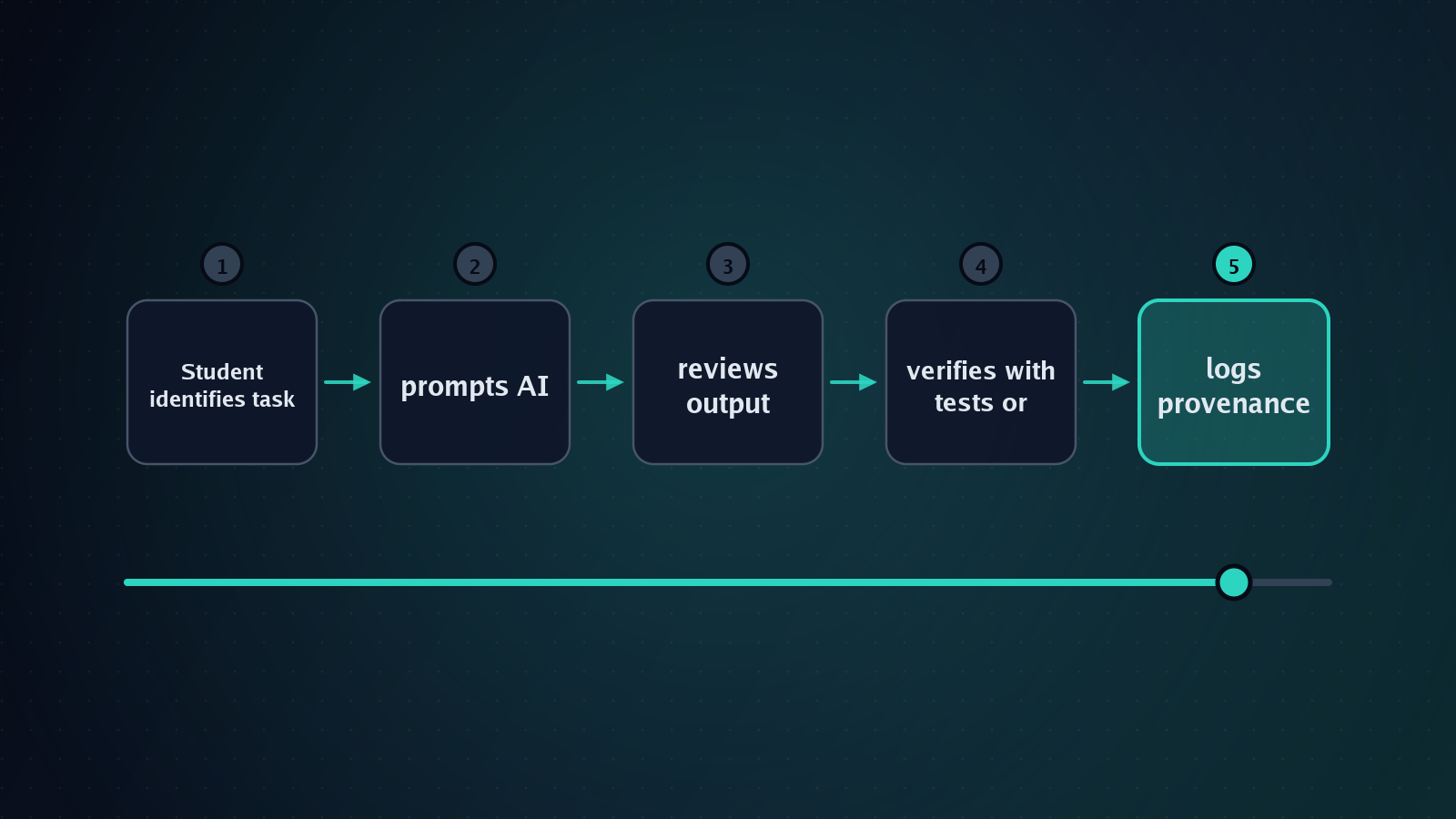
Teaching students to guide AI is the same as teaching professionals to guide automation: set boundaries, verify outputs, and keep humans accountable for final decisions.
References
-
Closing the AI guidance gap in education — openai.com
-
'Signal' President and VP warn agentic AI is insecure, unreliable, and a surveillance nightmare — coywolf.com (13 January 2026)
-
Donating MCP to the Agentic AI Foundation \ Anthropic — anthropic.com (9 December 2025)
-
[Why Go is an Ideal Language for AI-Assisted Software Engineering
- Google Developers Blog](https://developers.googleblog.com/why-go-is-an-ideal-language-for-ai-assisted-software-engineering/) — developers.googleblog.com (11 August 2026) -
AI in software engineering at Google: Progress and the path ahead — research.google (6 June 2024)