TuneBench: AI Agents Hit 99.5% Accuracy

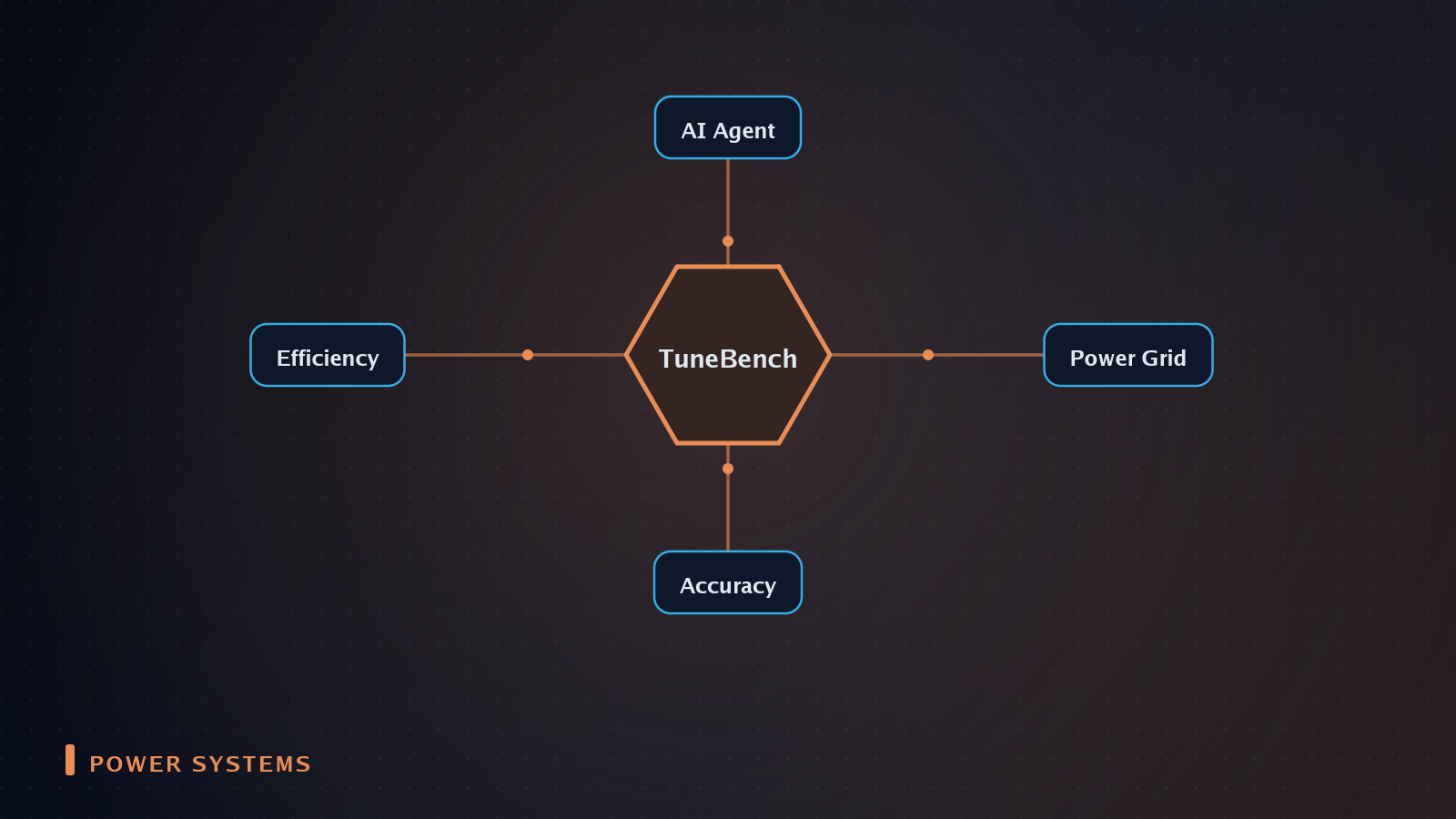
What is TuneBench?
TuneBench is built around two cases of increasing complexity: the governor and Automatic Voltage Regulator (AVR) of a synchronous generator and the control system of a Battery Energy Storage System (BESS), both tuned against active-power and voltage step tests within a budget of 15 simulations [1].
Performance is measured against target trajectories. Only the most advanced models, Opus 5.5 and GPT-6, accurately reproduce all target trajectories, with median R2 above 0.995 in every test and tracking errors up to two orders of magnitude lower than the baselines [1].
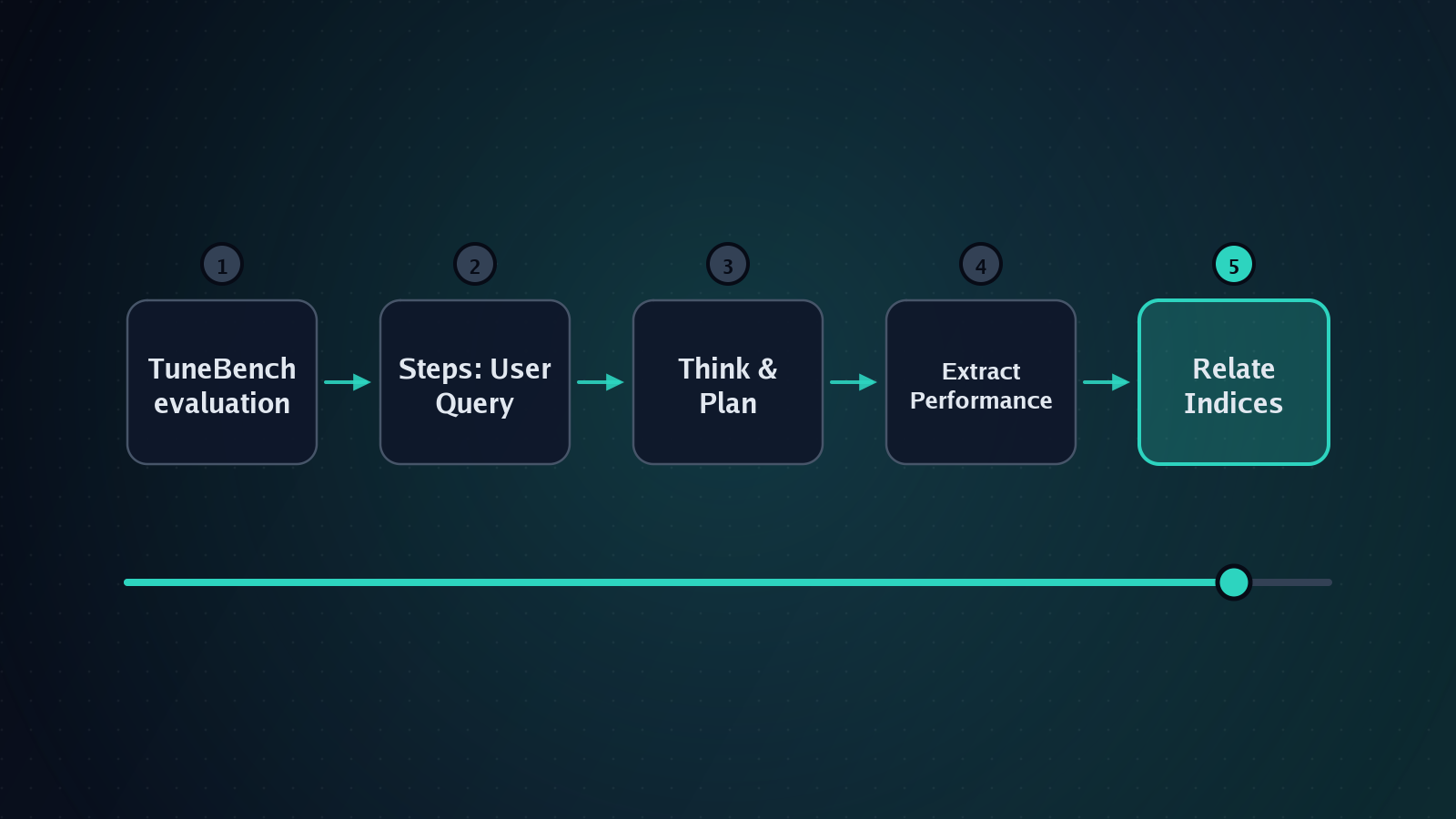
LLM-based agents are compared with random search and Genetic Algorithm (GA) baselines over 10 independent runs [1]. The agent logs show that these agents autonomously extract dynamic performance indices, such as settling time and damping, and relate them to specific control parameters, decomposing the tuning problem into physically interpretable sub-problems [1].
Benefits of Using AI in Power System Dynamic Model Calibration
Learn how to benchmark AI agents for power system dynamic model calibration and discover the benefits and challenges of using AI in this domain.
The core benefit demonstrated by TuneBench is accuracy under a tight simulation budget. Only the most advanced models, Opus 5.5 and GPT-6, accurately reproduce all target trajectories, with median R2 above 0.995 in every test and tracking errors up to two orders of magnitude lower than the baselines [1].
The agent logs show that these agents autonomously extract dynamic performance indices, such as settling time and damping, and relate them to specific control parameters, decomposing the tuning problem into physically interpretable sub-problems [1].
In agentic systems generally, an agentic system is essentially a network of specialized AI agents, working together like a well-coordinated team of experts toward a common goal [2]. Each agent is powered by a Large Language Model (LLM) but is carefully constrained in these ways: a specialized prompt that defines its role, context, and expertise, and a specific set of tools it can use [2].
The interaction between agents is governed by a directed graph structure, where each node is a computation/processing step, and each edge defines the possible communication paths [2]. Our agentic system is built on LangGraph, a powerful framework for orchestrating these complex agent interactions [2].
A practical benefit for operationalizing agents is efficiency. Caching by prompt hash can save 40% of API calls [3]. Parallel execution can turn 5-minute tasks into 30-second tasks [3]. Stateless agents are less prone to bugs [3]. Most tasks need simple agents [3].
| Approach | Typical Strength | Typical Cost |
|---|---|---|
| Random search | Simple to implement | High simulation budget |
| Genetic Algorithm | Explores parameter space | No semantic reasoning |
| LLM agent | Extracts performance indices and relates to parameters [1] | Needs broader data access [4] |
Challenges of Using AI in Power System Dynamic Model Calibration
The range of actions agents are expected to be able to perform will necessitate more and broader access to systems and data [4]. Increased autonomy and usage of more complex tools will allow agents to perform more actions than AI systems have seen so far [4].
This creates governance and safety constraints. Each agent type should have its own database role with the minimum necessary privileges [5]. Tables that agents can write to should use soft deletes with a deleted_by column that captures agent identity [5]. Column comments should be written as docstrings [5].
Workflow reliability requires explicit planning. The Think & Plan step in the workflow is responsible for devising a strategy to fulfill the user's request and performs process reflection [6]. The Think & Plan step is essential for orchestrating multi-step processes and evaluating whether each step is bringing the system closer to the goal [6].
Without a dedicated space for process reflection, the system would attempt to execute these steps linearly without evaluating whether each step is bringing it closer to the goal. With the thinking step in place, the system can pause, assess its progress in the workflow, and intelligently plan the subsequent tool calls needed to complete the user's request.
The Researcher Agent is being evolved into a hierarchy of domain-specific sub-agents to manage data across multiple preclinical domains [6]. That hierarchical decomposition is analogous to separating governor tuning from AVR tuning in TuneBench.
For power systems, broader access means crossing operational data boundaries. The principle of least privilege and auditable writes applies directly. Model validation requires reproducible cases, a fixed simulation budget, and a clear fidelity metric.
The workflow above reflects the observed behavior that agents autonomously extract dynamic performance indices and relate them to specific control parameters [1], within the simulation budget described in the benchmark [1].
-- Example defensive database roles for agentic access
CREATE ROLE agent_tuning_readonly;
CREATE ROLE agent_tuning_writer;

-- Soft delete audit
ALTER TABLE simulation_runs
ADD COLUMN deleted_at TIMESTAMP,
ADD COLUMN deleted_by VARCHAR(255);
Real-World Applications of TuneBench
TuneBench provides a reproducible way to compare agents. LLM-based agents are compared with random search and Genetic Algorithm (GA) baselines over 10 independent runs [1].
The benchmark covers two cases: governor and AVR of a synchronous generator and control system of a Battery Energy Storage System (BESS), both tuned against active-power and voltage step tests within a budget of 15 simulations [1].
For power grid operators, the implication is faster and more reliable model calibration for stability studies and control design. The same benchmarking discipline applies elsewhere. In Banking and FinTech, you would benchmark agents that calibrate risk models against historical stress tests with a limited evaluation budget. In Tax Returns, you would benchmark agents that select and configure data sources.
The system provides AI-assisted source recommendations to users when they have not selected any data source or have selected several without a clear focus [6]. This pattern of intent analysis and source suggestion is relevant when agents must choose which datasets to use for calibration.
Conclusion
TuneBench shows that the most advanced models, Opus 5.5 and GPT-6, can reach median R2 above 0.995 in every test with tracking errors up to two orders of magnitude lower than baselines [1]. Agents achieve this by autonomously extracting dynamic performance indices such as settling time and damping and relating them to specific control parameters [1].
The benchmark is specific to power system dynamic model calibration. The broader lesson for Banking, Education, HealthTech, FinTech and Tax Returns is not the power domain itself, but the method: define a fixed simulation budget, a clear fidelity metric, and a set of reproducible cases; compare LLM agents to classical baselines; and enforce governance as autonomy grows.
The range of actions agents are expected to be able to perform will necessitate more and broader access to systems and data [4]. Designing roles, audit columns, and stateless, simple agents from the start reduces risk while preserving the efficiency gains shown in TuneBench.
References
- TuneBench: Benchmarking AI Agents for Power System Dynamic Model Calibration — arxiv.org
- Building an Agentic AI System for Healthcare Support: A Journey into Practical AI Implementation at… — medium.com (3 January 2025)
- Best Practices for Building Agentic AI Systems: What Actually Works in Production — userjot.com (16 August 2025)
- Taxonomy of Failure Mode in Agentic AI Systems — cdn-dynmedia-1.microsoft.com (27 April 2025)
- Databases Were Not Designed For This — arpitbhayani.me (24 April 2026)
- Building Reliable Agentic AI Systems — martinfowler.com (21 June 2026)