Trading Costs with Agents

What is Agentic AI and Why Should You Care?
Agentic AI refers to systems that can perceive a goal, plan steps, call tools, and iterate toward completion with minimal human prompting. For developers in Banking, Education, HealthTech, FinTech and Tax Returns, that means moving from chat wrappers to durable workflows that can handle multi-step tasks under compliance constraints.
The core loop is not new in structure. Software is a directed graph [1], and around 20 years ago, we started to see DAG orchestrators become popular [1]. A directed acyclic graph, or DAG, is a graph with nodes connected by edges that have direction and no cycles, which is why programs were historically represented as flow charts. The agent loop builds on that idea.
The loop of an agent consists of 3 steps: LLM determines the next step, deterministic code executes the tool call, and the result is appended to the context window [1].
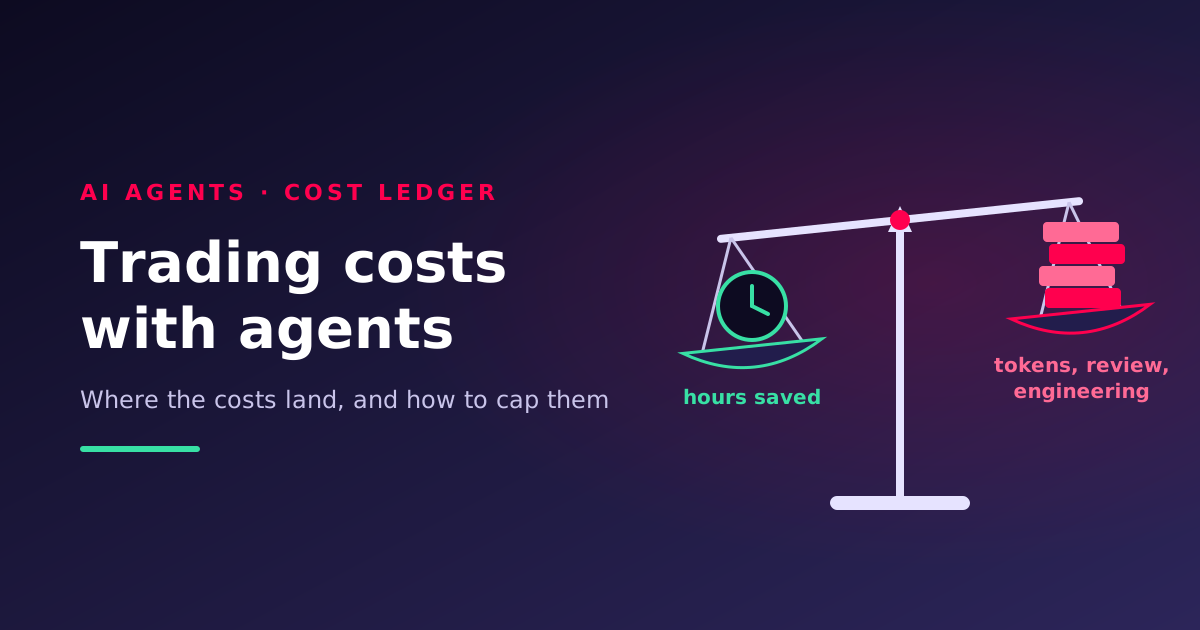
In regulated industries you should care because agents change where work happens. A production agent is not 'free.' It trades one cost for another [2]. You trade manual review time for engineering time, operational overhead, and new failure modes. If you understand the trade, you can place agents where they reduce risk instead of hiding it.
Benefits of Agentic AI
Benefits are visible first in repetitive, high-volume workflows with clear success criteria. In Banking and FinTech, agents can triage support tickets, reconcile statements, and generate audit trails. In Education, they can draft personalized practice sets and route questions to the right human. In HealthTech, they can pre-process intake forms and flag missing fields. In Tax Returns, they can assemble documents from multiple sources and check completeness.
Scale is a design choice that directly impacts cost. Dapr Agents can run thousands of agents efficiently on a single core [3]. That efficiency matters for cost-sensitive workloads like batch tax document processing or nightly bank reconciliation.
Integration breadth is also a factor. Dapr Agents can directly integrate with databases, documents, and unstructured data by connecting to dozens of different data sources [3]. In HealthTech and Banking, where data lives in HL7 feeds, core banking systems, LMS platforms, and S3 buckets, that matters.
Production readiness is about packaging, not prompts. Durable workflows and retries are foundational. Agents must survive restarts. Durable execution with explicit state checkpoints is the baseline. Dapr Agents uses a durable-execution workflow engine that guarantees each agent task executes to completion in the face of network interruptions, node crashes and other types of disruptive failures [3]. Dapr Agents can automatically retries agentic workflows and ensures task completion [3].
Limitations and Trade-offs of Agentic AI
The operating limits matter more than the demos.
The human cost is significant. Agents reward time-in-seat. They have a learning curve, especially around constraints, context, and review loops [2]. That is the human cost. You pay in prompt engineering, guardrails, testing, and ongoing monitoring.
Operationally, agents are stateful and non-deterministic. You need durable execution, retry logic, and observability. The Dapr pattern shows why this matters: retries are automatic and task completion is guaranteed despite failures [3].
Security and trust are sector-specific constraints. Secure enclaves are a set of cores that are reserved, isolated, and locked down to create a sectioned off area [4]. Everything that comes out of the enclave is encrypted: memory and network traffic, but also peripheral PCIe traffic to other devices such as the GPU [4]. Secure enclaves have traditionally been used to remove trust from the cloud provider, not necessarily from the application provider [4]. NVIDIA confidential computing recently added these hardware-based capabilities to their latest GPUs, making it possible to run GPU-based workloads in a secure enclave [4].
In practice, the limitation is not the model, it is the surrounding system: data access policy, auditability, and human-in-the-loop design.
Production-Ready Patterns for Agentic AI
Durable workflows and retries. Agents must survive restarts. Durable execution with explicit state checkpoints is the baseline. The Dapr pattern shows why this matters: retries are automatic and task completion is guaranteed despite failures [3].
Tool separation via MCP. The MCP Agent Server pattern represents a significant evolution in agent architecture [5]. While traditional MCP clients often act as agents consuming MCP server tools, these examples flip the paradigm. Agents can be packaged into MCP servers [5]. This directory contains examples of exposing MCP Agent workflows as MCP servers. It demonstrates how to build, launch, and interact with agent-powered MCP servers in different execution environments.
Decoupled Architecture: Separate agent logic from client interfaces [5]. Agent Interoperability: Enable multi-agent interactions through a standard protocol [5].
For Banking and Tax, this means the same reconciliation agent can be invoked from a web UI, a batch job, or another agent without rewriting logic.
Platform and delivery. Production agents need CI/CD, infra as code, and observability. Argonaut combines Kubernetes PaaS, a CI pipeline builder, and a Terraform state manager with prebuilt AWS and GCP modules [6]. Argonaut offers configurable build-and-deploy pipelines, powered by Dagger and ArgoCD, and deep integration with GitHub Actions and GitLab CI [6]. Argonaut supports container registries, multiple cloud accounts, observability stacks, cost visibility providers, CDNs, and the entire helm chart ecosystem of Kubernetes [6].
The agent loop can be visualized as a request/response cycle:
That loop is the contract you test.
Cost and Trade-off Table
When choosing a pattern, compare what you trade. The table below summarizes primary cost drivers so teams can align pattern choice with operational constraints.
| Pattern | When it fits | Primary cost |
|---|---|---|
| Single-agent with retries | Linear tasks, e.g., tax form completeness check | Context window growth, prompt drift |
| Multi-agent via MCP | Decomposed workflows, e.g., loan underwriting with separate credit, fraud, compliance agents | Coordination latency, protocol overhead |
| Durable workflow engine | Long-running, must-complete jobs, e.g., nightly bank reconciliation | Operational complexity, state storage |
Choosing a pattern is a cost trade. Single-agent reduces coordination overhead but increases context management cost. Multi-agent via MCP improves separation of concerns and reuse but adds protocol overhead. Durable engines guarantee completion at the price of state storage and operational complexity.
Real-World Examples of Agentic AI in Banking, Education, HealthTech, FinTech, and Tax Returns
These sectors share a need for auditability and data minimization, not just accuracy.
Banking: A production-ready pattern uses an agent to triage customer messages, extract entities, call read-only core banking APIs, and produce a human-reviewed summary with citations. The agent is packaged as an MCP server so the same logic is reused in chatbot and back-office tools. Durable execution ensures a reconciliation job completes even if a pod restarts.
Education: Agents generate practice problems from curriculum standards and route them to students based on prior performance. The agent logic is separated from the LMS client interface [5], allowing the same agent to serve web and mobile. Review loops are built in because agents reward time-in-seat around constraints and context [2].
HealthTech: Intake agents pre-process forms, normalize units, and flag missing required fields before human review. Integration with dozens of data sources [3] lets the agent pull from EHR, wearable exports, and document stores without custom glue per source. Secure enclaves provide an option for GPU workloads where data must remain encrypted in use [4].
FinTech: Onboarding agents assemble KYC evidence from emails, PDFs, and API responses, then hand off to a compliance agent via standard protocol [5]. The workflow is retried automatically on transient failures [3].
Tax Returns: Seasonal spikes demand efficient scaling. Running thousands of agents efficiently on a single core [3] reduces cost during peak filing windows. Agents check completeness, reconcile W-2s and 1099s, and produce a human-verified draft. The durable engine guarantees task execution to completion despite network interruptions [3].
Across all five domains, the subject means the same thing: automating constrained, auditable workflows. Sector vocabulary changes, but the pattern does not.
Best Practices for Implementing Agentic AI in Your Organization
Start with cost accounting. A production agent is not 'free.' It trades one cost for another [2]. Map the cost you remove — manual hours, errors — against the cost you add — engineering, infra, monitoring, review. Without explicit accounting, teams optimize for demo accuracy instead of total cost of ownership.
Design for constraints first. Define allowed tools, data access boundaries, and human approval gates before prompts. Agents reward time-in-seat especially around constraints, context, and review loops [2]. Constraints reduce failure modes and make review faster.
Make workflows durable and observable. Use a durable-execution engine that guarantees completion in the face of failures [3]. Instrument every tool call, LLM decision, and state transition. Observability is how you prove auditability in regulated domains.
Separate agent logic from clients. Package agents as MCP servers [5] and keep agent logic decoupled from client interfaces [5]. This enables reuse and interoperability [5]. The same agent can be invoked from web, batch, or other agents.
Test with real data shapes. Integration with dozens of data sources [3] is only useful if you test the actual schemas, auth, and rate limits you will hit in production. Synthetic tests miss edge cases that cause silent failures in banking and health data.
Secure by default. For sensitive data, evaluate enclave-based execution where encryption covers memory, network, and PCIe traffic [4]. Understand that secure enclaves have traditionally been used to remove trust from the cloud provider, not necessarily from the application provider [4].
Ship incremental. Begin with read-only assistance, add write actions behind human review, then graduate to autonomous execution where risk allows. The goal is reliable automation, not maximum autonomy.
Agents are infrastructure now. Treat them like services: versioned, tested, deployed via pipelines like Argonaut’s configurable build-and-deploy pipelines powered by Dagger and ArgoCD [6], and monitored with the same rigor as any production system.
Conclusion
Agentic AI shifts work from manual review to engineered workflows. The benefits are real in repetitive, auditable tasks across Banking, Education, HealthTech, FinTech and Tax Returns, but they come with explicit trade-offs in human time, operational complexity, and security design. By grounding agents in durable execution, clear MCP boundaries, and platform practices like those provided by Argonaut, teams can trade costs intentionally rather than accidentally.
References
- humanlayer/12-factor-agents — github.com (21 September 2025)
- The Agentic AI Handbook: Production-Ready Patterns — nibzard.com
- dapr/dapr-agents — github.com (27 October 2026)
- Launch HN: Tinfoil (YC P25): Verifiable Privacy for Cloud AI — news.ycombinator.com (15 May 2025)
- mcp-agent/examples/mcp_agent_server at main · lastmile-ai/mcp-agent — github.com (21 May 2025)
- Launch HN: Argonaut (YC S21) – Easily Deploy Apps and Infra to AWS and GCP — news.ycombinator.com