Observability in the Age of Agentic AI: Challenges and Opportunities

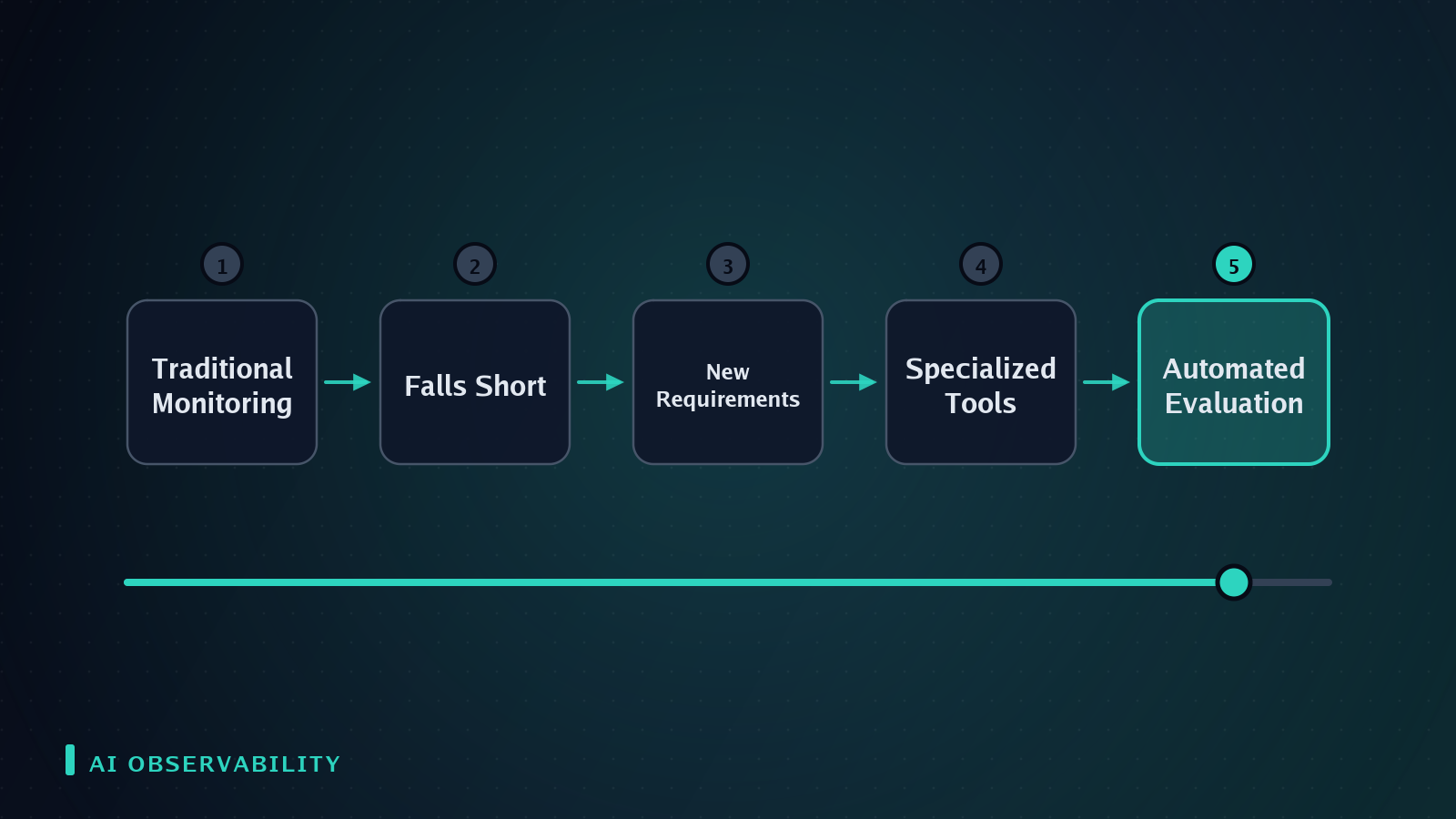
Agentic AI is moving from demos to production workflows in regulated industries. In Banking, Education, HealthTech, FinTech and Tax Returns, an agent is no longer a chatbot answering FAQs. It is an autonomous actor that retrieves records, drafts communications, routes requests, and sometimes acts on behalf of a user. That shift changes what observability must do.
Agentic AI refers to systems that plan, use tools, retrieve information, and execute multi-step actions with limited human supervision. An agentic system is an autonomous software agent with planning, tool use, retrieval and multi-step execution, as opposed to a single-turn model. A RAG pipeline is a retrieval-augmented generation pipeline that grounds LLM outputs in retrieved documents.
The core question is no longer “is the service up?” It is “did the agent do the right thing, for the right person, with the right data, and can we prove it?” The business implication is direct: in regulated sectors, correctness and provability are revenue and risk issues, not just engineering metrics. Loss of trust, compliance penalties, and financial errors drive the need for observability.
The Challenges of Observability in Agentic AI
Traditional systems have a request, a deterministic code path, and an output. Agentic systems have planning, tool use, retrieval, and multi-step execution. An agent can effectively zero-shot a real-world scenario [1], which means it can produce plausible-looking results for cases it was never explicitly tested on.
Specific examples show the risk:
- In HealthTech, a voice agent might summarize a patient intake correctly in a test script and hallucinate a medication allergy in production.
- In Tax Returns, an agent might combine prior-year data with current-year forms and produce a filing that looks complete but misattributes a deduction.
- In Banking and FinTech, an agent that retrieves account history and drafts a response can leak PII or misinterpret a risk flag.
The challenges are threefold:
- Non-determinism. Same prompt, different tool calls, different outputs.
- Long traces. An agent run is a graph of LLM calls, retrievals, and tool executions, not a single span.
- Action impact. An agent writes to systems, not just reads. A wrong action has regulatory and financial consequences.
Agents reward time-in-seat. They have a learning curve, especially around constraints, context, and review loops [2]. Teams often underestimate the operational cost of operating them.
A production agent is not “free.” It trades one cost for another [2]. You save human keystrokes but add monitoring, evaluation, and governance overhead.
Traditional Monitoring Tools Fall Short
Traditional observability in monoliths and microservices focused on uptime, latency, error rate, and request traces. Pretty dashboards, pre-built alerts, and magic integrations aren’t sufficient for the future we’re building today. Traditional monitoring and observability tools don’t have what it takes to compete in this world [1].
In Banking and Tax Returns, compliance requires auditability: who asked what, what data was accessed, what decision was made, and why. Standard APM traces capture latency and error rates but not semantic correctness, hallucination, or policy adherence.
Companies with LLM-based products deployed in production are monitoring outputs for hallucinations [3]. That is a signal that output quality, not just uptime, is now a production metric.
The gap shows up in incident response. With a traditional service, you replay a request and see a stack trace. With an agent, you need the full conversation, the retrieved documents, the tool arguments, and the evaluation scores that explain why the output was accepted or rejected.
New Requirements for Observability in Agentic AI
For the five sectors in scope, observability must be:
Traceability across tools and data sources. Every agent step must be linked to a trace ID that ties the user request to retrievals, tool calls, and final output. In HealthTech, that supports HIPAA audit logs. In Education, it supports FERPA compliance for student data access.
Semantic evaluation, not just latency. Teams need to measure faithfulness, relevancy, and redundancy in real time. Faithfulness measures whether the output is supported by retrieved context. Relevancy measures whether the output answers the user question. Redundancy measures repeated or unnecessary content. Traceloop uses real-time versions of known metrics like faithfulness, relevancy, redundancy, and others to detect regressions automatically [4]. Traceloop is a monitoring platform that detects when your LLM app fails [4].
Production evals and hallucination tracking. Monitoring outputs for hallucinations is now standard practice for retrieval-augmented generation. The open-sourced observability/monitoring tool LangFuse is used to track RAG and agents in production [3]. Many use it to track RAG and agents in production, run custom evals on the production traces focused on hallucination, and track how metrics are different across releases or customers [3].
Scenario coverage. Agents fail at edge cases that are rare in logs but high risk in regulated domains. Manual testing of voice AI is incredibly time-consuming and error-prone [5]. Automated scenario generation reduces that risk.
Cost and risk accounting. Observability must surface token cost, tool call cost, and risk exposure per request. Agents are usually not worth it when the task is faster to do by hand than to specify precisely [2].
A minimal observability data model for agentic systems looks like:
The model keeps request context, execution graph, and quality scores together for audit and debugging. USER to SESSION links identity to interaction. SESSION to AGENT_RUN captures multi-turn runs. AGENT_RUN to STEP and then to TOOL_CALL and RETRIEVAL preserves the causal graph. EVALUATION to METRIC stores semantic scores per run. OUTPUT ties final result back to the run.
Specialized Tools for Monitoring and Evaluation
Teams in the target sectors are adopting purpose-built tools rather than retrofitting APM.
| Tool / Approach | Primary Use | Typical Signal |
|---|---|---|
| LangFuse | Track RAG and agents in production, run custom evals on production traces | Hallucination rate per customer/release |
| Ragas | Evaluating RAG pipelines | Faithfulness, answer relevancy |
| Traceloop | Monitoring LLM apps for failures | Real-time metric regressions |
| Vocera | Automated testing for voice agents | Scenario coverage and production call monitoring |
But for monitoring or evaluating RAG systems, I found Ragas to be the most helpful [3]. It is widely referenced for offline evaluation of retrieval quality.
LangFuse is used to track RAG and agents in production [3]. It enables teams to compare metrics across releases or customers, which matters in FinTech where behavior must be consistent across branches.
Traceloop is a monitoring platform that detects when your LLM app fails [4]. It uses real-time versions of known metrics like faithfulness, relevancy, redundancy, and many others [4].
Critical analysis: these tools improve visibility but add pipeline complexity, storage cost for traces, and the need to define ground truth for evals. LangFuse and Traceloop require instrumentation changes and careful metric calibration to avoid false positives. Ragas is strong offline but needs adaptation for live monitoring.
In voice agent programs, manual testing does not scale. We were working on voice agents in healthcare, and kept running into the same problem: manually testing was incredibly time-consuming and error-prone [5]. Vocera's platform automatically simulates real personas and generates testing scenarios [5]. Vocera automatically simulates real personas, generates a wide range of testing scenarios from your prompts/call scripts and monitors all production calls [5]. We generate scenarios and metrics automatically, so developers do not have to spend time defining their scenarios or eval metrics [5].
Automating Evaluation and Scenario Generation
Manual test suites decay fast. Agents change behavior with model updates, prompt changes, and new tools. Automated scenario generation creates a living test set.
A practical workflow:
The diagram shows the loop: Product defines constraints and risk cases, e.g., HIPAA access boundaries for HealthTech or tax deduction rules for Tax Returns. Generator creates persona profiles and prompts. Simulator executes test calls against the agent. Evaluator scores traces and outputs against policies and quality metrics, returning pass/fail and metric deltas to Product. Vocera saves developers time by automating evaluation and scenario generation [5].
Best practices for regulated sectors:
- Separate observability from evaluation. Observability is what happened. Evaluation is whether it was correct. Both must be stored together.
- Log data access explicitly. In HealthTech and Tax Returns, log which records were retrieved and whether access was authorized. HIPAA requires audit trails of PHI access; FERPA requires tracking student record access in Education.
- Version prompts, tools, and evals together. A metric regression should point to a specific change.
- Human-in-the-loop for high-risk actions. Use observability to route uncertain outputs to review rather than auto-approve.
- Measure cost per successful outcome. A production agent is not “free.” It trades one cost for another [2].
Potential pitfalls:
- Over-relying on dashboards without semantic signals. Pretty dashboards, pre-built alerts, and magic integrations aren’t sufficient [1].
- Treating evaluation as a one-time benchmark. Production data drifts, so evals must run continuously on production traces.
- Ignoring the learning curve. Agents reward time-in-seat. They have a learning curve, especially around constraints, context, and review loops [2].
- Deploying agents where specification cost exceeds benefit. Agents are usually not worth it when the task is faster to do by hand than to specify precisely [2].
- Underestimating cost and risk accounting. Token and tool call costs accumulate, and risk exposure per request must be tracked alongside quality metrics.
Observability in agentic AI is less about infrastructure uptime and more about proving correctness, safety, and compliance over time. In Banking, Education, HealthTech, FinTech and Tax Returns, that proof is a regulatory requirement, not a nice-to-have. The main points are: define agentic and RAG concepts clearly, move beyond latency to semantic and audit metrics, use purpose-built tools with critical evaluation, automate scenario generation for regulated edge cases, and account for cost and risk as first-class signals.
References
- It’s The End Of Observability As We Know It (And I Feel Fine) — honeycomb.io
- The Agentic AI Handbook: Production-Ready Patterns - Log - nibzard — nibzard.com (21 January 2026)
- How are generative AI companies monitoring their systems in production? — news.ycombinator.com (20 September 2023)
- Launch HN: Traceloop (YC W23) – Detecting LLM Hallucinations with OpenTelemetry — news.ycombinator.com (17 July 2024)
- Launch HN: Vocera (YC F24) – Testing and Observability for Voice AI — news.ycombinator.com (3 December 2024)