Hybrid Execution for Coding Agents

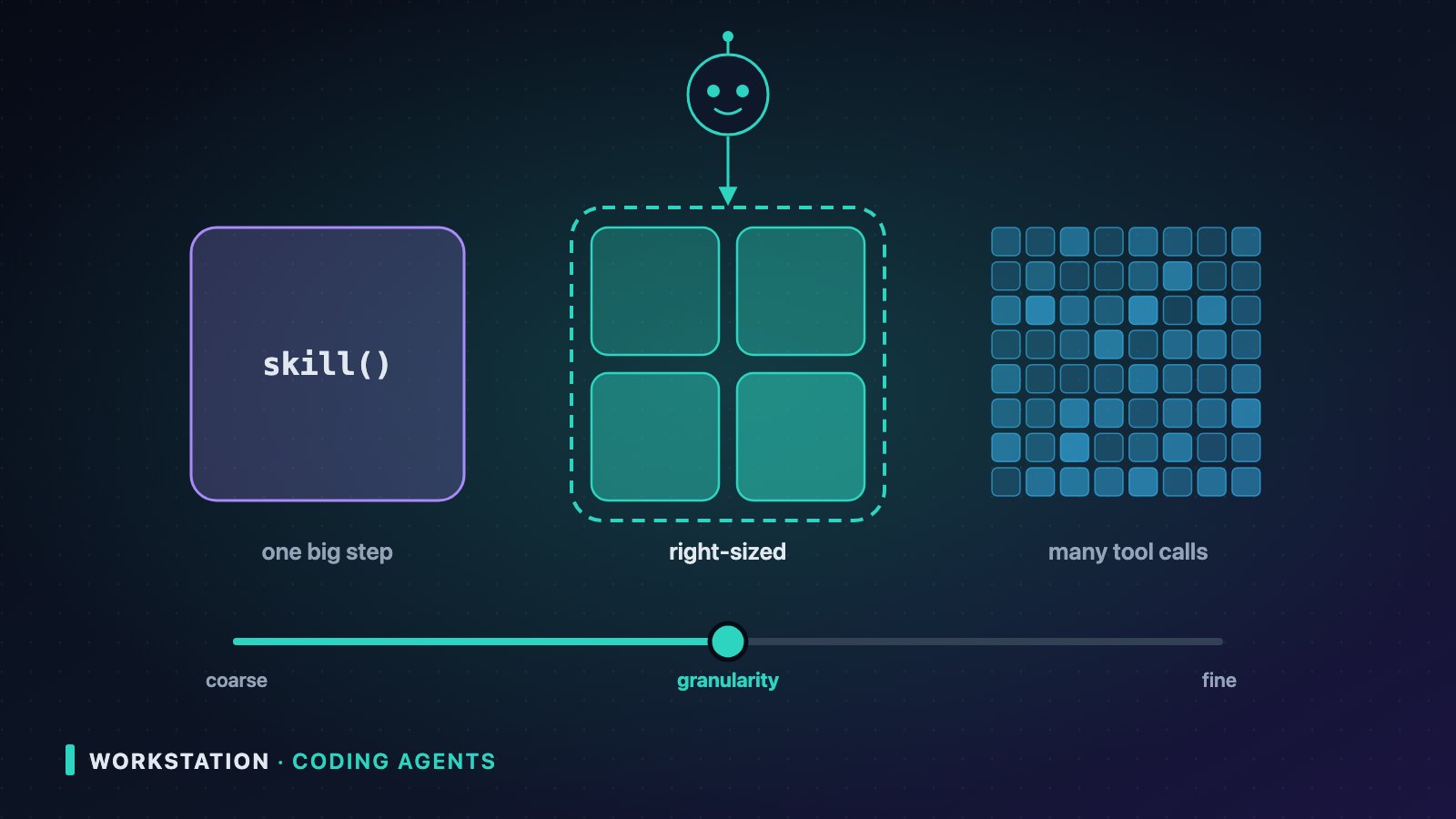
Coding agents in banking, FinTech, education, HealthTech and tax return workflows face a recurring tension: run a whole task with a high-level skill and risk hidden errors, or run everything with primitive tool calls and drown in latency and prompt noise. Adaptive skill granularity is the practice of letting the agent choose the right level of abstraction for the moment, and change it mid-execution when conditions demand.
What is Adaptive Skill Granularity?
Adaptive skill granularity is about treating skills as execution abstractions with variable resolution, not as static macros.
Reusable skills allow large language model agents to package task-specific procedures, tool affordances, and execution guidance into modular units. Prior work has largely studied how agents retrieve, compose, or synthesize skills before execution. Adaptive granularity shifts focus to what happens during execution.
In practice this means the same task may be solved through primitive tool calls, macro skills, or hybrid execution that starts with a macro and falls back to micro-level recovery. The agent is not locked into one style.
For a banking or FinTech developer, think of it as the difference between invoking a "Reconcile daily settlements" skill and manually stepping through fetch-statement, parse-CSV, match-ledger, write-adjustment one tool at a time. Adaptive granularity lets the agent start at the macro level for speed, then drop to primitives for verification when risk is high.
Skills and skill libraries are the building blocks here. A skill library is a collection of reusable units that encode how a task is done. Primitives are the smallest independently callable units, such as fetch_statement or write_adjustment, while macro skills orchestrate multiple primitives into a named workflow. Adaptive granularity sits on top of both.
Benefits of Hybrid Execution for Coding Agents
Hybrid execution combines speed with controllability.
Efficiency. Macro skills compress multi-step procedures into a single orchestrated unit. When the context is routine and well bounded, this reduces round trips and token use.
Effectiveness and safety. When the macro encounters ambiguity, a constraint violation, or a regulatory check, the agent can fall back to micro steps for explicit verification. Our findings suggest that skill libraries for coding agents should be treated not only as retrievable resources, but also as controllable, verifiable, and recoverable execution abstractions.
Recoverability. A failure inside a macro does not have to abort the whole job. With hybrid execution the agent can isolate the failing sub-step, re-execute it with primitives, and resume the macro.
In sectors where a wrong write is costly, this trade-off matters. In banking, a settlement posting error triggers manual remediation and audit. In HealthTech, an incorrect data mapping can affect reporting. In tax returns, a misapplied rule can create compliance exposure. Adaptive granularity lets you keep velocity on the happy path and enforce precision on the risky path.
Speed versus precision is the core trade-off. Macros are faster and less noisy but hide intermediate decisions. Primitives are slower and verbose but auditable. Hybrid execution lets you tune that balance per operation and per risk appetite, rather than choosing one globally.
Implementing Adaptive Skill Granularity in Banking and FinTech
Implementation is less about new models and more about design of the skill library and execution policy.
A practical pattern is to define skills at two levels for the same capability: a macro skill that orchestrates, and a set of primitive skills that expose the underlying tools.
The execution policy can be expressed as:
The diagram shows the lifecycle: start with macro, fall back to micro on signal, verify, then resume.
A simple policy table can guide when to switch:
| Signal | Macro behavior | Micro fallback trigger |
|---|---|---|
| Known schema, green path | Run macro end-to-end | None |
| Missing field / data drift | Attempt macro with defaults | Fall back to primitive fetch and parse |
| Regulatory check required | Macro proposes, pauses for verification | Execute step-by-step with audit log |
| Exception / tool error | Retry macro once | Decompose to primitives and recover |
For Banking and FinTech, the constraints are not different in kind from other sectors, they are different in consequence. The subject means the same technically, but the thresholds for falling back are lower and the verification steps are more explicit. You would not pretend the domain changes the mechanism; you would change the risk appetite that drives the decision to drop to micro.
Instrumentation is essential. Log which level was used for each step, why a fallback occurred, and the verification outcome. A minimal record includes: skill_id, execution_level: macro|micro, fallback_reason, verification_passed, latency_ms. This evidence lets you tighten or loosen thresholds over time.
Real-World Examples of Adaptive Skill Granularity in Action
Payment reconciliation in FinTech. A macro skill "Reconcile daily card settlements" runs the normal flow. On volume mismatch, it falls back to primitives: fetch raw settlement file, list ledger entries, compare identifiers, produce a diff for review, then resume.
Clinical coding assistance in HealthTech. A macro suggests ICD codes from notes. On low confidence, the agent falls back to primitive retrieval of coding guidelines and step-by-step mapping, keeping the suggestion verifiable.
The same pattern applies across industries: start coarse, go fine when needed.
Best Practices for Implementing Hybrid Execution
Design skills as controllable abstractions. Skills should support start, pause, inspect, and resume. Expose entry and exit points so the agent can hand off between macro and micro.
Instrument execution. Emit structured logs for level used, fallback reason, and verification outcome. Store them with the task run for audit.
Define explicit fallback signals. Use concrete signals such as ambiguity score threshold, missing required field, regulatory flag, or tool error code. Encode them in the skill definition, not in prompt heuristics.
Keep primitives testable. Micro steps should be independently callable and unit tested. Reliable fallback depends on reliable primitives.
Align granularity with risk. Set conservative fallback thresholds for writes and financial calculations. Allow more aggressive macro use for read-only summaries.
Limitations and challenges. Hybrid execution adds complexity to the skill library and execution engine. You must maintain two levels of the same capability and keep them in sync. Fallback logic can increase latency on the unhappy path, and poor instrumentation makes it hard to learn thresholds. Agents may oscillate between levels if signals are noisy. These costs are manageable in high-consequence domains but may be overkill for low-risk workflows.
Adaptive skill granularity does not replace skill retrieval or composition. It complements them by making execution itself adaptive. For developers building coding agents in regulated, high-consequence domains, hybrid execution offers a pragmatic way to keep agents fast on routine work and precise where it matters.
Conclusion
Adaptive skill granularity treats skill libraries as controllable, verifiable, and recoverable execution abstractions rather than just retrievable resources. By allowing agents to start with macro skills and fall back to primitives on explicit signals, you gain efficiency on the happy path and safety on the risky path. The key is intentional skill design, clear fallback policies, and instrumentation that records level choice and verification outcomes. Used deliberately, hybrid execution balances speed and precision without locking you into one abstraction level.