Code as Infrastructure

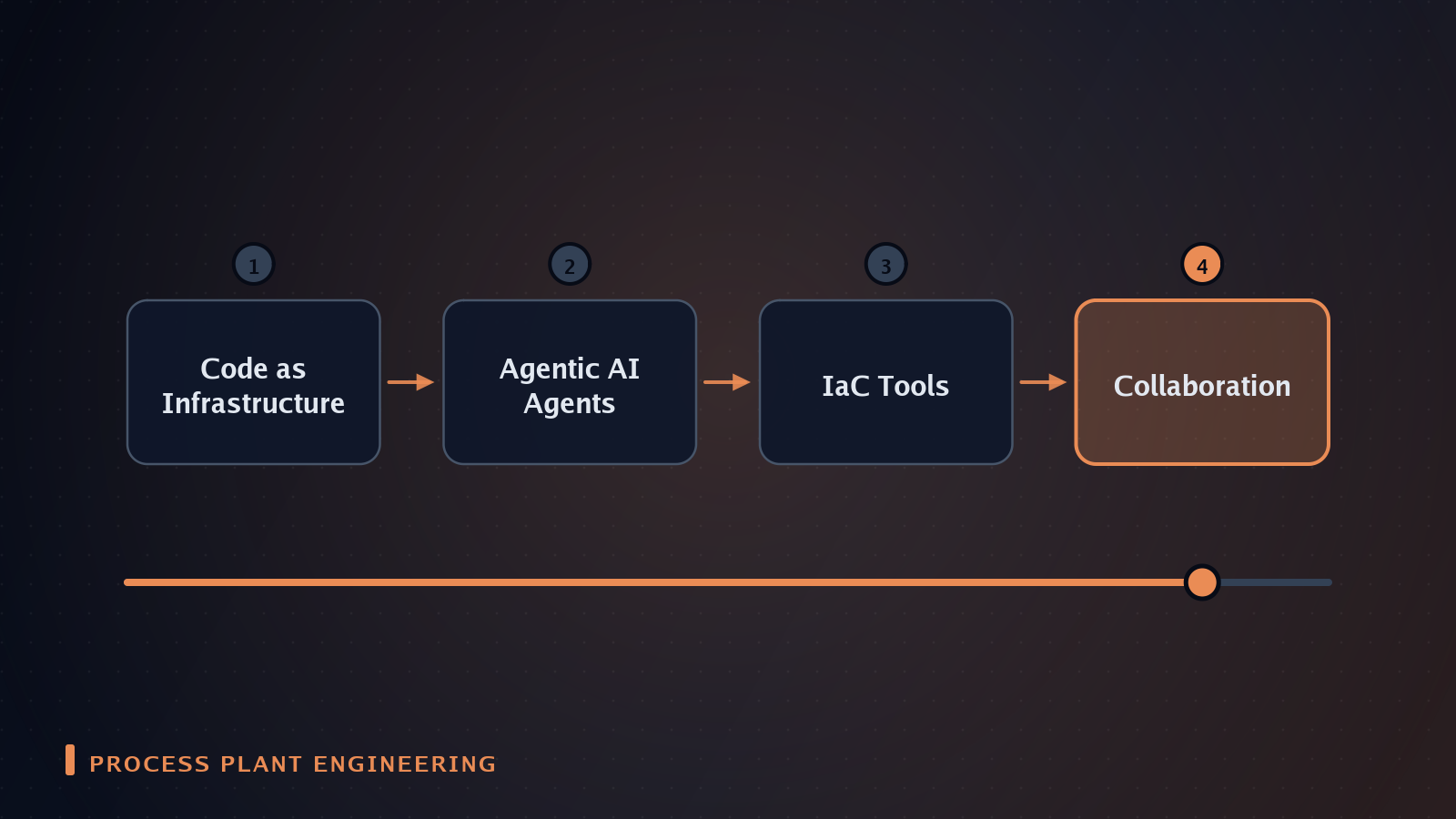
The Rise of Agentic AI in Process Plant Engineering
Process plant engineering is a useful metaphor for how modern software teams in banking, education, HealthTech, FinTech and tax returns operate. The “plant” is no longer steel and pipes; it is the continuous flow of data, compliance checks, model runs and customer interactions that must be reliable, auditable and scalable.
The shift is from human-in-the-loop scripting to agentic systems that can observe, decide and act within guardrails. The core idea is simple: AI should help us produce better code [1]. In regulated sectors this means code that is correct, explainable and traceable, not just fast.
Coding agents make this even more powerful [1]. For a FinTech lender, that knowledge is risk models, KYC rules and audit logs. For a HealthTech provider, it is clinical protocols and data privacy constraints. For a tax returns platform, it is seasonal law changes and per-jurisdiction filing rules. The agent’s value is not novelty; it is consistent reuse of institutional knowledge under policy.
The pain points are familiar across these industries. Teams scale quickly but platform teams do not. Engineers spend time provisioning environments and debugging alerts instead of shipping features. Compliance requires a tamper-evident record of who did what, and when. These are infrastructure problems.
Argonaut: Simplifying the Development Process
Infrastructure as code is the plant control room. The developer experience of working with Kubernetes and Terraform has historically been the bottleneck.
Argonaut combines Kubernetes PaaS, a CI pipeline builder, and a Terraform state manager with prebuilt AWS and GCP modules [2]. Argonaut provides an intuitive developer experience that simplifies working with Kubernetes and enables developer self-service, reducing the burden on devops and platform teams [2]. Argonaut lets you set up production-ready infrastructure and customize as you scale [2].
In practice for the target sectors, this means a loan origination team can spin up an isolated environment for a new credit model, with logging and audit already wired, without filing a ticket. Over the last two years, we’ve enabled customers to scale their engineering teams 10x and manage 10+ environments in parallel without needing a dedicated infra/DevOps team [2].
Model Context Protocol: Enabling Better Code
Agentic AI is only useful if agents can access the right context, safely. The Model Context Protocol is the emerging wiring standard for that.
There are now more than 10,000 active public MCP servers, covering everything from developer tools to Fortune 500 deployments [3]. MCP has been adopted by ChatGPT, Cursor, Gemini, Microsoft Copilot, Visual Studio Code, and other popular AI products [3]. Enterprise-grade infrastructure now exists with deployment support for MCP from providers including AWS, Cloudflare, Google Cloud, and Microsoft Azure [3]. The Model Context Protocol’s governance model will remain unchanged: the project’s maintainers will continue to prioritize community input and transparent decision-making [3].
For banking and HealthTech, MCP adoption means agents can be given read-only access to schemas, runbooks and historical incident data without exposing raw production credentials. The protocol does not replace internal policy; it standardizes how context is offered.
A typical flow in these sectors looks like:
This is a claim about a pattern, not a guaranteed implementation. The value is that context retrieval becomes explicit and auditable, which aligns with regulatory expectations in FinTech and HealthTech.
Real-World Applications and Benefits
Autonomous Operations and Triage
In production, alerts are noise. Sonarly can triage alerts and fix bugs with full context of your production system [4]. Sonarly assigns blame, triages severity, and removes duplicates, with an average of 50% of customers' alerts being duplicates [4]. Sonarly has an 84% root-cause accuracy, powered by its codebase graph [4]. Sonarly can post analysis directly in your Slack or Discord alert channel, in-thread, with the right person blamed [4].
For a tax returns platform during filing season, silencing duplicate alerts and assigning the right engineer in-channel reduces mean time to resolution without creating a new tool habit.
Trust and Governance for Agents
Agentic systems need verifiable trust. Mnemom computes a single, public, cryptographically verifiable Trust Rating for every AI agent [5]. The stack is designed from first principles, not assembled from acquisitions [5]. Mnemom governs what can happen — policy is checked before the action runs, and every step leaves a cryptographic receipt [5]. The result is a tamper-evident, Ed25519-signed record and a portable Trust Rating anyone can verify [5].
In banking and HealthTech, this framing maps directly to existing controls: policy checked before action, receipts for audit. The difference is that the receipts are machine-verifiable and portable across vendors.
Developer Integration
Adoption hinges on ergonomics. Voker has an SDK for various languages and LLM frameworks and libraries [6]. The languages with explicit SDK support are JS & TS and Python [6].
To use the Voker SDK, you need to install the package using npm, pnpm, yarn, or bun [6]. To use the Voker SDK, you need to set up the environment by copying the API Key from the Voker dashboard and pasting it into your.env.local file [6].
# Install
npm i @voker/voker
# or: pnpm i @voker/voker
# or: yarn add @voker/voker
# or: bun add @voker/voker
#.env.local
VOKER_API_KEY=<your-secret-api-key>
import { Voker } from '@voker/voker';
import 'dotenv/config';

const voker = new Voker({ apiKey: process.env.VOKER_API_KEY });
This is not a claim about agentic AI generally; it is a concrete onboarding step. For teams in education and FinTech that already use Node or Python, the barrier to experimenting with agents is low.
Trade-offs across approaches
Different agentic AI approaches optimize for different constraints in regulated engineering.
Self-service PaaS like Argonaut trades upfront platform investment for faster environment provisioning and reduced DevOps load, but requires clear cost controls and policy guardrails to prevent sprawl in regulated sectors.
MCP context sharing standardizes auditable context access across tools, improving reuse of institutional knowledge. The constraint is careful scoping of what context is exposed, since read-only access must still respect data residency and least privilege.
Autonomous triage reduces alert fatigue and MTTR by automating root cause and blame assignment. The constraint is retaining human sign-off for production changes to satisfy audit requirements.
Cryptographic trust ratings provide verifiable agent behavior with tamper-evident receipts. The constraint is new procurement and audit processes to evaluate portable Trust Ratings.
The table summarizes these trade-offs:
| Approach | Strength | Constraint for Regulated Sectors |
|---|---|---|
| Self-service PaaS like Argonaut | Faster environments, less DevOps load | Requires clear cost and policy guardrails |
| MCP context sharing | Standardized, auditable context access | Needs careful scoping of what context is exposed |
| Autonomous triage | Reduces alert fatigue, faster MTTR | Must retain human sign-off for production changes |
| Cryptographic trust ratings | Verifiable agent behavior | New procurement and audit processes |
Conclusion: The Future of Process Plant Engineering
The subject means essentially the same thing in banking, education, HealthTech, FinTech and tax returns as it does in process engineering: safe, repeatable flow of work under constraints. The vocabulary changes, but the needs do not.
Agentic AI will not replace platform teams. It will change their work from ticket taking to policy design. Code as infrastructure means treating agent behavior, context access and deployment pipelines as first-class engineering artifacts, with the same rigor applied to a loan decision engine as to a chemical reactor.
The near-term win is not autonomy for its own sake. It is reducing toil, improving collaboration across compliance and engineering, and making decision-making auditable. Those outcomes are sector-agnostic, and they are where the next wave of engineering value will be built.
References
- Agentic Engineering Patterns - Simon Willison's Weblog — simonwillison.net (4 March 2026)
- Launch HN: Argonaut (YC S21) – Easily Deploy Apps and Infra to AWS and GCP | Hacker News — news.ycombinator.com
- Donating the Model Context Protocol and establishing the Agentic AI Foundation — anthropic.com (9 December 2025)
- Sonarly - Your software fixes itself — sonarly.com (17 February 2026)
- Mnemom — The trust plane for the agentic internet — mnemom.ai (18 February 2026)
- Voker | Analytics for AI Agents — voker.ai (12 May 2026)