Agentic AI Boosts Efficiency

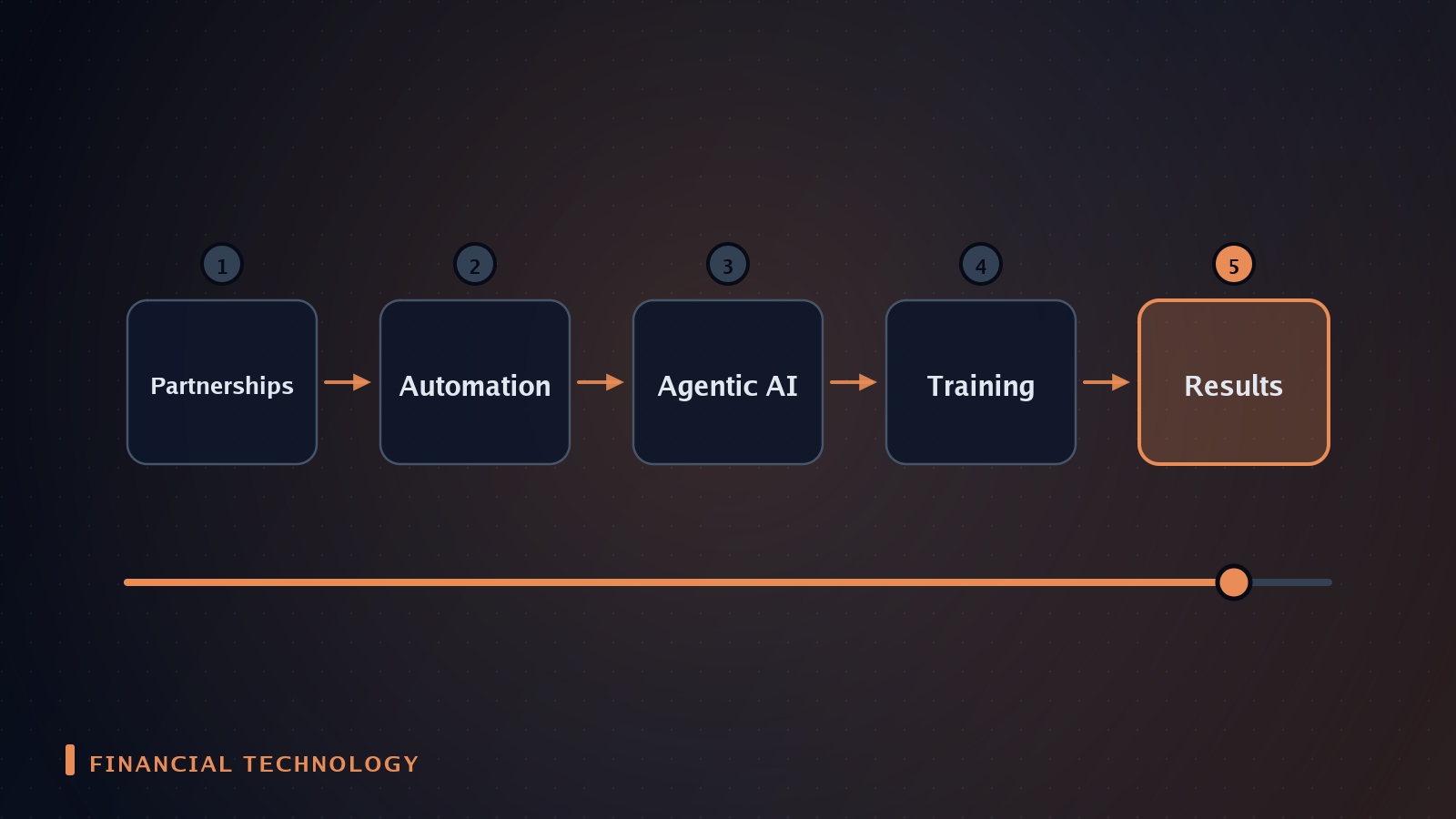
Agentic AI is moving from research demos to operational workloads in banking and fintech. For institutions that must balance compliance, legacy core systems, and rising customer expectations, the value is not a generic chatbot. It is modular agent capabilities that can be incorporated into existing products, tested against real session behavior, and deployed with measurable pick-rate and regression signals.
Community Banks Partner with Fintech
Community banks operate under structural constraints. Community banks mostly don't have programmers on staff, and are reliant on core processors like Fiserv, Jack Henry & Associates, and Fidelity National Information Services [1]. That dependency shapes how new technology arrives: not by building in-house, but by partnering.
Partnering with fintechs has allowed some community banks to greatly strengthen their franchises. Cross River Bank is an interesting example; a major line of their business is originating loans for fintechs which are then largely sold to funding sources that the fintech has lined up [1]. The pattern is shared risk and shared capability. The bank provides charter, compliance, and core connectivity; the fintech provides UX, distribution, and often the agent layer.
Agentic AI Advances in Banking
In banking, an agentic advance is measured by how well it mimics existing agent behavior and how reliably it is evaluated before ship.
Armature Search mimics how Claude Code and Codex search the web, reaching over 90% similarity with their results in our tests [2]. Armature Search® mimics how Claude Code and Codex search the web. It reaches over 90% similarity with their results in our tests, so we can evaluate every change before it ships [2].
Evaluation is session-level, not turn-level. Where tracing platforms evaluate turn by turn, Cekura evaluates the full session. Imagine a banking agent where the user fails verification in step 1, but the agent hallucinates and proceeds anyway [3].
Testing and monitoring platforms are designed to simulate real user conversations with AI agents [3]. Teams use Cekura to simulate real user conversations, stress-test prompts and LLM behavior, and catch regressions before they hit production [3].
The mock tool platform allows for the definition of tool schemas, behavior, and return values for simulations [3]. Mock tool platform - Agents call tools. Running simulations against real APIs is slow and flaky. Our mock tool platform lets you define tool schemas, behavior, and return values so simulations exercise tool selection and decision-making without touching production systems [3].
A simple banking agent request path can be modeled as:
This pattern keeps production risk low while allowing rapid iteration on prompts and tool selection.
Training Computer Use Agents
One of the highest-potential opportunities for AI is training computer use agents [4]. Training AI agents to use computers, browsers, and software is one of the highest-potential opportunities for AI [4].
The emerging method to improve this is called Reinforcement Learning with Verifiable Rewards [RLVR] [4]. The emerging method to improve this is called Reinforcement Learning with Verifiable Rewards [RLVR] [4].
Practical gains are being measured on simulators. One of our customers saw a ~20% improvement in date-picking performance when training on our flight booking simulator [4]. One of our customers saw a ~20% improvement in date-picking performance when training on our flight booking simulator [4].
Open environments accelerate research. We plan to release our environments to the public so developers/researchers can hack them for their own experimentation [4].
For banks, computer use agents map to the desktop and web interfaces staff already use: loan origination systems, CRM, reporting tools. Training on verifiable simulators lets teams improve accuracy without touching production data.
A minimal training loop sketch:
class Verifier:
  def check(self, action, ground_truth):
  return action == ground_truth

class Agent:
  def act(self, state):
  return state # placeholder policy

class Simulator:
  def episodes(self):
  for i in range(10):
  yield {"state": i, "ground_truth": i}

agent = Agent()
verifier = Verifier()
sim = Simulator()

for ep in sim.episodes():
  state = ep["state"]
  action = agent.act(state)
  reward = 1 if verifier.check(action, ep["ground_truth"]) else 0
  # agent.update(reward) would be called here
The loop is only meaningful if the verifier is grounded in business rules, not just textual similarity.
Real-World Applications and Results
Results in agent deployments are reported as pick rates, eval pass rates, and leaderboards.
Measured two ways: picks on the repository panel · live agent traffic on your site. Your pick rate on the panel: 2% → 11% [2]. The pick rate on the repository panel increased from 2% to 11% [2].
Eval suites show regression control. Eval suite nightly · running + 6 more. Send an invoice ✓ ✓ ✓ ✓ ✓. Refund a charge ✓ ✓ ✓ ✓ ✓. Export a report ✓ ✓ ✗ ✓ ✓. Onboard a customer ✓ ✓ ✓ ✓ ✓. 19 of 20 passed · one regression caught [2]. 19 of 20 tests passed, with one regression caught, in the eval suite [2].
Product analytics leaderboards illustrate context-dependent selection. In the leaderboards, Posthog has a 41% pick rate, Amplitude has an 18% pick rate, Mixpanel has a 12% pick rate, and Google Analytics has an 8% pick rate [2].
Leaderboards One strong methodology, applied category by category across hundreds of runs: who gets picked, and in which context. View the leaderboards → product analytics · 218 runs 1 Posthog 41% 2 Amplitude 18% 3 Mixpanel 12% 4 Google Analytics 8% [2].
For banking, the comparable metric is not pick rate alone. It is session completion with compliance checks intact. Full-session evaluation is the key difference from turn-by-turn tracing, because a banking agent can appear correct per turn while hallucinating across steps [3].
What This Means Across Sectors
Banking: Agentic AI improves customer experiences via faster triage and self-service, enhances security via session-level evaluation and mock tool testing, and streamlines operations via modular automations that sit on top of core processors.
Education, HealthTech, and Tax Returns share the same constraints: regulated data, legacy systems, and staff without dedicated programmers. The subject applies the same way everywhere: small modular agent capabilities, evaluated in full sessions, and shipped via fintech partnership rather than in-house rebuild.
The efficiency gain is not from a bigger model. It is from better evaluation, safer simulation, and incremental incorporation into existing products.
References
- Community Banking and Fintech — bam.kalzumeus.com
- Armature · Get discovered and used by coding agents — armature.tech (3 August 2026)
- Launch HN: Cekura (YC F24) – Testing and monitoring for voice and chat AI agents | Hacker News — news.ycombinator.com (3 March 2026)
- Launch HN: Halluminate (YC S25) – Simulating the internet to train computer use — news.ycombinator.com (11 August 2025)